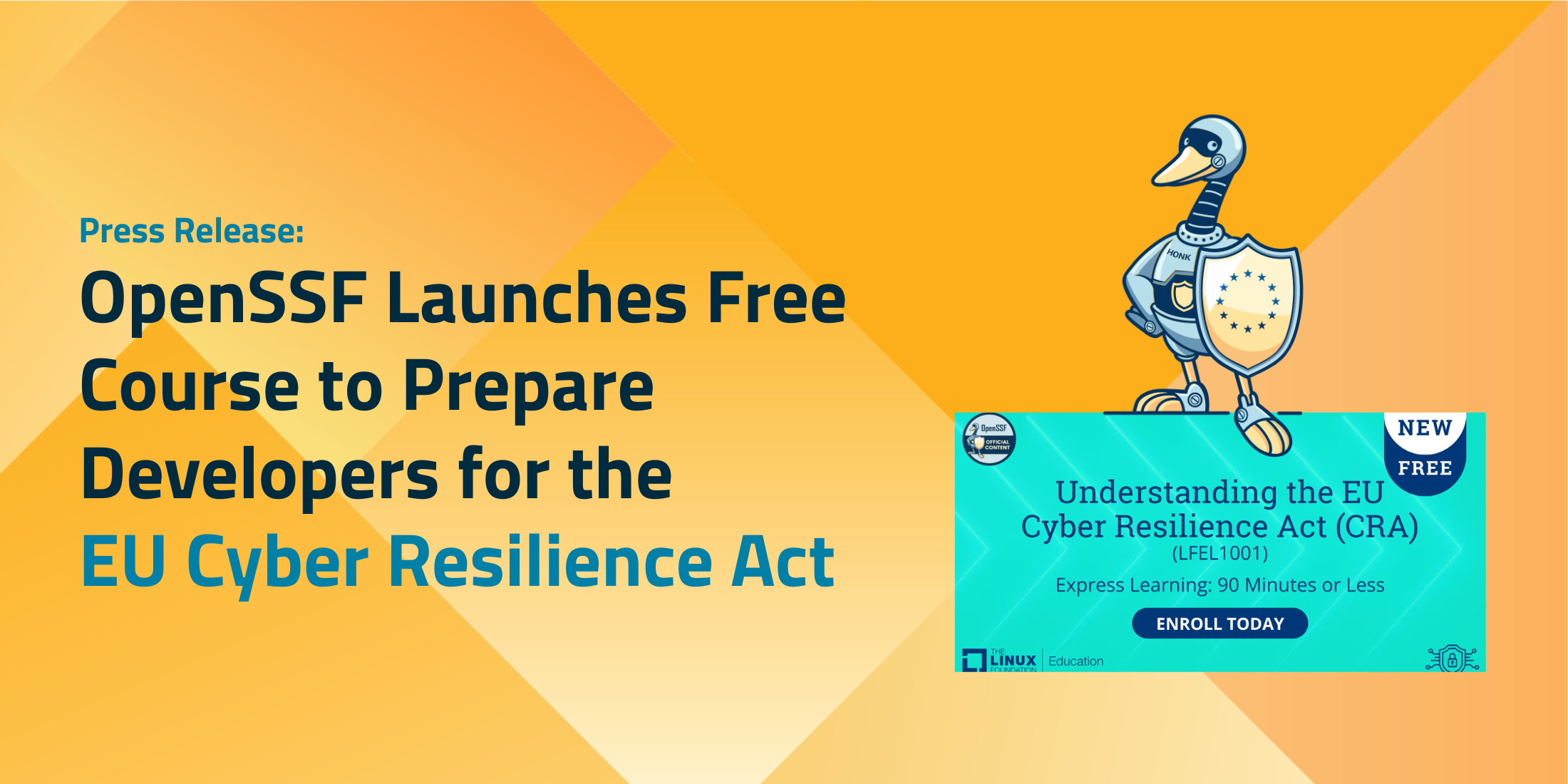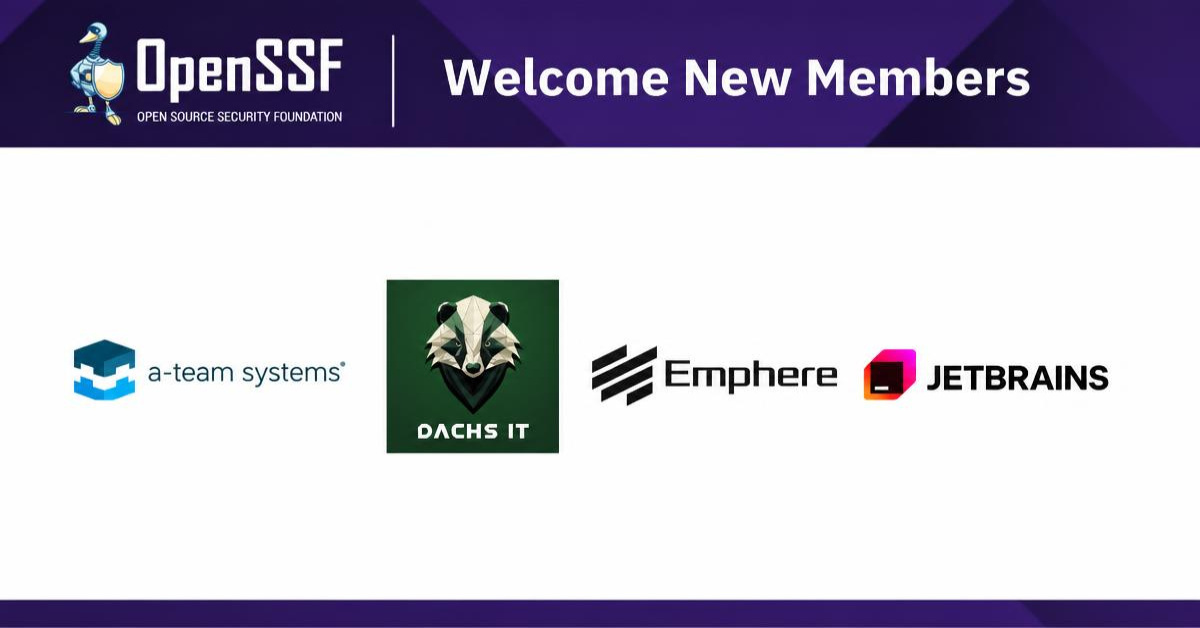
The OpenSSF announced expanded membership during its Community Day Europe, welcoming four new members: A-Team Systems, Emphere, DACHS IT GMBH, and JetBrains. The Foundation also released significant CRA resources to…
Read More
Foundation celebrates five additional members, new cyber reasoning sandbox project, and release of v1.0.0 Python Secure Coding Guide to support open source security globally
MINNEAPOLIS – OpenSSF Community Day North America – May 21, 2026 – The Open Source Security Foundation (OpenSSF), a cross-industry initiative of the Linux Foundation focused on sustainably securing open source software, today announced five new members have joined the foundation. The OpenSSF also notes additional technical resources for Python secure coding, the first cohort of OpenSSF Ambassadors, and new projects like OSS-CRS joining the foundation’s sandbox during OpenSSF Community Day North America in Minneapolis. OpenSSF’s efforts ensure that open source remains a trusted foundation for digital innovation by addressing the technical, legal, and human elements of modern cybersecurity.
These milestones address two main converging pressures in the software ecosystem: increasingly mandatory security standards and the need to unify organizations and countries behind those standards. By providing practical resources, the OpenSSF helps projects navigate complex requirements such as the CRA. The project continues to expand its global community as well, keeping all that benefit from open source software ahead of sophisticated risks and threats.
“As the threat landscape for software supply chains becomes more complex, the need for community driven security standards has never been more urgent,” said Steve Fernandez, General Manager of OpenSSF. “The growth we’re seeing in our membership and the arrival of projects like OSS-CRS show that security is an important priority for all. The OpenSSF is providing the practical tools and guidance developers need to build more resilient software.”
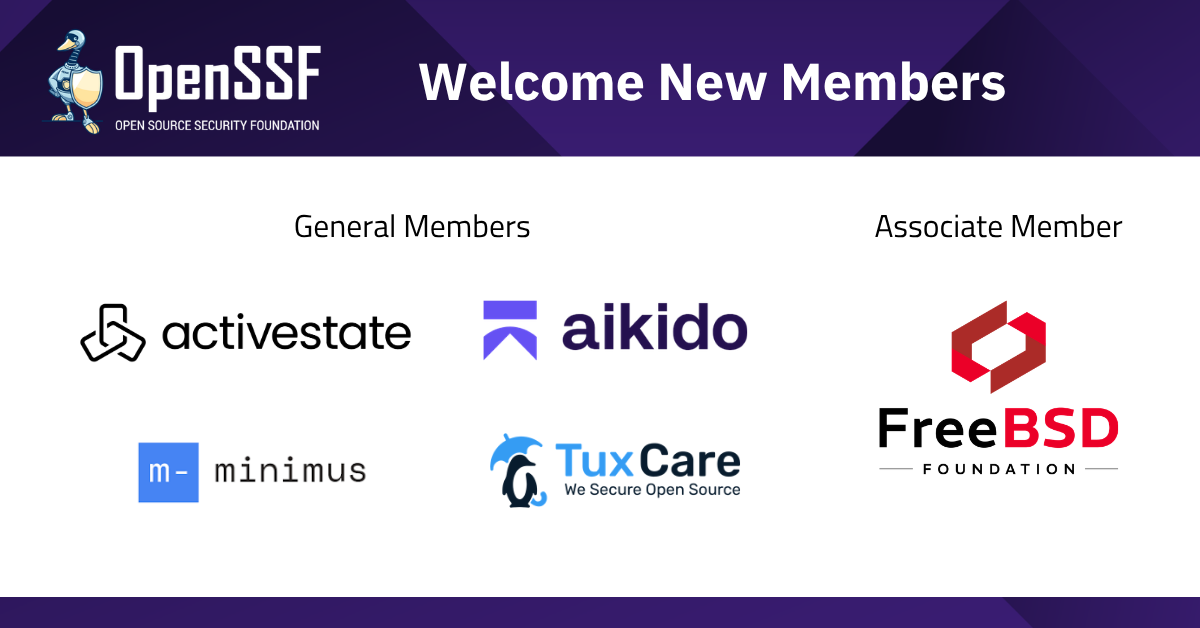
New OpenSSF members include ActiveState, Aikido, Minimus, and TuxCare, who join the Foundation as General Members. The FreeBSD Foundation also joins as an Associate Member. These organizations will contribute to working groups and technical initiatives to help drive the strategic direction of the OpenSSF. By collaborating within a neutral forum, these members support the long term sustainability of the open source ecosystem.
Foundation Updates and Milestones
In the second quarter of 2026, the OpenSSF achieved several milestones to secure and support more resilient software for all:
Supporting Quotes
“The Linux Foundation and OpenSSF are where the serious work on open source security gets done. No single organization secures the software supply chain alone. Thirty years of building secure open source infrastructure is what we bring to that work, and that work is better done together.”
– Abby Kearns, CEO, ActiveState
“Open source software is the foundation of modern software development, and supporting that ecosystem has always been core to Aikido’s mission. Through projects like Safe Chain, Zen Firewall, OpenGrep, and BetterLeaks, we’re investing in practical, community-driven security tooling that helps developers build and ship software with speed, trust and confidence. We believe securing open source is a shared responsibility, and we’re proud to contribute technologies that make the broader ecosystem safer and more resilient for everyone.”
– Willem Delbare, Founder and CEO, Aikido Security
“As a critical component of the global digital infrastructure, we believe FreeBSD must be part of the security discussions shaping the future of open source. Joining the OpenSSF will enable us to collaborate with others to help protect the software the world depends on.”
– Deb Goodkin, Executive Director, FreeBSD Foundation
“Minimus is proud to join OpenSSF and work alongside its other members to help secure the open source ecosystem that allows us all to thrive. Enabling developers to build on open source components while keeping security teams happy is central to our business, and we intimately understand the responsibility we all share in achieving that goal.”
– Kat Cosgrove, Head of Developer Advocacy, Minimus
“TuxCare is pleased to be joining OpenSSF and the cross-industry effort to strengthen open-source security. For more than a decade, we’ve worked to keep open source secure and reliable in enterprise production over the long term. We see that kind of sustained reliability as essential to the trusted, secure open-source ecosystem OpenSSF envisions.”
– Igor Seletskiy, CEO, TuxCare
Events and Gatherings
OpenSSF members are gathering this week in Minneapolis at OpenSSF Community Day North America. To get involved with the OpenSSF community, join us at the following upcoming events: OpenSSF Community Day Europe (Prague; October 6) and Open Source Summit Europe (Prague; October 7-9).
Additional Resources
About the OpenSSF
The Open Source Security Foundation (OpenSSF) is a cross-industry organization at the Linux Foundation that brings together the industry’s most important open source security initiatives and the individuals and companies that support them. The OpenSSF is committed to collaboration and working both upstream and with existing communities to advance open source security for all. For more information, please visit us at openssf.org.
About the Linux Foundation
The Linux Foundation is the world’s leading home for collaboration on open source software, hardware, standards, and data. Linux Foundation projects are critical to the world’s infrastructure, including Linux, Kubernetes, LF Decentralized Trust, Node.js, ONAP, OpenChain, OpenSSF, PyTorch, RISC-V, SPDX, Zephyr, and more. The Linux Foundation focuses on leveraging best practices and addressing the needs of contributors, users, and solution providers to create sustainable models for open collaboration. For more information, please visit us at linuxfoundation.org.
The Linux Foundation has registered trademarks and uses trademarks. For a list of trademarks of The Linux Foundation, please see its trademark usage page: www.linuxfoundation.org/trademark-usage. Linux is a registered trademark of Linus Torvalds.
Media Contact
Grace Lucier
The Linux Foundation
pr@linuxfoundation.org
Foundation welcomes Helvethink, Spectro Cloud, Quantrexion as members, offers Kusari Inspector for free to projects, and celebrates increased investment in AI security
AMSTERDAM – Open Source SecurityCon Europe – March 23, 2026 – The Open Source Security Foundation (OpenSSF), a cross-industry initiative of the Linux Foundation that focuses on sustainably securing open source software (OSS), today announced new members and key project momentum during Open Source SecurityCon Europe.
New OpenSSF members include Helvethink, Spectro Cloud, and Quantrexion, who join the Foundation as General Members. As members, these companies will engage with working groups, contribute to technical initiatives, and help guide the strategic direction of the OpenSSF. Together, members support open, transparent, and community-driven security innovation, and the long-term sustainability of the Foundation.
“Open source security continues to evolve significantly in the face of new, automated threats,” said Steve Fernandez, General Manager of OpenSSF. “Our member organizations are seeding a more secure future, built with longevity in mind, by working with the OpenSSF. This network of projects, maintainers, and thousands of contributors is key to reinforcing reliable, sustainable open source software for all.”
Foundation Updates and Milestones
In the past quarter, OpenSSF has furthered its mission to secure open source software with the following achievements:
OpenSSF growth follows the announcement of $12.5 million in grant funding awarded to OpenSSF and Alpha-Omega from leading AI providers. Funding from these leaders underscores broad industry support for more sustainable AI security assistance that empowers maintainers. Learn more about how OpenSSF and Alpha-Omega are using this grant to build long-term, sustainable security solutions, here.
Supporting Quotes
“At Helvethink, we work at the intersection of cloud architecture, platform engineering, and DevSecOps. Open source components are foundational to modern infrastructure from Kubernetes and IaC tooling to CI/CD pipelines and security automation. Strengthening this ecosystem requires measurable standards, robust software supply chain security practices, and active collaboration across the community. By joining OpenSSF, we are actively participating in several working groups to contribute to initiatives focused on supply chain integrity, secure-by-design principles, and the continuous improvement of cloud-native security practices.”
– José Goncalves, co-founder, Helvethink
“Quantrexion is proud to join OpenSSF and support its mission to strengthen the security, resilience, and trustworthiness of open source software. As a company focused on governance and human risk management, we see secure open ecosystems as a critical part of long-term digital resilience.”
– Dionysis Karamitopoulos, CEO, Quantrexion
“Open source is the foundation of modern infrastructure — and its security is a shared responsibility. By joining the OpenSSF, Spectro Cloud is investing directly in the community work that raises the bar for everyone. Just as importantly, it strengthens the standards and practices behind the software we ship, so our customers can deploy Kubernetes with confidence in the integrity of every component. We’re proud to support the OpenSSF mission and to keep translating that momentum into real product capabilities that make secure software a default, not a bolt-on.”
– Saad Malik, CTO and co-founder, Spectro Cloud
Events and Gatherings
OpenSSF members are gathering this week in Amsterdam at Open Source SecurityCon Europe. To get involved with the OpenSSF community, join us at the following upcoming events:
Additional Resources
About the OpenSSF
The Open Source Security Foundation (OpenSSF) is a cross-industry organization at the Linux Foundation that brings together the industry’s most important open source security initiatives and the individuals and companies that support them. The OpenSSF is committed to collaboration and working both upstream and with existing communities to advance open source security for all. For more information, please visit us at openssf.org.
Media Contact
Grace Lucier
The Linux Foundation
Anthropic, Amazon Web Services (AWS), GitHub, Google, Google DeepMind, Microsoft, and OpenAI Join Forces with the Foundation to Invest in Sustainable Security Solutions for the Open Source Ecosystem
SAN FRANCISCO – March 17, 2026 – The Linux Foundation, the nonprofit organization enabling mass innovation through open source, today announced $12.5 million in total grants from Anthropic, AWS, GitHub, Google, Google DeepMind, Microsoft, and OpenAI to strengthen the security of the open source software ecosystem. The funding will be managed by Alpha-Omega and the Open Source Security Foundation (OpenSSF), trusted security initiatives within the Linux Foundation, to develop long-term, sustainable security solutions that support open source communities worldwide.
As the security landscape grows more complex, advances in AI are dramatically increasing the speed and scale of vulnerability discovery in open source software. Maintainers are now facing an unprecedented influx of security findings, many of which are generated by automated systems, without the resources or tooling needed to triage and remediate them effectively. Through this investment, Alpha-Omega and OpenSSF will work directly with maintainers and their communities to make emerging security capabilities accessible, practical, and aligned with existing project workflows. The effort will support sustainable strategies that help maintainers manage growing security demands while improving the overall resilience of the open source ecosystem.
“Alpha-Omega was built on the idea that open source security should be both normal and achievable. By funding audits and embedding security experts directly into the ecosystem, we’ve proven that targeted investment works,” said Michael Winser, Co-Founder of Alpha-Omega. “Now, we’re scaling that expertise. We are excited to bring maintainer-centric AI security assistance to the hundreds of thousands of projects that power our world.”
“Grant funding alone is not going to help solve the problem that AI tools are causing today on open source security teams,” said Greg Kroah-Hartman of the Linux kernel project. “OpenSSF has the active resources needed to support numerous projects that will help these overworked maintainers with the triage and processing of the increased AI-generated security reports they are currently receiving.”
“Our commitment remains focused: to sustainably secure the entire lifecycle of open source software,” said Steve Fernandez, General Manager of OpenSSF. “By directly empowering the maintainers, we have an extraordinary opportunity to ensure that those at the front lines of software security have the tools and standards to take preventative measures to stay ahead of issues and build a more resilient ecosystem for everyone.”
To learn more about open source security initiatives at the Linux Foundation, please visit openssf.org and alpha-omega.dev.
“The open source ecosystem underpins nearly every software system in the world, and its security can’t be taken for granted. This investment reflects our belief that the best way to improve security outcomes is to work directly with maintainers and give them the resources and tooling to address threats at scale. Ensuring the world safely navigates the transition to transformative AI means investing in the foundations it runs on.”
– Vitaly Gudanets, CISO, Anthropic
“Over the past four years, our work with Alpha-Omega has proven it can deliver real results for the open source ecosystem at scale—from helping the Rust Foundation deploy Trusted Publishing to enabling critical vulnerability fixes across Node.js and PyPI. We are excited to increase our investment in Alpha-Omega and to work with our collaborators and directly with maintainers to provide not just funding, but the right tools and expertise that projects actually need to handle AI-generated security reports at scale.”
— Mark Ryland, Director, AWS Security
“Building on our initial commitment alongside Google and Microsoft four years ago, we’re now confronting new security challenges as AI transforms vulnerability discovery. That’s why AWS is investing an additional $2.5 million in Alpha-Omega. We believe the same advanced models creating these challenges can also solve them through better tooling and automation, but only through collaboration between industry leaders and the open source security community.”
— Stormy Peters, Head of Open Source Strategy and Marketing, Amazon Web Services
“As the home for open source, GitHub knows that code is only as strong as the community behind it. Supporting the Linux Foundation’s Alpha-Omega initiative extends our longstanding commitment to securing the global software supply chain. Through funding, training, and AI-powered tools, we’re empowering maintainers to identify risks faster and prevent burnout.”
— Kyle Daigle, COO, GitHub
“Securing the open source ecosystem is a shared responsibility that requires more than just capital, it also requires giving maintainers the right tools to stay ahead of evolving threats. By combining AI-driven innovation with the proven frameworks of Alpha-Omega and OpenSSF, we are empowering the community to not just react to threats, but build systemic resilience.”
— Evan Kotsovinos, Vice President of Privacy, Safety and Security, Google
“Securing open source is a shared responsibility, and we have to move as fast as the technology does. We’re focused on turning AI’s ability to find and patch vulnerabilities into a massive defensive advantage. Supporting Alpha-Omega and OpenSSF is an important step for us, right alongside our work on OSS-Fuzz, Big Sleep and CodeMender. We’re going to keep building on this to put these capabilities into the hands of maintainers, leveraging AI to help scale society’s collective resistance to cyber attacks.”
— Four Flynn, VP, Security and Privacy, Google DeepMind
“Open source software is a critical part of the modern technology landscape. As AI accelerates both software development and the discovery of vulnerabilities, the industry must step up to protect this shared infrastructure. This collaboration represents an important step in democratizing AI-powered defenses, and we’re proud to support Alpha-Omega and the OpenSSF in delivering scalable, maintainer-first solutions that secure the code powering our digital society.”
— Mark Russinovich, CTO, Deputy CISO and Technical Fellow, Microsoft Azure
“This is a critical moment for global cybersecurity that requires unprecedented levels of collaboration across the industry, and sustained commitment. For artificial intelligence to benefit us all, we need to listen closely to maintainers and strengthen the open source foundations we all depend on. Maintainers make an extraordinary contribution, and this program is an important step in providing them the support they need.”
— Dane Stuckey, CISO, OpenAI
Alpha-Omega protects society by funding and catalyzing sustainable security across open source software. With over 70 grants totalling over $20M across major ecosystems, package registries, and individual projects, Alpha-Omega has an established track record of “turning money into security.” Backed by Anthropic, AWS, Citi, GitHub, Google, Google DeepMind, Microsoft, and OpenAI, Alpha-Omega partners with maintainers, security experts, and communities to invest where it can have the greatest impact. For more information, visit us at alpha-omega.dev.
The Open Source Security Foundation (OpenSSF) is a cross-industry organization at the Linux Foundation that brings together the industry’s most important open source security initiatives and the individuals and companies that support them. The OpenSSF is committed to collaboration and working both upstream and with existing communities to advance open source security for all. For more information, please visit us at openssf.org.
The Linux Foundation is the world’s leading home for collaboration on open source software, hardware, standards, and data. Linux Foundation projects, including Linux, Kubernetes, Model Context Protocol (MCP), OpenChain, OpenSearch, OpenSSF, OpenStack, PyTorch, Ray, RISC-V, SPDX and Zephyr, provide the foundation for global infrastructure. The Linux Foundation is focused on leveraging best practices and addressing the needs of contributors, users, and solution providers to create sustainable models for open collaboration. For more information, please visit us at linuxfoundation.org.
Media Contact
Grace Lucier
The Linux Foundation
Foundation honors community achievements and strategic efforts to secure ML pipeline during community event in Amsterdam
AMSTERDAM – OpenSSF Community Day Europe – August 28, 2025 – The Open Source Security Foundation (OpenSSF), a cross-industry initiative of the Linux Foundation that focuses on sustainably securing open source software (OSS), presents the Golden Egg Award during OpenSSF Community Day Europe and celebrates notable momentum across the security industry. The Foundation’s milestones include achievements in AI/ML security, policy education, and global community engagement.
OpenSSF continues to shine a light on those who go above and beyond in our community with the Golden Egg Awards. The Golden Egg symbolizes gratitude for recipients’ selfless dedication to securing open source projects through community engagement, engineering, innovation, and thoughtful leadership. This year, we celebrate:
OpenSSF is supported by more than 118 member organizations and 1,519 technical contributors across OpenSSF projects, serving as a vendor-neutral partner to affiliated open source foundations and projects. As securing the global technology infrastructure continues to get more complex, OpenSSF will remain a trusted home to further the reliability, security, and universal trust of open source software.
Over the past quarter, OpenSSF has made several key achievements in its mission to sustainably secure open source software, including:
“Securing the AI and ML landscape requires a coordinated approach across the entire pipeline,” said Steve Fernandez, General Manager at OpenSSF. “Through our MLSecOps initiatives with OpenSSF members and policy education with our communities, we’re giving practitioners and their organizations actionable guidance to identify vulnerabilities, understand their role in the global regulatory ecosystem, and build a tapestry of trust from data to deployment.”
OpenSSF continues to expand its influence on the international stage. OpenSSF Community Days drew record attendance globally, including standing-room-only participation in India, strong engagement in Japan, and sustained presence in North America.
“As AI and ML adoption grows, so do the security risks. Visualizing Secure MLOps (MLSecOps): A Practical Guide for Building Robust AI/ML Pipeline Security is a practical guide that bridges the gap between ML innovation and security using open-source DevOps tools. It’s a valuable resource for anyone building and securing AI/ML pipelines.” Sarah Evans, Distinguished Engineer, Dell Technologies
“The whitepaper distills our collective expertise into a pragmatic roadmap, pairing open source controls with ML-security threats. Collaborating through the AI/ML Security WG proved that open, vendor-neutral teamwork can significantly accelerate the adoption of secure AI systems.” Andrey Shorov, Senior Security Technology Specialist at Product Security, Ericsson
“The Cybersecurity Skills Framework is more than a checklist — it’s a practical roadmap for embedding security into every layer of enterprise readiness, open source development, and workforce culture across international borders. By aligning skills with real-world global threats, it empowers teams worldwide to build secure software from the start.” Jamie Thomas, Chief Client Innovation Officer and the Enterprise Security Executive, IBM
“Open source is global by design, and so are the challenges we face with new regulations like the EU Cyber Resilience Act,” said Christopher “CRob” Robinson, Chief Security Architect, OpenSSF. “The Global Cyber Policy Working Group helps policymakers understand how open source is built and supports maintainers and manufacturers as they prepare for compliance.”
“The OpenSSF’s brief guide to the Cyber Resilience Act is a critical resource for the open source community, helping developers and contributors understand how the new EU law applies to their projects. It clarifies legal obligations and provides a roadmap for proactively enhancing their code’s security.” Dave Russo, Senior Principal Program Manager, Red Hat Product Security
New and existing OpenSSF members are gathering this week in Amsterdam at the annual OpenSSF Community Day Europe.
OpenSSF will continue its engagement across Europe this fall with participation in the Linux Foundation Europe Member Summit (October 28) and the Linux Foundation Europe Roadshow (October 29), both in Ghent, Belgium. At the Roadshow, OpenSSF will sponsor and host the CRA in Practice: Secure Maintenance track, building on last year’s standing-room-only CRA workshop. On October 30, OpenSSF will co-host the European Open Source Security Forum with CEPS in Brussels, bringing together open source leaders, European policymakers, and security experts to collaborate on the future of open source security policy. A landing page for this event will be available soon, check the OpenSSF events calendar for updates and registration details.
The Open Source Security Foundation (OpenSSF) is a cross-industry organization at the Linux Foundation that brings together the industry’s most important open source security initiatives and the individuals and companies that support them. The OpenSSF is committed to collaboration and working both upstream and with existing communities to advance open source security for all. For more information, please visit us at openssf.org.
Media Contact
Grace Lucier
The Linux Foundation
Foundation furthers mission to enhance the security of open source software
DENVER – OpenSSF Community Day North America – June 26, 2025 – The Open Source Security Foundation (OpenSSF), a cross-industry initiative of the Linux Foundation that focuses on sustainably securing open source software (OSS), welcomes six new members from leading technology and security companies. New general members include balena, Buildkite, Canonical, Trace Machina, and Triam Security and associate members include Erlang Ecosystem Foundation (EEF). The Foundation also presents the Golden Egg Award during OpenSSF Community Day NA 2025.
“We are thrilled to welcome six new member companies and honor existing contributors during our annual North America Community Day event this week,” said Steve Fernandez, General Manager at OpenSSF. “As companies expand their global footprint and depend more and more on interconnected technologies, it is vital we work together to advance open source security at every layer – from code to systems to people. With the support of our new members, we can share best practices, push for standards and ensure security is front and center in all development.”
The OpenSSF continues to shine a light on those who go above and beyond in our community with the Golden Egg Awards. The Golden Egg symbolizes gratitude for awardees’ selfless dedication to securing open source projects through community engagement, engineering, innovation, and thoughtful leadership. This year, we celebrate:
Their efforts have made a lasting impact on the open source security ecosystem, and we are deeply grateful for their continued contributions.
OpenSSF is supported by more than 3,156 technical contributors across OpenSSF projects – providing a vendor-neutral partner to affiliated open source foundations and projects. Recent project updates include:
New and existing OpenSSF members are gathering this week in Denver at the annual OpenSSF Community Day NA 2025. Join the community at upcoming 2025 OpenSSF-hosted events, including OpenSSF Community Day India, OpenSSF Community Day Europe, OpenSSF Community Day Korea, and Open Source SecurityCon 2025.
“At balena, we understand that securing edge computing and IoT solutions is critical for all companies deploying connected devices. As developers focused on enabling reliable and secure operations with balenaCloud, we’re deeply committed to sharing our knowledge and expertise. We’re proud to join OpenSSF to contribute to open collaboration, believing that together we can build more mature security solutions that truly help companies protect their edge fleets and raise collective awareness across the open-source ecosystem.”
– Harald Fischer, Security Aspect Lead, balena
“Joining OpenSSF is a natural extension of Buildkite’s mission to empower teams with secure, scalable, and resilient software delivery. With Buildkite Package Registries, our customers get SLSA-compliant software provenance built in. There’s no complex setup or extra tooling required. We’ve done the heavy lifting so teams can securely publish trusted artifacts from Buildkite Pipelines with minimal effort. We’re excited to collaborate with the OpenSSF community to raise the bar for open source software supply chain security.”
– Ken Thompson, Vice President of Product Management, Buildkite
“Protecting the security of the open source ecosystem is not an easy feat, nor one that can be tackled by any single industry player. OpenSSF leads projects that are shaping this vast landscape. Canonical is proud to join OpenSSF on its mission to spearhead open source security across the entire market. For over 20 years we have delivered security-focused products and services across a broad spectrum of open source technologies. In today’s world, software security, reliability, and provenance is more important than ever. Together we will write the next chapter for open source security frameworks, processes and tools for the benefit of all users.”
– Luci Stanescu, Security Engineering Manager, Canonical
“Starting in 2024, the EEF’s Security WG focused community resources on improving our supply chain infrastructure and tooling to enable us to comply with present and upcoming cybersecurity laws and directives. This year we achieved OpenChain Certification (ISO/IEC 5230) for the core Erlang and Elixir libraries and tooling, and also became the default CVE Numbering Authority (CNA) for all open-source Erlang, Elixir and Gleam language packages. Joining the OpenSSF has been instrumental in connecting us to experts in the field and facilitating relationships with security practitioners in other open-source projects.”
– Alistair Woodman, Board Chair, Erlang Ecosystem Foundation
“Trace Machina is a technology company, founded in September 2023, that builds infrastructure software for developers to go faster. Our current core product, NativeLink, is a build caching and remote execution platform that speeds up compute-heavy work. As a company we believe both in building our products open source whenever possible, and in supporting the open source ecosystem and community. We believe open source software is a crucial philosophy in technology, especially in the security space. We’re thrilled to join the OpenSSF as a member organization and to continue being active in this wonderful community.”
– Tyrone Greenfield, Chief of Staff, Trace Machina
“Triam Security is proud to join the Open-Source Security Foundation to support its mission of strengthening the security posture of critical open source software. As container security vulnerabilities continue to pose significant risks to the software supply chain, our expertise in implementing SLSA Level 3/4 controls and building near-zero CVE solutions through CleanStart aligns perfectly with OpenSSF’s supply chain security initiatives. We look forward to collaborating with the community on advancing SLSA adoption, developing security best practices, improving vulnerability management processes, and promoting standards that enhance the security, transparency, and trust in the open-source ecosystem.”
– Biswajit De, CTO, Triam Security
About the OpenSSF
The Open Source Security Foundation (OpenSSF) is a cross-industry organization at the Linux Foundation that brings together the industry’s most important open source security initiatives and the individuals and companies that support them. The OpenSSF is committed to collaboration and working both upstream and with existing communities to advance open source security for all. For more information, please visit us at openssf.org.
Media Contact
Natasha Woods
The Linux Foundation
New Customizable Global Framework Aligns IT Job Roles with Practical Cybersecurity Skills
SAN FRANCISCO, CA – May 14, 2025 – The Linux Foundation, the nonprofit organization enabling mass innovation through open source, today announced the launch of the Cybersecurity Skills Framework, a global reference guide that helps organizations identify and address critical cybersecurity competencies across a broad range of IT job families; extending beyond cybersecurity specialists. Produced in collaboration with the Open Source Security Foundation (OpenSSF) and Linux Foundation Education, the framework delivers actionable guidance to enterprise leaders looking to systematically reduce cyber risk.
As cybersecurity threats grow in both scale and complexity, enterprise leaders are struggling to align job roles with the practical skills needed to mount an effective defense. Despite cybersecurity being one of the top three most in-demand tech roles for enterprises, major talent readiness gaps remain. According to the Linux Foundation’s 2024 State of Tech Talent Report, 64 percent of organizations report candidates lack essential skills and it now takes an average of 10.2 months to hire and onboard new technical staff. Additional research from the Linux Foundation found that 62 percent of open source project stewards lacked dedicated personnel for security incident response, despite 74 percent maintaining formal cybersecurity reporting mechanisms.
These trends reflect a broader industry dilemma—growing awareness of cybersecurity needs without the personnel to tackle them—driven by unclear role expectations and fragmented training pathways. The Cybersecurity Skills Framework addresses these issues with a practical, globally relevant onramp that organizations can use to assess and build internal security capabilities. The framework provides leaders with an easy way to understand the cybersecurity skills needed, quickly identify knowledge gaps, and incorporate critical skills into all of their IT roles. By establishing a shared language for cybersecurity readiness, the framework prepares everyone who touches a system to take responsibility for security, not just the cybersecurity specialists: from app developers to web developers, network engineers to database engineers, solutions architects to enterprise architects.
The framework defines practical cybersecurity expectations across foundational, intermediate, and advanced proficiency levels, while mapping those skills to recognized standards such as the DoD 8140, CISA NICE Framework, and the ICT e-CF. By aligning with widely adopted standards and allowing for customization, the framework can be easily adopted across industries, regions, and organizational sizes. The framework is available in a free, easy to use web interface which allows users to select relevant job families, move skills between categories, delete any that don’t apply and add custom items they require.
The framework was produced as a result of a global research effort, with contributions and feedback from cybersecurity educators, government advisors, framework stewards, and technical training experts, who together brought comprehensive expertise in workforce development, national defense, professional certification, and open source security.
“Cybersecurity is now a leadership issue, not just a technical one,” said Steve Fernandez, General Manager at OpenSSF. “Our framework gives organizations a straightforward way to identify gaps and prioritize the security skills that matter most, based on role and responsibility—not just checklists. It’s about building real-world resilience.”
The Cybersecurity Skills Framework provides guidance for key roles, including web and software developers, DevOps engineers, IT project managers, platform architects, GRC managers and more. Each job role is defined by its primary cybersecurity responsibilities and aligned with practical skills in areas like secure design, compliance, vulnerability management, and incident response.
“This framework is a valuable tool for CIOs, CISOs, and enterprise learning teams,” said Clyde Seepersad, SVP and General Manager of Linux Foundation Education. “In an era of accelerating threats, leaders need clear pathways for strengthening security culture across technical teams. This resource helps organizations take a proactive approach to employee development and risk reduction.”
The Linux Foundation and OpenSSF will update the framework annually and welcome community feedback from adopters. Organizations are encouraged to adapt and extend the model to align with their specific needs, security posture, and product portfolios.
To access the full Cybersecurity Skills Framework and explore how your organization can adopt it, visit: http://cybersecurityframework.io
Join us on Wednesday, June 11 at 11:00 am EDT for a webinar discussing the Cybersecurity Skills Framework. Visit here to register.
Supporting Quotes
“As cloud native adoption grows, so does the complexity of managing security across distributed systems. The Cybersecurity Skills Framework offers a clear, actionable resource for teams working in modern environments to assess skills, reduce risk, and embed security into every stage of the software lifecycle.”
– Chris Aniszczyk, CTO, CNCF
“As the cybersecurity landscape grows more complex, particularly with the rapid rise in AI technologies, security can no longer be siloed. Businesses must champion a culture of security awareness, education, and preparedness across functions. The new framework contributes to a stronger security posture by ensuring every team—from developers to IT leaders—understands the specific security skills they need.”
– Jamie Thomas, IBM Enterprise Security Executive
“Cybersecurity is a shared responsibility, and closing the skills gap is essential to building secure systems at scale. The OpenSSF Cybersecurity Skills Framework provides a clear, actionable roadmap for equipping technical teams with the right knowledge to protect our digital infrastructure, thus raising the bar for security readiness across the industry.”
– Arun Gupta, VP of Developer Programs, Intel / Governing Board Chair for CNCF & OpenSSF
“Cybersecurity today seems more complicated than ever. It can be difficult to keep up with the evolving cyber risk landscape and what skills internal teams need to approach and mitigate those risks. The Cybersecurity Skills Framework is a much needed blueprint for how developers should approach career development, teams plan for adapting to new risks, and organizations build training governance for the continuous evolution of their cybersecurity programs.”
– Michael Lieberman, CTO and Co-Founder, Kusari
“The Cybersecurity Skills Framework is grounded in extensive global research and community collaboration. By surfacing practical, role-specific insights, the framework helps enterprise leaders understand where their cybersecurity capabilities stand—and where they need to grow. It’s a meaningful step toward bridging the persistent skills gap we’ve seen across sectors.”
– Hilary Carter, SVP Research at the Linux Foundation
“Security is a shared responsibility across the open source ecosystem. This framework is a powerful tool to help developers, project leaders, and enterprise teams better understand how their roles contribute to a secure software supply chain. It supports the kind of continuous learning culture that is essential to sustainable open source development.”
– Robin Bender Ginn, Executive Director, OpenJS Foundation
“The need for experienced cybersecurity practitioners continues to increase, and a clear understanding of cybersecurity roles, responsibilities, and required skills is not just beneficial – it is the foundation for a resilient and secure organization. The Linux Foundation’s Cybersecurity Skills Framework provides guidance to help leaders and practitioners understand the baseline skills needed for various roles. It serves as an excellent starting point for cybersecurity practitioners looking to enter the field or plan their career progression. Additionally, it helps leaders identify the necessary roles and skills to meet their cybersecurity demands.”
– Dave Russo, Senior Principal Program Manager, Secure Development, Red Hat
###
About the Linux Foundation
The Linux Foundation is the world’s leading home for collaboration on open source software, hardware, standards, and data. Linux Foundation projects are critical to the world’s infrastructure, including Linux, Kubernetes, LF Decentralized Trust, Node.js, ONAP, OpenChain, OpenSSF, PyTorch, RISC-V, SPDX, Zephyr, and more. The Linux Foundation focuses on leveraging best practices and addressing the needs of contributors, users, and solution providers to create sustainable models for open collaboration. For more information, please visit us at linuxfoundation.org.
The Linux Foundation has registered trademarks and uses trademarks. For a list of trademarks of The Linux Foundation, please see its trademark usage page: www.linuxfoundation.org/trademark-usage. Linux is a registered trademark of Linus Torvalds.
Media Contact
Noah Lehman
The Linux Foundation
nlehman@linuxfoundation.org