Tag

Newsletter

What’s in the SOSS? Podcast #75 – S3E27 From Upstream to Downstream: Managing Open Source Risk in a Changing Regulatory Era with Vincent Danen

By Podcast

Summary

In this episode of What’s in the SOSS’ “Big Thoughts, Open Sources,” host CRob sits down with Vincent Danen, Vice President of Product Security at Red Hat, for a deep dive into the evolving landscape of open source vulnerability disclosure. Drawing on over two decades of open source security experience, Vincent reflects on the history and critical role of the CVE program while addressing modern challenges like the rise of alternative advisory systems and the flood of AI-assisted vulnerability disclosures. The conversation explores the shifting dynamics between upstream maintainers and downstream consumers, the practical utility – and missing user experience – of SBOMs, and how emerging regulations like the EU Cyber Resilience Act impact global software supply chain security.

Conversation Highlights

00:00 – Introduction & Open Source Origins
04:26 – The Evolution of CVE and Vulnerability Data
11:02 – Coordinated Vulnerability Disclosure in a Fast-Paced World
17:53 – AI’s Impact on Vulnerability Discovery & Response
27:20 – Realizing the Value of SBOMs and VEX
35:05 – Contextualizing Risk and Exploitability
42:55 – Regulatory Expectations and the Future of Supply Chain Security

Transcript

Intro Music & Promotional Clip (00:00)
Security was one of those things where we did not compete. It is table stakes for everybody. Our users deserve better than just like, “I’m gonna get this fix out faster than you because I’m not going to tell you about it.” None of us thought that and I believe today that still rings true – we don’t we don’t believe that. That’s part of the open source community that works.

CRob (00:25)
Welcome, welcome, welcome to Big Thoughts Open Sources, where we get the opportunity to talk with people from across the open source ecosystem, talking about supply chain security, software security, AI security, and a lot of other topics. Today, we are joined by a friend of the show and a longtime contributor and collaborator with the OpenSSF, Vincent Danen. You’re the Vice President of product security at Red Hat?

Vincent Danen (00:54)
Hey, CRob. Yes, yes, that is I have the dubious honor of being the VP of product security at Red Hat, as you well know, because we’ve known each other.

CRob (01:04)
A long time. Probably longer than some of the audience members are old.

Vincent Danen (01:09)
well, hopefully you didn’t say alive. I don’t think it’s been that long. We’re not that old.

CRob (01:15)
Hahaha

Well, so today we have a whole exciting series of questions. We’re going to have a great dialogue about broadly open source security. But before we get there, let’s kind of get in the way back machine. I want you to kind of describe to the audience. What is your open source origin story? How did you get into this whole little unique slice of heaven?

Vincent Danen (01:44)
Oh man, we’re going back, the way back machine is right. So I’ve been at, I mean, I’ve been a Red Hat for 17 years, was at Mandriva or Linux Mandrake when I joined them eight years prior to that. So I’ve been doing open source for over 25 years.

CRob (02:01)
Wow!

Vincent Danen (02:02)
Yeah, yeah, I think the first, actually it’s really funny, the first, not the first distro that I used, but the one that I used seriously, I was actually to run my BBS.

And that was like Red Hat Linux 5.

Yeah, it was Red Hat Linux 5, but it didn’t work with some of my SCSI drives. So I switched over to Linux Mandrake, which I think they were trying to be a little tempestuous, impetuous. They were like version six. And so I was using that, which is when I started volunteering, actually doing Package Management for Linux Mandrake while I was doing some Linux consulting on the side, I ran my own business. And they… enjoyed the work that I was doing. So they’re like, hey, you want to do that? Plus I was writing technical articles. If you go back like Tech Republic and a couple other outfits, I was writing a whole bunch of articles on Linux and open source, which was a ton of fun and learned a lot. And, and then I started working for Linux Mandrake doing packaging and documentation. And then one day they were like, Hey, one of these guys wants to be working on the kernel full time and not dealing with some of these vulnerabilities like in wu-ftpd and some of these older things are like, there’s only one per month roughly that you’re gonna have to do. you wanna take that on? And I was like, yeah, sure, whatever, I can do that. And that one a month turned into one a week, turned into one a day, turned into how many hundreds a day are we up to now? Like it’s a lot. So I kind of, fell into the whole security space by accident because somebody suckered me into it. And 25 years later, I’m still doing it. So I must’ve found my…found my niche.

CRob (03:41)
Yeah, well it’s something that I’ve had the opportunity to work alongside you. You’re very passionate about, which is important because it’s not a fun job all the time, right? It can be pretty hard.

Vincent Danen (03:52)
no, no, it’s definitely not a fun job. Almost all the time, at least these days, right? I mean, I think any honest security practitioner will tell you that. But I mean, the open source part of it is a blast, right? Like I, I mean, I have drunk all the Kool-Aid. I am a firm believer in open source, not just open source software, but like the open source ethos, the mythology around open source and the philosophy and the principles and

Man, these are things to live by and I love it.

CRob (04:26)
Yeah. So let’s start to dive into our topic today. Broadly, vulnerability disclosure. And let’s start off with kind of the elephant in the room, so to speak. So a lot of our work today in coordinating vulnerabilities goes through the CVE program, which is a program that’s funded by the US federal government. And there’s a couple of different

You have the CVE program, you have the National Vulnerability Database. But broadly, the CVE has been having some problems with funding, some uncertainty with politics. And in the meantime, the vulnerabilities are rapidly increasing. So from your perspective, and kind of with this 25 year history, what has worked well as part of vulnerability disclosure specific to CVE or not and kind of where are we starting to see it come apart at the seams.

Vincent Danen (05:31)
Great question. I think the actual CV part of it is very central to it, right? Because if I go back to those 25 years, when CV first started, it was basically in response to, we have a vulnerability, it’s called six different things, and nobody knows what they’re talking about, right? So I mean, like, I still remember old send mail vulnerabilities, which would have like a bug force ID and X force ID.

Bob’s ID, and then there was a CV name and the CV was that promise of we will have one name for every vulnerability. So when you’re asking about a buffer overflow or send mail, because Lord knows there was enough of them back then, which one are you talking about?

Right, so if I’m sitting here and I’m a defender and I’m supposed to fix it, I would like to know which patch you’re referring to so I can tell you whether or not that patch was applied, whether or not it’s applicable, all of those sorts of things. So CV was great, it lived up to that promise, every vulnerability got a CVE name, everybody knew what it was called and what it was referred to. I think nowadays the biggest challenge that we have is one, CV isn’t comprehensive.

CRob (06:40)
Yeah

Vincent Danen (06:41)
Right, so if you look at, and it drives me nuts, like GitHub security advisors. There’s a bunch of those without CV names. Valid vulnerabilities, right, but they don’t have a CV name. So when you’re looking at it, it’s like you have customers or people are asking you, have you fixed this GHSA?

And it’s an advisory, I don’t know, what’s the CV name, right? So we don’t necessarily treat everything as it doesn’t exist unless it has a CV, because that’s not how vulnerabilities work, but I find it very frustrating, and I think this is where we’re starting to see some cracks in the seams, is like, GHSAs are valid, and they are, but they don’t have a CV name and nobody cares. It’s like, they’re not out there, like, I don’t know, GitHub if you’re listening, you could have a mechanism as a CNA where you basically assign CVs to all these things, right? Or work with those maintainers to be able to say like, hey, you should have a CV or some kind of policy there. But when we’re looking at all of the noise that came out last year, right? With all the funding kerfuffle and all of this other stuff. And then everyone’s like, I know, I’m going to create a GCV or some other type of CVE or a…

Like we were going back to the bug force IDs and the X force IDs. Even this will probably make you laugh because this is a bit of a blast from the past to like the DWF. Right? Like CV worked and they were like, ah, no, we should have DWF too. And then like that didn’t work. And so I worry about all of these competing ecosystems when we had something that worked really, really well. It was basically a dictionary. It just described a thing and identified the thing.

And that’s it. That’s all we need. We don’t need any of the other stuff. Now I think that maybe CV is going a little bit off the rails and lean more into like NVD land where NVD was like, we’re going to enrich all this stuff. We’re going to give you this extra data. We’re going to give it a CVSS score and all this jazz. That was never what CV was meant for. It was never meant to say, this is the severity. This is a CVSS. Whatever it was like, this is the thing. This is the coded effects. Downstream users, upstream users, you figure it out. right? And that model works well.

CRob (08:56)
That’s been, I think, absolutely agree that CVE is that one identifier to rule them all. That way everybody had kind of that same shared understanding. And in Red Hat, that CVE may have these three effects and in Windows it might have these 12 other effects. But it was nice that everybody had, this is what the problem is. This is the root cause.

Vincent Danen (09:19)
Yeah, and when you, this is my beef with NVD, right? Because they started out as a database for the US government to rate things in the context of the government’s use. Everyone and their dog decided like, this is a cool database, we’re gonna use it too, right? And it was a very much one size fits all, right? And you noted different effects, like the thing I love about open source is it’s one, right? It is ubiquitous, it is everywhere and everybody is using it.

But, that means you’ve got different compilers. You’ve got different versions of interpreted languages, so like your Go’s, your Pythons, your Rubys. You have different operating systems with different security contexts, like Windows operates very differently than Linux does. Mac OS is similar, but there’s different compilers, right? And then everybody compiles these things differently. They have different hardening flags and all of these sorts of things. So unless you look at it from the vendor context of like, this is how it’s used. This is the security context around it. This is how it’s compiled. Those scores and those severities are going to be different. Like Mac OS doesn’t have SELinux, but we do. It’s enabled by default. Shame on you if you turn it off. It works really well. But I mean, we’ll rate those things in that context, right? Or with somewhat like the Fortify source or SSP or some of these other compiler flags. I mean, I’m not a Mac guy other than a user. Like I don’t develop on it.

Do those hardening flags exist in that C compiler? Literally no idea. But that’s going to change something from like remote code execution to a denial of service, right? In a lot of cases. So those have to be accounted for.

CRob (11:02)
Yeah, exactly. One thing, so from your perspective, you mentioned that you went from one CVE a week to one a day to one an hour. It’s interesting from your perspective and kind of your interactions with the upstream and downstream communities, how has this rapid acceleration of more information, more vulnerabilities being shared. How do you think that’s affecting people?

Vincent Danen (11:35)
Um…I think people are giving up on the notion of coordinated vulnerability disclosure

CRob (11:41)
Say it isn’t so.

Vincent Danen (11:42)
Which I actually think is terrible. No, I think it’s terrible. Think. The thing I think to realize when it comes to open source is you have up streams, you have down streams, and you have a wide variety of everything else. You’re never gonna be able to coordinate everything across everybody who’s a piece of open source, right? Like that’s just a fact. But there are, I’ll say congregations of different types of open source that are available from different vendors. And that’s where you have your commercial open source vendors, right? So whether it’s Canonical or SUSE or Red Hat or whatever, right?

They are large distributors who provide significant chunks of what that open source is being used out on the internet, particularly when it comes to critical infrastructure. I don’t know this for fact, but I do believe that like a nuclear reactor isn’t going to be updating from the Linux kernel directly, nor are they going to be building all of their source code, because why won’t they?

CRob (12:38)
Hope not.

Vincent Danen (12:40)
Their job is to make sure that nuclear energy is run safely and securely and…all of those sorts of things, their job is not to build an operating system or to maintain it, right? So they’re going to be going to a commercial enterprise open source vendor, and they’re gonna be going for that. So the notion that we’ve had for probably the last 20 years is, I don’t wanna call them cabals, because that sounds bad…

But like groups of people who dealt with embargoed vulnerabilities representing major open source vendors, that basically account for what I would say is 80, 90 % of the critical infrastructure that’s being used. Red Hat is one of them, but it is by no means unique. We would share information because we had these tenants, like I remember when I was back at Mandriva and I was working with Red Hat and I was working with SUSE and I was working with Debian, security was one of those things where we did not compete. We agreed very much that it is table stakes for everybody. Our users deserve better than just like, I’m gonna get this fixed out faster than you because I’m not going to tell you about it. And this is my competitive advantage. None of us thought that. And I believe today that still rings true. Don’t believe that. That’s part of the open source community that works. Right now, what I’m seeing is people are not disclosing to those channels and they’re just making things available online, right?

I don’t know when this is going to go live, so I don’t know in reference to time, but like last week is copy fail, that came out and that was just public and a lot of enterprise open source vendors were caught flat-footed because it was just disclosed, there was no coordination, right? Now I’m not saying that the Linux kernel is the only place that this is happening, it obviously isn’t, this one just happened to be pretty remarkable in terms of its publicity, right?

And I just think this is going to get worse unless we figure out how to make this better. And we do have those mechanisms, but it’s, I don’t know if it’s an education thing. I don’t know if it’s part of like some of the stewardship in, you know, CRA land, you know, where foundations are involved. But of course not all open source communities have foundations.

So it’s really complicated, but there’s a few places where people have traditionally gone, or they’ll go to a vendor, an open source enterprise vendor and report, like this happens to Red Hat all the time, people report vulnerabilities to us, and we will work with the community and kind of do that middleman coordination to make sure that everybody has a fair chance of understanding the vulnerability, contributing to its fix, and then having a standard date for when these things go public, right?

CRob (15:36)
Yeah.

Vincent Danen (15:37)
And I think we have to work harder at that because if we don’t, we get more copy fail like things where it’s like a zero day that shouldn’t have been.

CRob (15:48)
I have a personal hypothesis about this in that much like development today, we have a lot of non-traditional people kind of dabbling in the vulnerability disclosure space and they don’t have that experience or that understanding of how things work in the ecosystem. And that’s one of the things like I can say that we are working to try to help educate and provide these consistent means because it’s important. The whole idea about coordinated vulnerability disclosure is that everybody involved has the ability to have some type of solution so that when it goes public, the end users have the ability to get treatment and make themselves whole.

Vincent Danen (16:29)
Yep. Oh no, 100 percent. And I think it’s just going to get worse with the, I mean, you’ve seen what it looks like the last week or two. If you look at like a CV details and the number of CVEs coming in week over week now, like I think someone was telling me at least when it came to like Red Hat, just with some of the vulnerabilities that were like, we’ve almost eclipsed what we got all of last year already. Right. So I mean, like this is insane. And…

CRob (16:51)
already. Wow.

Vincent Danen (16:52)
Already. Right. So I mean, like this is insane. And
Like the coordination around all of this, like as much as I like to say AI is useful for a bunch of stuff, like it’s really great for finding things, right? AI doesn’t coordinate disclosure. People have to do that, right? So there’s still a, mean, people are wondering about human loop and value of security researchers, like that’s it, right? Part of it is the relational piece, the coordination, things like that. Like AI is good at finding it. Hopefully it’s good at fixing it, but we have to be able to coordinate and then everybody else has to be able to apply these things and everyone’s personal acceptance of AI is different as well. So do humans want to validate things?

I’m sure that some upstreams will want to do that. So you have to account for that as well. But it’s just the sheer volume is going to be the hard part. And I think people will get frustrated because, I’ve submitted my 3,800 CVs or CV, potential CV reports. No one’s getting back to me. So I’m just going to go dump these on Twitter or X now.

CRob (17:53)
And since you invoked the name of our shared friend, let’s pivot a little bit and talk about how AI is changing the economics of vulnerability discovery and not necessarily focusing on the economics of vulnerability response. So from a PSIRT perspective, which is a product security and incident response team, which is the organization that you represent within Red Hat.

How do you today kind of distinguish between something that AI helped with the research and versus the volume of just AI slop where you’re just getting a huge volume of reports and how can we help maintainers with this kind of situation?

Vincent Danen (18:40)
Yeah, I think that the usage of AI slop is diminishing, right? Like last year, 100%, lots of garbage was floating around. From what I’ve seen, a lot of the reports and things that even we’ve experimented with, it’s actually really good now. So there’s less slop, more true positives, those sorts of things, right? I think it’s going to get to a spot where there’s…

There’s a difference between the quality and the quantity. I think the quality has definitely gotten better. I would say as a recipient of a report, I would be asking for a proof of concept as well. Don’t just generate a bunch of things and then just shoot it over the wall. Years ago, people used to do that with fuzzing, They’d fuzz image magic or something like that, and then give us a tarball of all these fuzzed files and be like, hey, we think there’s some problems here.

Like, thanks, could you please point them out to me? Like, don’t just give me a million fuzzer files of random input and then like some of them crash and some of them don’t. Like you gotta weed through some of this stuff yourself first, right? So the notion of like test it first, like actually be able to reproduce it, make sure it’s valid is really good. Particularly since I think a lot of people are using AI tools. And this is my hypothesis. A lot of people are using AI tools right now to submit bugs to bug bounty programs and get their payouts. Right? In fact, we’ve seen some bug bounty programs close because they’re like, well, I mean, you guys are just going to be using AI for this stuff, not vetting it at all. We’re just going to stop paying these things. And I actually think we’re, I think the days of bug bounty programs are done.

CRob (20:28)
I think it’s definitely limited. would agree with that.

Vincent Danen (20:31)
You know, because all we’re doing then is we’re giving people money and they’re investing in these tokens to do all this work, knowing that they’re gonna get this payoff, right? And the incentive isn’t there. Now I’ve always been a, prior to AI, I’ve been opposed to bug bounty programs, just because if you’re gonna be doing this for open source, this is called giving back to the community, right? Like you shouldn’t get paid for this. You should like, you find, I find a bug in a piece of software, I feel like it’s my duty as the end user of that software, the recipient of that value that it gives me to give that to the maintainer, whether it’s a security bug or regular bug, right?

CRob (21:10)
Mmmhmm. Well, and that’s an interesting…we’ve heard a lot of feedback from the upstream community around the volume of these things. And thinking about it, unlike older tools like static analyzers, which sometimes required very expensive licenses for, and only, that was kind of the dominion of commercial enterprises, with these new large language models.

Some of them you could do open models, local things for free or low cost, but then even the well-known name brand frontier models, you can get in at $20 a month. So the economics for the research, the finding piece is greatly reduced. So, outside of a proof of vulnerability or concept, what else would you recommend for people that are trying to use these tools and are hoping to…build a relationship or at least have a good interaction with upstream.

Vincent Danen (22:07)
Yeah, it’s honestly vetting it, right? Like don’t just find it. Excuse me, find it and vet it. Like you gotta put a little bit of elbow grease in there because if you don’t, at the end of the day, you’re just telling my guys like, you gotta do it. Or you’re telling upstream, you gotta do it, right? And if you’ve got 100 different people submitting basically the same vulnerability, because I mean, we’re seeing that now, right?

CRob (22:29)
Mm-hmm.

Vincent Danen (22:31)
Interestingly, for a very long time, I’ve seen, you know, people will report a vulnerability and a month later, somebody else completely random, completely different reporting the same vulnerability. So this is not a new phenomenon exclusive to AI. Like it happened. It’s just the scale and speed of it is everything that’s speeding up. Right? So if we’re going to be dumping all of this stuff on maintainers or vendors or any other recipient of this, you got to do your due diligence. Like they’re going to have to do some level of human effort to triage these things.

I think it’s our responsibility and job to figure out how do we use these tools to help with that triage to make it faster, right? I was actually having a conversation with someone this morning, the same kind of idea, right? Where they’re like, well, I think that humans need to validate all of these things. And I’m like, I agree to an extent, but if we’re being flooded with this stuff, we literally can’t because then we’re all sitting on backlogs of stuff that we’ll call embargoed, but isn’t actually embargoed because somebody else is finding it and reporting it somewhere else.

And then we get into that whole, just even the coordination of CVE names, nevermind the coordination of responsible disclosure. So we have to get better at, like, how do we do rapid vulnerability assessments or judging the validity of a report with another agent or a series of agents? There was a talk, I actually think it was at the SOSS Fusion event maybe two years ago.

And someone was talking about this idea of AI decisions made by consensus, right? Where you have like three or four different agents that are designed differently, trained differently, looking at the same problem. And if all four of them or three of them or whatever your panel is agree that it is a thing, then you go do that thing.

CRob (24:22)
That’s interesting.

Vincent Danen (24:23)
If you have one of them disagree and it has valid, then it triggers a human review, right? And I think that if we…build systems like that, then we’re able to get through that backlog, do the triage quickly and reserve the things that maybe the models aren’t confident on. Then we get a human being to look at.

CRob (24:42)
Mmmhmm. And that’s been one. The great thing about open source is all the source code is freely publicly available that you can look at it, make changes and submit it back upstream. Bad thing about open source is that all the source code is publicly available and anybody can look at it and make changes,

Vincent Danen (25:00)
Yep.

CRob (25:01)
Which again, you mentioned that the kind of the duplicative reports has always been a problem. And even thinking about like the dawn of fuzzers, how all these tools create a large volume of information. You get a lot of data, but kind of identifying the wheat from the chaff is hard because you might have a critical vulnerability hidden inside of thousands of either knot bugs or very low things that would yield very little outcome for an attacker.

Vincent Danen (25:34)
Yeah, but these are the same problems we’ve always had, right? It’s just a tool that’s different, right? If I look at like a SAS T-scanners, right? I mean, my goodness, there’s so much noise in those things. It is a needle in a haystack trying to find a true positive, a true vulnerability in these things. You’ll find a lot of weaknesses, great defects, like, yes, we should improve the code and whatnot. But most of them are like, just, they don’t mean anything, right?

And so a lot of people get frustrated and I find a lot of these scanning tools run for compliance reasons, not for actual security reasons. Right. And this is actually one of the things that makes me really happy about some of these advances in these AI tools is like we can actually zero in on that signal and get rid of a lot of the noise, especially now, right? We’ll call AI slop noise. And there was some signal buried in there, but there was a lot of slop around it right now that that stuff is basically being fixed, it’s drained off, it’s better now. And I expect three

Three months from now, it’s going to be better. Six months from now, it be even better. A year from now, it’ll probably blow our minds because these things just keep iterating, and they just keep getting better. So we’re going to end up having better tools. I don’t think SAS tools have gotten better over the last decade. They’re basically the same thing. And now we have people talking about using AI to filter through SAS findings. Well, what does that tell you? Now we’re going to use AI to figure out how much of this is signal in here.

Now we’re going to use AI to figure out how much of this is signal.

CRob (27:01)
A tool to fix my tool.

Vincent Danen (27:03)
Totally, totally. But now we don’t even need that other tool because the tool that would have fixed that tool is actually doing a better job. Right. And so I actually think this is great. We just have to ride the wave and wait for it to come down, right? And normalize a little bit.

CRob (27:20)
Right. Well, and one thing that kind of offered a glimmer of hope to kind of improve the signal to noise ratio was one of our favorite topics, software bill of materials.

Vincent Danen (27:35)
Mm.

CRob (27:36)
And it was awesome. Like when it was initially presented, governments jumped on it and put requirements out. seeing with like the EU CRA, SBOMs are part of that requirement. But from upstream,There’s limited utility for an upstream maintainer to, they’re rarely if ever gonna use an SBOM. But as you work your way down the supply chain it becomes increasingly more important. From your perspective as one of those, you’re a downstream from upstream. What metadata from your perspective is required for people like you to be able to make these risk-based decisions based off of the…packages that you’re sharing and supporting for your customers.

Vincent Danen (28:23)
Yeah, I mean, it’s for me, it’s the basic stuff, right? It’s the name of the package, it’s the version, it’s a release. A git commit, right? So that as I’m traversing git history, I know like this version equates to this git commit and I can see, because then I can actually start trolling through the git commits for fixes and stuff to know which versions are affected by things and whatnot. And I think there’s some, I can’t remember who was talking about this at Vulcan a couple of weeks ago, but there’s a really neat, maybe it was the folks from Google, but like some very neat get graphing things where they can actually start to determine, because it git is messy with all of the branches and commits and forks and everything else. It’s like, what’s that window of risk? When was it introduced? When was it remedied? How many branches are in there so we can see if we’re on this branch, was it affected or not, right? That’s the sort of information that was useful for me as a downstream reproducer, right?

There’s a lot of stuff that is useful from like a legal compliance perspective, like licensing and whatever else. But I mean, I think fundamentally, folks who assemble a collection of open source don’t necessarily need an SBOM from upstream, right? Because they’ll be assembling all of these things. if I look at it from my perspective, I produce an SBOM for RHEL, like for the operating system. I don’t produce an SBOM for OpenSSH or an SBOM for OpenSSL, right? That’s a component in my SBOM, right? Because nobody’s looking for you know, where is ssl.c in my compiled code, right? They’re just looking for like, where’s my open ssl library? Where do I have it all over my estate, right? The difference will be for some of these, and different ecosystems are different, but like the ones that come to mind are like npm, where you take all of these different dependencies for a project.

and you smush them all into one file to minimize it. And I don’t really, can’t tell what’s in there or what’s not. SBOMB for that would be really helpful because I might need to fix a vulnerability in one of those dependencies that I’m as a downstream, I’m just pulling the one package that’s inclusive of a bunch of other things. Go is another example, right? All of these things shoved into one binary and like there are tools to be able to determine what it was and whatnot, but I have to go look at the binary itself.

That means I can’t do an analysis if I have like an SBOM aggregator tool where I’m like, where is this Go module used in my estate? I can’t go and interrogate all these Go binaries all over the place. Like I just, want like a text file that tells me these things, right? So I mean, like for some upstreams, SBOMs would be super, super handy. For some of them probably doesn’t matter so much. Really critical for the producers.

And also really important that, you know, end users actually start using them. Like there was a promise for SBOMs that has never been realized. And it’s been like a decade plus, right? Certainly the impetus on it for the last five, six years, right? And I don’t see that it’s actually been well used other than saying, I have my SBOM, my compliance box is ticked, but we’re not actually using it for anything.

CRob (32:06)
And that’s been, I would say we’ve been involved with this SBOM space for almost a decade now. There’s been a lot of focus on producing it. Make the SBOM and you’ve got a lot of different permutations and you can go down and do transitive and transitive dependencies. But there’s been very little focus on using these things, aggregating it and then kind of extracting wisdom as a operator. Like how do I find out exactly where I need to go jiggle the handle or deploy a fix somewhere.

Vincent Danen (32:37)
Yeah, when you said jiggle the handle, I was thinking of a toilet. Right?

CRob (32:40)
Right, exactly. We’ve got to flush out vulnerability.

Vincent Danen (32:43)
But it means it’s true. Like to date, topics around SBOMs have been largely engineering focused or academic. Nobody’s putting on their UX hat and going, how would a user use this? What are the tools for this? Like if I can give a personal story that will throw a Red Hat a little bit under the bus. Yeah, I mean, it’s okay. Like they’ll work for me, so it’s fine. Like when we were producing VEX documents,

CRob (33:11)
Mm-hmm.

Vincent Danen (33:11)
right? Like we created them to the CSAF VEX standard. We published them. We did all of these things. I’m like, this is awesome, you guys. I love this. What are we using that a customer could use to actually interpret these files? And the answer I got back was like, I don’t know. I mean, you could go to CSAF and see if they have any tools. I’m like, are you kidding me?

This is the answer, like you guys engineered a solution that, I mean, I was not a believer in it at first, but they proved me wrong, right? It happens, and I’m glad for it. But then they weren’t giving me the tool to use it. So then I went off and I was like, well, forget this, and I wrote my own, right? So now there’s a VEX reader Python module that I wrote

CRob (33:54)
Oh nice

Vincent Danen (33:54)
That would actually do that because I’m like, how do I tell a customer to use this? And we’re like, here’s a document. And they’re like, okay.

CRob (34:04)
and
Vincent Danen (34:05)
And it has all the information that you want, period, run away. That felt a lot like the way we thought about SBOMs. We’ll create the SBOM, like, yeah, you can go use the SPDX tooling for that. Okay, I mean, that’s great. So I can take some JSON and spit it into text. I can grep around it, I guess. What else can I do with it? And we just, never told them.

Right, which made it of limited use.

CRob (34:34)
Mmhm. Yet it got baked into a lot of international regulations and requirements selling to governments.

Vincent Danen (34:43)
Right, because it sounds good and it is the right thing to do, but there’s so much more that can be done with it other than just having it. Right, like the mental picture I always have is like, here Mr. Mrs. Customer, here’s your SBOMB. They’re like, thank you. They throw it in the filing cabinet and they walk away. Right, like we might as well just print it out on paper for all the good it’s gonna do most. Now, I mean.

I don’t want to brush every single customer with the same, or like some of them are probably using it, but like as an industry, I don’t see SBOM usage being anywhere near what it should be.

CRob (35:29)
No. I agree.

Vincent Danen (35:21)
Like we should, we should be able to tell as like users of enterprise software or open source software, like I know precisely where in my, especially with containers…

CRob (35:33)
Mm-hmm.

Vincent Danen (35:33)
Because that has exploded the size. And we used to talk about what our real estate looked like, right? And now It’s like tent cities, not skyscrapers, right? Like there’s things everywhere. And it’s like, where are all the things? Like I see this with vulnerability scans for like Kubernetes clusters. And they’re like, my God, there’s like thousands of vulnerabilities here. It’s like, well, actually there’s dozens. They just show up a hundred times because you have a hundred containers, but you don’t normalize your list, right? And like, those are the things that we…

You need to know where these things are and it becomes that much more important in this containerized world.

CRob (36:16)
Mmhmm. So an interesting adjacent topic. Let’s talk about exploitability. And I’m in a container, I’m on bare metal, I’m on a phone. Exploitability can mean different things to different people. Could you maybe think about from your perspective when you’re given instructions by global regulators or
questions from customers. When you’re thinking about exploitability, what does that mean to like you and your crew?

Vincent Danen (36:48)
Yeah, this is a topic of hot debate, right? Because in theory, in theory, academically, every vulnerability is technically exploitable, right? Because if it wasn’t technically exploitable, it wouldn’t be a vulnerability, it would be a weakness, or it would be a bug. Our philosophy, and we are by no means alone, is that they are not all created equal.

Right, so like this CVE, that CVE, and this CVE are not all the same. Some will be remote code execution without authentication. Some will be local privilege escalation. I need to have shell access first. Right, so we have to start there when it comes to exploitability. In some of these things, it doesn’t matter if it’s exploitable. Right, if there’s sufficient security context and constraints around it.

Like I always say, nobody runs their there’s banking systems naked on the internet, absent any web application firewalls or traditional firewalls or anything, because they wouldn’t be in business long, right? So we have to assume there’s a certain moat of some size. And I know that some people, I saw this on LinkedIn the other day, some people were like, well, the walls don’t work. We have to adopt zero trust architectures and assume that attackers are in there. I mean, that’s true to an extent, right? Because you have insider threats, you’ve got…secretaries clicking links that they shouldn’t be and fishing is still the number one source of breaches. So I mean, that tells you that that’s not a software vulnerability. That’s a human thing, human trickery and susceptibility and then misconfigurations. Those are probably the two biggest things for exploitation. Software exploitation is, I mean, it’s getting worse. If you look at like Verizon’s DBIR, the numbers are turning higher in terms of software exploitation, but it’s still not necessarily easy. And when you look at things like a local privilege escalation inside a container, right?

When you’re in a container, you’re not expected to have shell access, right? So if an attacker can get shell access into your container, isn’t that the problem you should be solving? More so than the privilege escalation within the container and provided it is not a route privileged container, still not gonna get you a ton of privileges, right? So like these are some of those security contexts that are around things or privileged container.

So when we’re looking at it from exploitability, there are so many different factors, right? Like bare metal versus container versus a virtual machine, right? Like how far down the stack can I go? Can I do a container escape or break out of a virtual machine if I’m already on the bare metal server itself? Like all of those different considerations. I think the worst thing in this is gonna be really something to pay attention to in the age of AI, right? Because…

If we do get a thousand vulnerabilities a week when we used to get a hundred, right? We’re looking at a 10 X increase. We can’t treat them all the same because nobody can patch a thousand every week, right? And I’m not talking about the vendors. I’m talking about downstream consumers, right? Cause everybody I talked to, they’re not, they don’t do updates in YOLO mode. They want to test this stuff first, which means people have to fire it up, download it, test it, do all their things.

and propagate it to production, monitor, make sure it works properly. And then they can’t just turn around and be like, there’s the next patch and do it again. Nobody’s business model is to apply patches. Their business model is to run their business. They have to do their security due diligence, of course, but that’s not their job. So we really have to be looking at things in terms of what is the actual impact of exploitation for this thing, and then decide what are we going to do…

Like the old promise of CVSS prioritization, not risk. Right? Exactly. Exactly. So like, it’s a it’s a guide. It’s useful from given 1000 things, which ones do I attack first, maybe CVSS is the right way to do it. Well, you know, within like, those that are critical, which ones have the highest CVSS, I work my way down, then I’m back to the importance or whatever. Or I’m looking at it in terms of my business context, which is another reason why SBOMS are helpful. Like,

CRob (40:56)
Mm-hmm.

Vincent Danen (40:57)
Prioritization, not risk. Right?

CRob (40:59)
Exactly. It’s the string, not the number.

Vincent Danen (41:02)
Exactly. Exactly. So like, it’s a it’s a guide. It’s useful from given 1000 things, which ones do I attack first, maybe CVSS is the right way to do it. Well, you know, within like, those that are critical, which ones have the highest CVSS, I work my way down, then I’m back to the importance or whatever. Or I’m looking at it in terms of my business context, which is another reason why SBOMS are helpful.

Like…What does this vulnerability mean to me? Where is it deployed? Is it only deployed in a testing environment or a QE environment? Maybe I don’t care as much unless it’s in production. Like I was talking with a customer the other day and there are probably going to be times when we have to apply these fixes in production as soon as they’re available.

CRob (41:43)
Yep

Vincent Danen (41:45)
How do we know which ones to do that for? And I’m like, your business context?

CRob (41:)
Mmhm

Vincent Danen (41:45)
You knowing what you’re running? And then I would be going for the ones that we label critical first. Like at the end of the day, that’s it, right?

CRob (41:59)
Yeah. It always amuses me that we still today there are, and it may be a researcher trying to break into the industry, or where people make a giant deal out of a vulnerability that you have to be root to do. A root user could install a malicious package. Yes. Right, they could do that anyway. They don’t care.

Vincent Danen (42:16)
Yep. It’s like, cool. They could do that anyways.

CRob (42:19)
Right. They could do that anyway and they don’t care.

Vincent Danen (42:21)
Oh yeah. No, mean, and it’s, and it’s funny, right? And we’ve, we’ve, you’ve been doing this long enough. I’ve been doing this long enough. There’s like, there was the one ghost script vulnerability that had the cool song and I can’t remember what the name of it was, but it had the, song and like the logo and you know, everyone’s trying to make a name for themselves. And I mean this with the greatest respect for the security researchers. Some of them do fantastic jobs and give you the facts.

CRob (42:47)
Mm-hmm.

Vincent Danen (42:47)
Some of them hype it up because it looks good on a resume if they found a dozen critical vulnerabilities. And then turns out that they’re actually low, right? But they’re gonna hype it up and they’re gonna get everybody’s attention because they don’t, a job interview depends on it or whatever, right? Like, I don’t know.

CRob (43:04)
And exactly as you described, the risk that a downstream user incurs is solely based on their context. They can have firewalls or processes and monitoring. They can have a lot of things that would reduce that down to a critical, yes, we need to fix, but it’s not something I need to shut the whole business down today to go install a bunch of patches.

Vincent Danen (43:28)
Totally, totally. And it’s really important to have that context. Otherwise, due to sheer panic, people will make poor decisions like, I read this thing on the internet and now I’m downloading some random code that purports to fix it. Because my vendor isn’t fixing it fast enough. Because you know your vendor is actually testing these things before they ship it out to you, right?

CRob (43:49)
Testing it exactly.

Vincent Danen (43:51)
So that you don’t have to do as much testing yourself. We’ll make sure that we don’t bork your system when you do the upgrade. But the alternative of like, oh, Billy Bob said, you know, if I run this Ansible playbook or this script, that’ll fix it. And I’m a panicked, unskilled person and I go run it. That’s the stuff of nightmares because you might have just created a bigger problem for yourself, right? So like, how do we used to call this? Like the sensibility, calm, bringing calm to panic and stuff like that seesaw program we had customer security awareness that we used to do.

CRob (44:28)
Mm-hmm. Yep, the seesaw, yeah, Again, giving people the information so they can make decisions on their own based off of their own context and data.

Vincent Danen (44:37)
Yeah, informed decisions.

CRob (44:40)
Mm-hmm. Speaking about interesting new big things, it’s 2026, and this is the year where our friend, the EU Cyber Resilience Act is coming into effect. Where there are some vulnerability reporting requirements that are in place for manufacturers like Red Hat and others. So, um thinking about that, how can PSIRTS or upstream, downstream, how can we all coordinate so that when there is something that falls into that threshold that you need to report and react to, that exploited vulnerability, how can we work together to try to help? Everybody in the supply chain to react to these things so that we all can achieve the regulatory goals that the EU set out, for example.

Vincent Danen (45:31)
Yeah, I mean, I don’t know. I mean, that’s it. That’s my honest answer, right? Because prior to all of the growth and vulnerabilities discovered by AI that we’re not slopping, we’re actually good, right? Like, it’s just like, we’ve to find the right avenue, you know, whether it’s like SIRTS, Vince platform, or there are some existing mechanisms to do this. So we should probably still try to use them as much as we can. But with the volume part included in that, like, I mean,

Can Vince, not me, the other Vince, search Vince, can it handle a thousand a week? 10,000 a week. Or 10,000 not every week, but one week, right? Like can it handle that level of coordination? I literally don’t know. So like there’s going to be challenges there that I think we’re, like we’re going to stumble and trip and figure some of these things out as we go because we never design most of these systems for scale.

CRob (46:30)
Yeah, correct. Well, and then again, the whole exploited aspect of it, we’ve all in IR, we’ve always thought about, you know, if something is being if we have evidence, something’s being actively exploited, you know, we throw all the switches, we all hands on deck, it’s an emergency. But, those were rare situations. had a couple a year maybe where something was being actively exploited. But now, theoretically, just the language, anything could be exploited, as you mentioned. And now we all, some of us are on the hook for more consequences than others of us. But how are we gonna work together to kind of, again, all participants in the ecosystem?

Vincent Danen (47:17)
So I’m gonna throw something out that’s maybe a little controversial.

CRob (47:20)
Woo!

Vincent Danen (47:21)
I think rather than putting the burden on vendors to go report to a government body that their software is being exploited, right? Because, I mean, we might know, but it literally depends on a customer telling us, right? And maybe they have other things that they’re focused on if they’re being exploited, right? If they’re suffering a breach because of some exploited software.
Services out there like CISIS, Kev is one. Vulncheck has a Kev that’s a little bit more timely, a little more comprehensive than CISIS, right? There are sources out there, right? Gray Noise, Accorded Future. There’s a bunch of other places that governments could be going to for that information like, hey, give us the signals of things being exploited, right? I don’t know that every vendor can do what…Those guys do, because that’s their business.

So for me, it feels like maybe you’re asking the wrong person to do this. And I understand there’s the accountability aspect that they want and is appropriate for vendors. But to tell you, the moment something is being exploited, I may literally not know. VulnCheck may know before me. And in fact, I might be finding out from VulnCheck, because it might not be my customer who’s using this piece of open source software. It might be some other customer of some other vendor that’s using it, but I still ship that piece of software and may be also vulnerable in that way. So I depend on these services to tell me whether or not I should be paying attention to something or fixing it faster. To me, that feels like those are the people that should be feeding those government agencies awareness from that perspective.

Now it’s a little different when it comes to a security incident, right? Because that’s very much like something happened to Red Hat or something happened to SUSE or something happened to Fedora or some upstream community, right? But if it happens to me, then I know about it and I can tell you. Exploidable open source that a whole bunch of people ship, I may not know and might not be the first person to tell you. And then are they going to sit there and take on that coordination effort to say like, hey guys, XYZ open source vendor is reporting exploitation of this piece of software, are they gonna go back to every other manufacturer and tell them? Like I don’t think they’re gonna take on that level of coordination. So it makes me wonder, why do we have to do that in the first place? There are better ways to do this, right? That’s my hot take.

CRob (49:55)
I like it. Well, and again, Vincent, this was an excellent conversation on some very timely topics. As we wind down, any final thoughts you want to share with either upstream maintainers, downstream consumers, or your peers?

Vincent Danen (50:12)
Yeah, yeah, one, please let’s not fracture the CV ecosystem, right? I have lived through all the different IDs, meaning the same thing. I never wanna go back to those. Those were the dark days, the dark ages of security disclosures. I don’t wanna go back to that, right? The other thing is I think we have to figure out how to make coordinated responsible disclosures a thing again, because…

It doesn’t matter. Like, again, it’s not a competitive nature between companies or even upstream downstream, right? Like we’re not trying to make upstream look bad. Upstream shouldn’t necessarily be trying to make us look bad. Open source is being used and we’re all happy, right? Like that’s why we do it. It shouldn’t be a competition because there are literally tens of millions of systems that depend on us being the adults in the room and doing this stuff the right way. And so I don’t know what that looks like, but I think we have to figure it out and I actually think we have to figure out.

CRob (51:19)
I agree. Well, I really look forward to collaborating with you and our other ecosystem friends as we kind of think through some of these things.

Vincent Danen (51:27)
Yeah, me too.

CRob (51:29)
And with that, this is a wrap. I want everyone to stay cyber safe and sound out there. Thank you, Vincent, for all the work you have done and all the work we’re gonna get to do together. And I hope everyone out there, happy open sourcing.

Vincent Danen (51:42)
Awesome, thanks, CRob. Thank you.
OpenSSF Newsletter – September 2026

By Newsletter

September brings a commitment to sustainable package registries, practical Cyber Resilience Act (CRA) guidance, new community security work, and three conversations on AI, regulation, and dependency risk. Join us in Prague for OpenSSF Community Day Europe on October 6.

TL;DR

  • 🏗️ Sustainable Package Registries → OpenSSF’s Governing Board supports durable funding models for public registries.
  • 🌱 Grow CRA Readiness → A role-specific community garden journey for maintainers, stewards, and manufacturers.
  • 🔐 Security Slam 2026 → OpenSSF and CNCF TAG Security team up for a fall security challenge.
  • 🎙️ Podcast: Three September Episodes → CRA guidance with Madalin Neag, AI and security with Mark Russinovich, and dependency debt with Abby Kearns.
  • 🛠️ Project Releases → Updates from OpenSSF Scorecard, OpenBao, gittuf, Zarf, protobom, Gemara, and Sigstore.
  • 📅 OpenSSF Community Day Europe → Join us October 6 in Prague; project demos  and booth volunteers are welcome.

5 min read

We’re In: Enterprise Commitment to Sustainable Package Registries

Public package registries face rising security and operating costs. OpenSSF’s Governing Board commits to supporting sustainable funding models as enterprise customers while keeping access available to individual developers. Read the commitment.
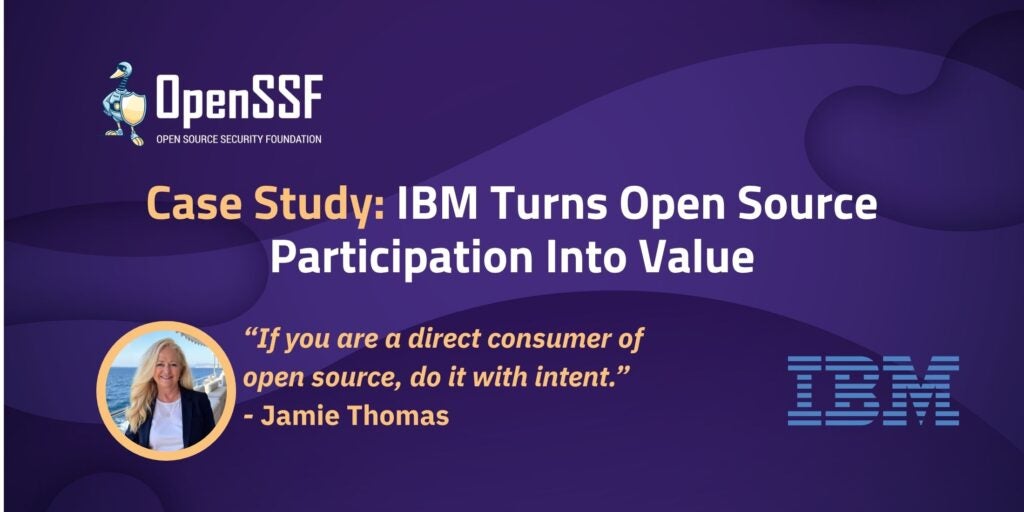
Case Study: How Does IBM Turn Open Source Participation Into Enterprise and Career Value?

IBM Enterprise Security Executive Jamie Thomas discusses how IBM’s historical journey with Java, Linux, and Red Hat shaped its strategy for turning open source software consumption into intentional stewardship, enterprise value, and career growth for developers. Through OpenSSF, that participation brings enterprise experience into a community working to secure the software upon which everyone depends. Learn more.

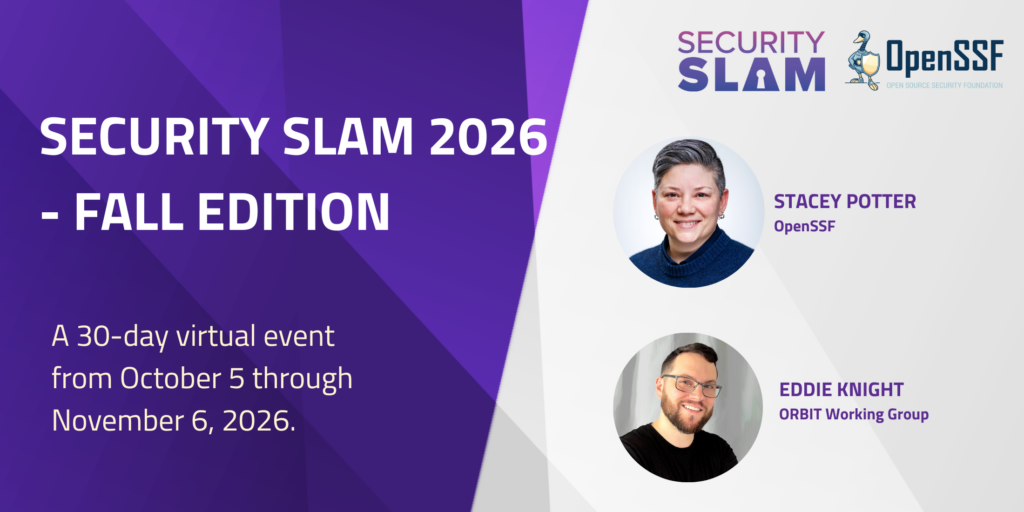
Security Slam 2026 – Fall Edition

OpenSSF and CNCF TAG Security are partnering on the fall Security Slam around KubeCon + CloudNativeCon North America. Learn how projects and contributors can take part.
Summer Mentorship Showcase

Meet emerging developers contributing to stronger software supply chain security through OpenSSF’s summer mentorship program. Read their stories.
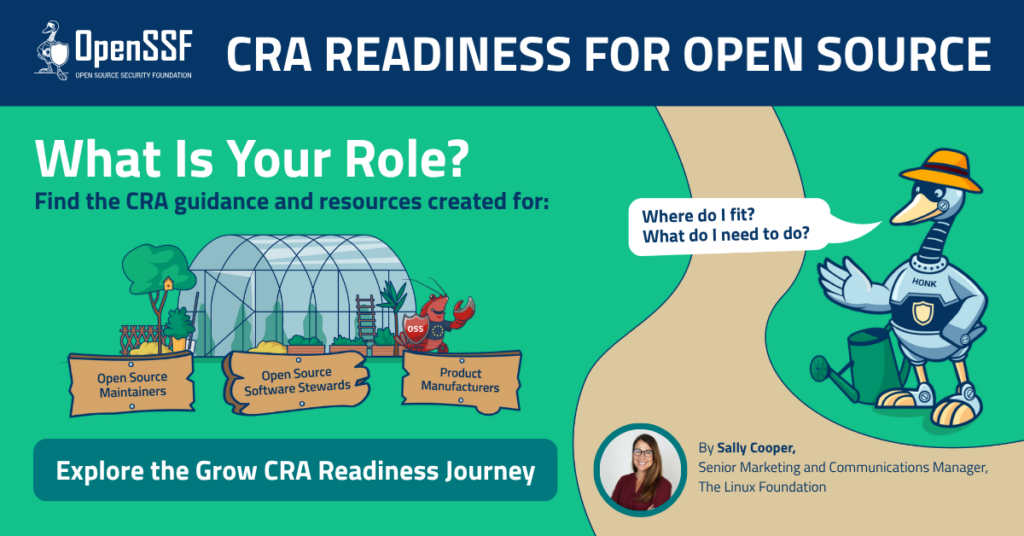
Grow CRA Readiness: Find Your Path Through the European Union Cyber Resilience Act

OpenSSF’s community garden journey helps maintainers, open source software stewards, and manufacturers identify the CRA guidance and resources relevant to their roles. Explore the journey and the community guide to the September 11 manufacturer reporting deadline. 
Empowering Open Source Security with Scalable Infrastructure

AWS describes how funding and scalable compute can support maintainers’ CI, fuzzing, testing, and artifact distribution. Read the guest blog.
A Community Guide to the EU CRA September 11 Deadline for Manufacturers

Discover key insights into the European Union Cyber Resilience Act (CRA) September 11, 2026 reporting obligations for manufacturers, alongside practical guidance enabling open source maintainers and stewards to streamline security response workflows. Read the community guide.
Open by Default After AI: The GDS Guidance and the Enforcement Question

The Government Digital Service (GDS) issued guidance reaffirming that public sector code should remain “open by default,” refuting NHS England’s decision to hide GitHub repositories over AI-driven vulnerability concerns by clarifying that opacity is not a valid substitute for proper security hygiene and rapid patching. Read here

What’s in the SOSS? An OpenSSF Podcast

#71 – S3E23 Navigating the New Era: The EU Cyber Resilience Act Explained with Madalin Neag
OpenSSF EU Policy Advisor Madalin Neag demystifies the EU Cyber Resilience Act (CRA). Learn how the CRA establishes a horizontal cybersecurity baseline for digital products. Listen now

#72 – S3E24 Balancing AI’s Double-Edged Sword: Software Engineering, Unlearning, and Ecosystem Sustainability with Mark Russinovich

Join Azure CTO and OpenSSF Board Chair Mark Russinovich as he discusses AI’s impact on software engineering, supply chain security, and vulnerability management. Listen now

#73 – S3E25 Securing the Source: Navigating AI Velocity, CRA Compliance, and Dependency Debt with Abby Kearns 

In this episode of What’s in the SOSS, ActiveState CEO Abby Kearns breaks down the rapidly evolving open source security landscape. Listen now

News from OpenSSF Community Meetings and Projects

  • Contribute in Prague: Project maintainers and contributors can lead 30-minute Lightning Learning sessions during OpenSSF Community Day Europe on October 6. Sign up for a session.
  • Volunteers at Open Source Summit Europe can take short shifts at the OpenSSF booth for demos and questions. Sign up for a booth shift.
  • OpenSSF Scorecard migrated its public infrastructure with AboutCode to AWS and published the scorecard-infra repository. Community-hosted Allstar ended in August; users should move to self-hosted Allstar.
  • Self-hosted Allstar instructions.
  • The TAC approved the sandbox application for a new SBOM & VEX Working Group. Read the application.
  • OpenBao released v2.7.0 beta with external KMS-backed keys, post-quantum support, and PostgreSQL read scalability; v2.6.2 includes security fixes. Beta release; stable release.
  • OpenBao v2.6.2 release.
  • gittuf v0.16.0 adds SHA-256 repository support, storage and TUI improvements, and key inspection tools. Release notes.
  • Zarf v0.85.0 adds v1beta1 component config publishing, OCI source prefixing, and Helm retry controls. Release notes.
  • Protobom v0.6.0 expanded SPDX support and serialization; v0.6.1 followed. v0.6.0; v0.6.1.
  • Gemara released go-gemara v0.10.0 and established repositories for GRC Store capabilities. Explore Gemara.
  • The Securing Software Repositories WG discussed npm’s post-quantum package-signature plans with Sigstore. Sigstore also released Rekor v1.5.4, including a hashedrekord CLI default and request hardening. Rekor release.
  • The AI/ML Security and Best Practices WGs completed an initial draft of Finding and Fixing Vulnerabilities using AI (LFD126). Course draft.
  • Security Insights launched a web-based Form & Wizard Editor for maintainers. Open the editor.
  • Model Signing merged its Open Model Signing Conformance Suite and is developing dataset-signing and multi-signature logging proposals.
  • Alpha-Omega continues its Security Engineer in Residence work with the Apache Software Foundation, Erlang Ecosystem Foundation, and OSTIF. ASF update; Erlang update; OSTIF update.
  • OpenSSF’s CRA community garden journey offers role-specific paths for maintainers, stewards, and manufacturers. Explore it.
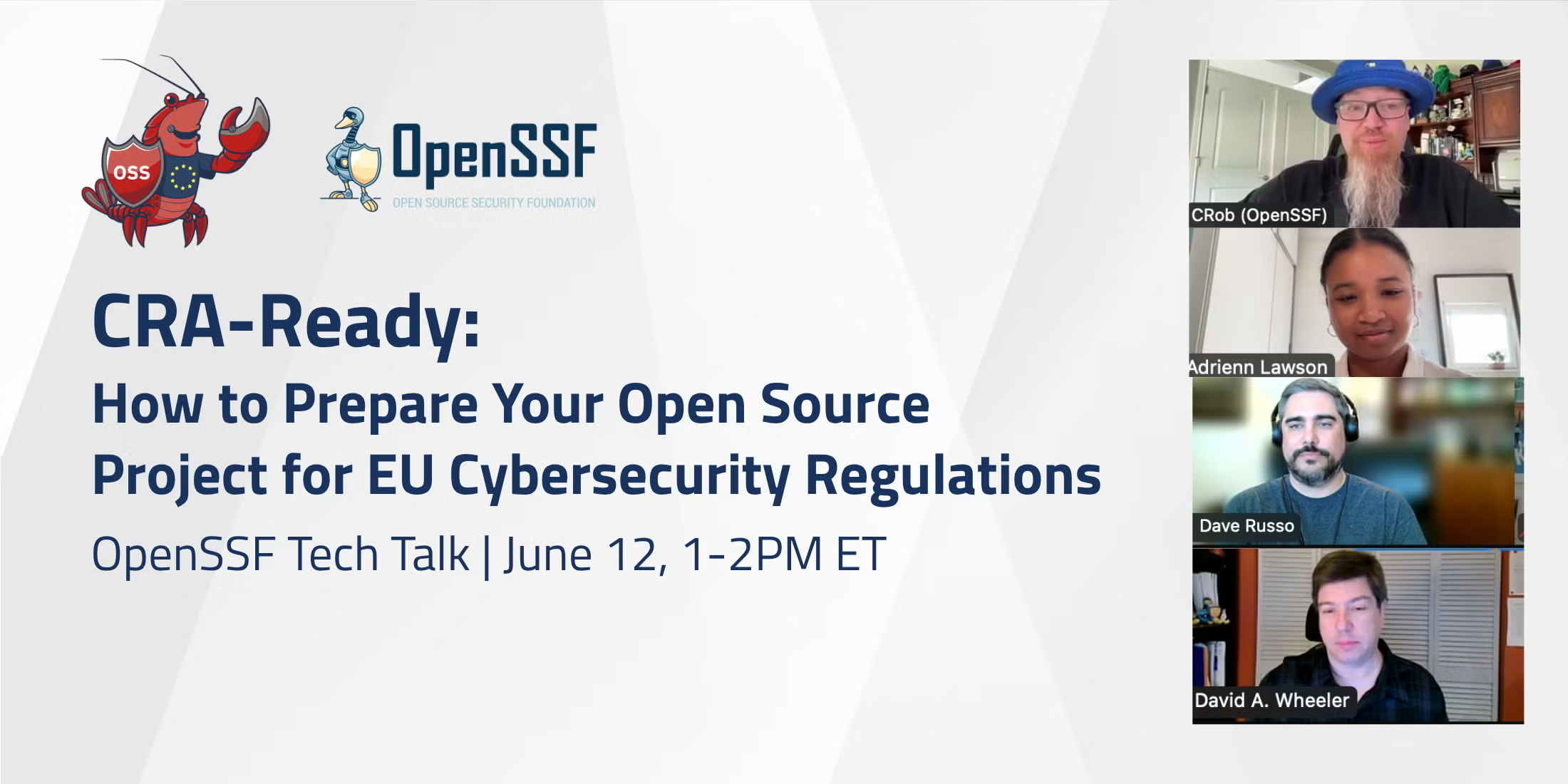
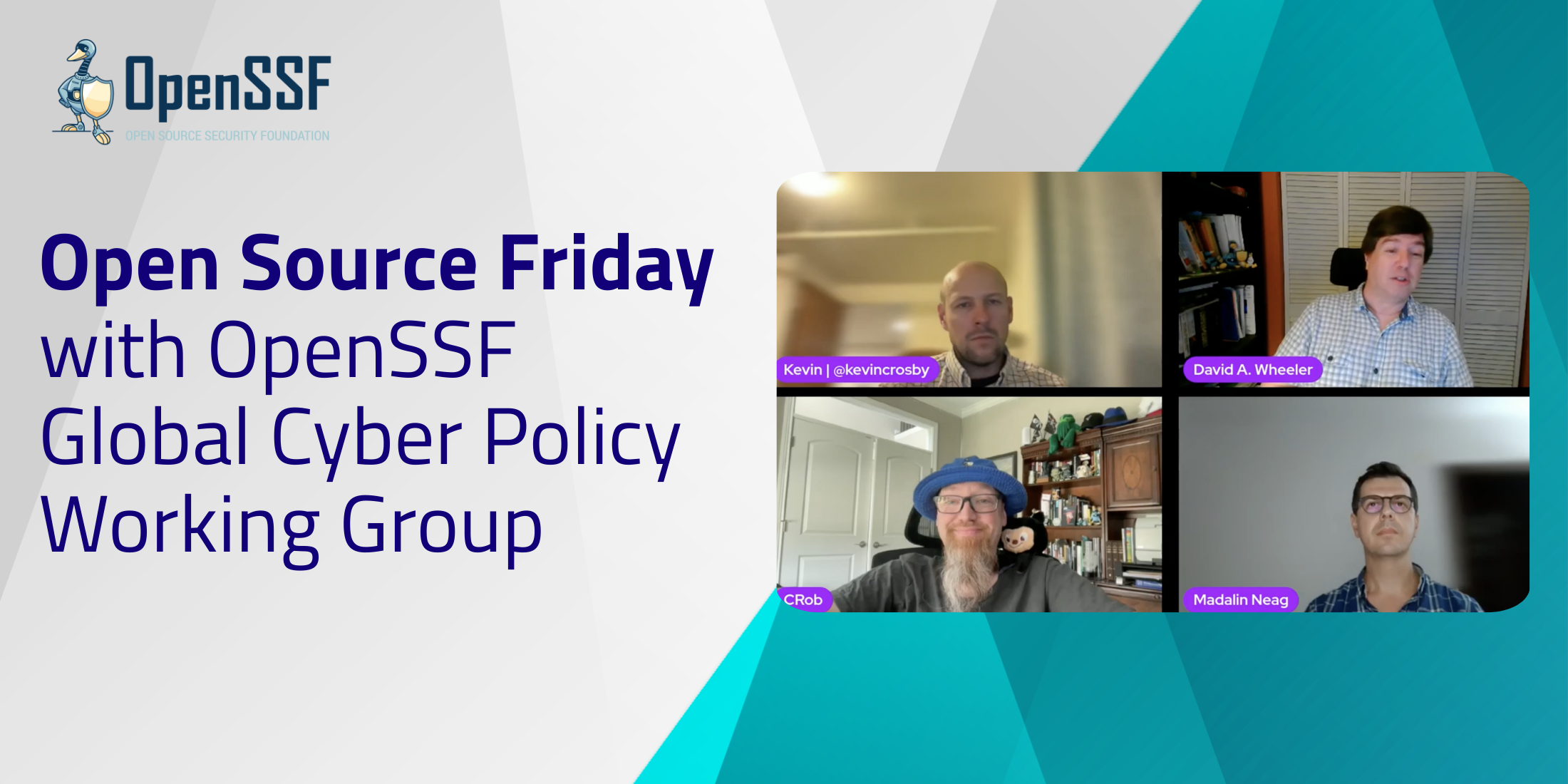
  • Recap and resources from the recent Global Cyber Policy Working Group’s CRA Tech Talk:
  • Upcoming community meetings.

Cybersecurity Policy & Regulatory Updates

Meet OpenSSF at These Upcoming Events!

  • OpenSSF Community Day Europe — October 6, Prague. Event details and registration.
  • Open Source Summit Europe — October 7–9, Prague. Event page.
    • Join the OpenSSF Global Cyber Policy Working Group for an interactive workshop (and boxed lunch!) at Open Source Summit Europe + Embedded Linux Conference, Friday October 9, 2026 12:45 – 14:00 CEST | Chamber Hall (Floor 3)
  • AGNTCon + MCPCon North America — October 20–23, San Jose. OpenSSF preview.
  • Open Source SecurityCon North America — November 9, Salt Lake City. Event page.
  • KubeCon + CloudNativeCon North America — November 9–12, Salt Lake City. Security Slam preview.
    • Meet OpenSSF & Zarf at Zarfest — November 11 | 6:30–9:30 p.m. Register

Ways to Participate

There are a number of ways for individuals and organizations to participate in OpenSSF. Learn more here.

You’re invited to…

Join a Working Group or Project

Chat with us on Slack

Follow us on X, Mastodon, Bluesky, and LinkedIn

Join OpenSSF

See You Next Month!

Missed an issue? Browse the newsletter archive. Send ideas for next month to marketing@openssf.org.

Regards,

The OpenSSF Team

December Newsletter - OpenSSF

OpenSSF Newsletter – December 2025

By Newsletter

Welcome to the December 2025 edition of the OpenSSF Newsletter! Here’s a roundup of the latest developments, key events, and upcoming opportunities in the Open Source Security community.

TL;DR:

🎁 2025 OpenSSF Annual Report

🎁 Free OpenSSF and Linux Foundation Education Courses

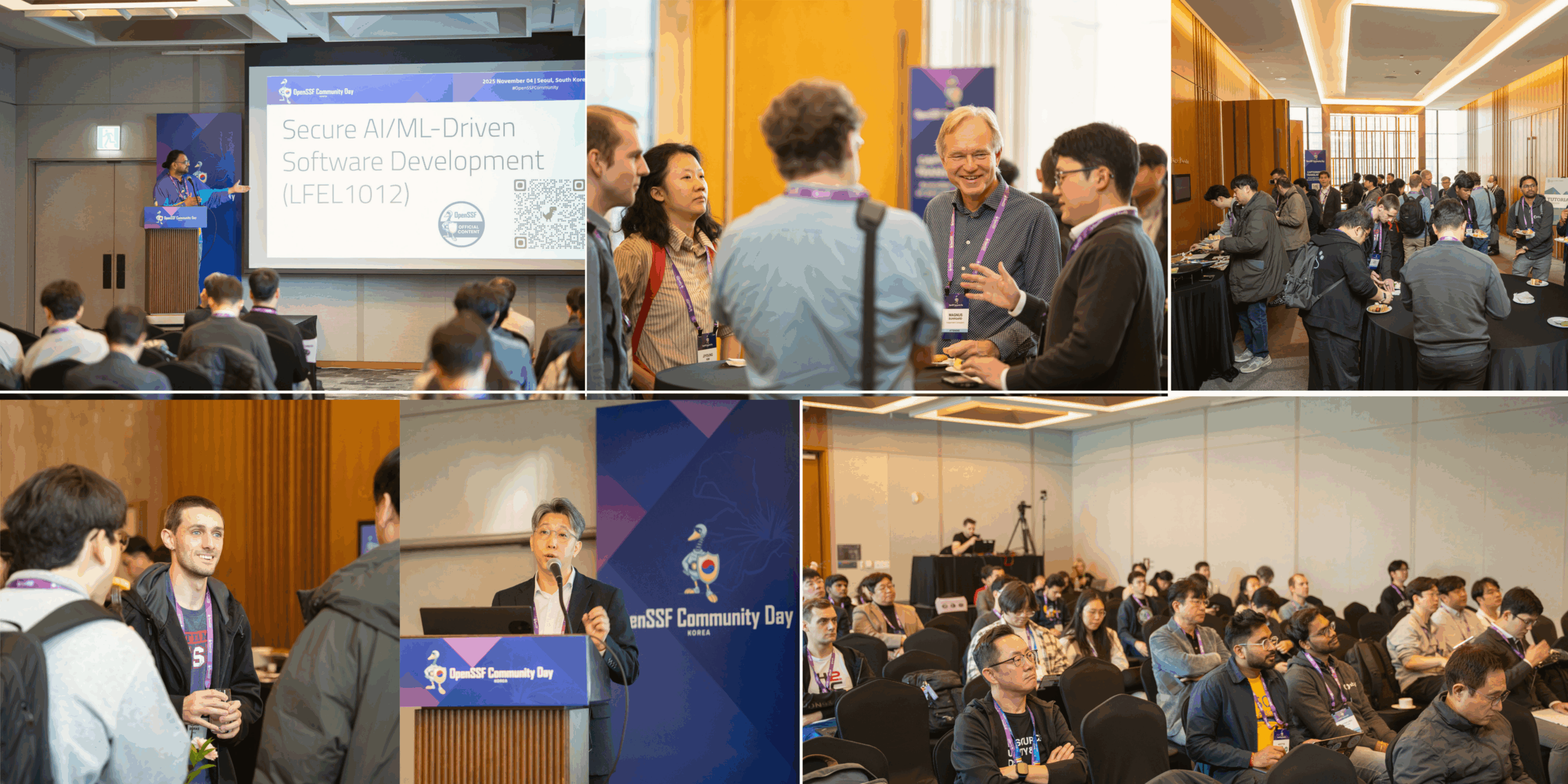
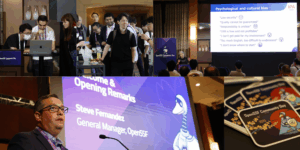
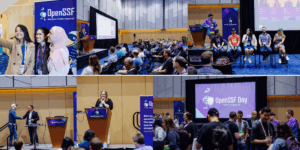
☃️ Recap: OpenSSF Community Day Korea 2025

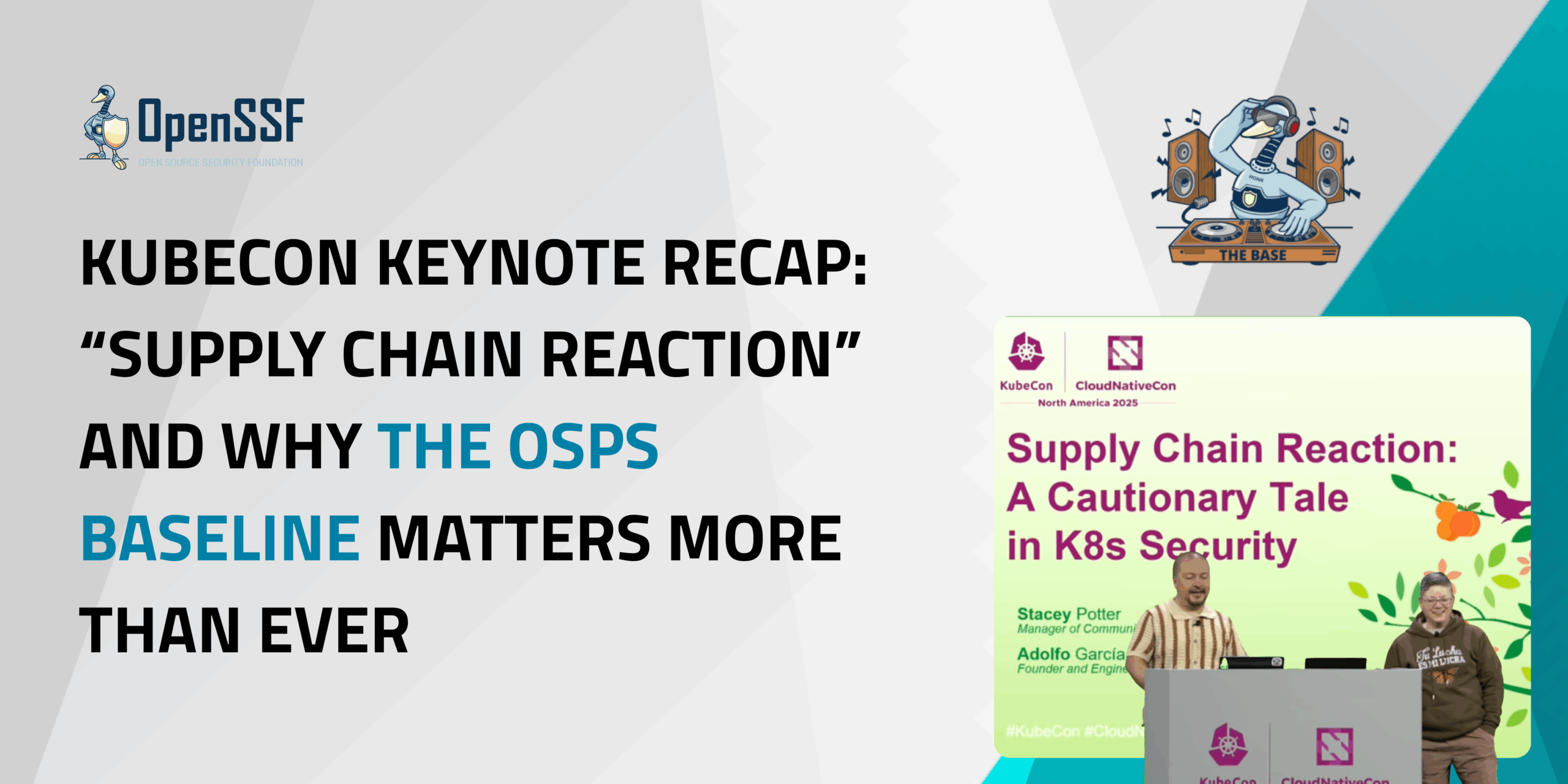
☃️ KubeCon Keynote Recap

☃️ OpenSSF at OSPOlogyLive Europe

☃️ New podcast episodes (#46–47): AI, open source & collaboration (Jay White, Microsoft) and supply chain security in academia (Justin Cappos, NYU)

❄️ Alpha-Omega strengthened SBOM tooling and FreeBSD security

❄️ Gemara site launched

❄️ SecurityCon NA session videos now online

❄️ SLSA v1.2 adds a new Source Track

❄️ OpenBao v2.4.4 released

❄️ Upcoming events: FOSDEM (31 Jan & 1 Feb 2026), Open Source SecurityCon (23 March 2026), KubeCon+CloudNativeCon Europe (23-26, March 2026)

2025 OpenSSF Annual Report

2025 OpenSSF Annual Report

Discover how the open source security community moved forward in 2025. The OpenSSF Annual Report highlights major achievements in education, tooling, vulnerability management, research, and global collaboration with insights from leadership and working groups. It’s a powerful look at how far we’ve come and where we’re headed as we work together to strengthen the security of open source software.

Download the 2025 OpenSSF Annual Report and explore the progress, impact, and vision shaping the future of open source security.

Blogs: What’s New in the OpenSSF Community?

From Beginner to Builder: Free OpenSSF and Linux Foundation Education Courses

From Beginner to Builder: Free OpenSSF and Linux Foundation Education Courses

Level up your open source security skills with this practical roundup from Ejiro Oghenekome and Sal Kimmich, CSM, a curated list of free, self-paced Linux Foundation Education and OpenSSF courses built for developers who want to contribute with confidence. From secure coding and threat modeling to OpenSSF Scorecard automation, SBOMs/signatures, and even essential context like ethics, inclusion, and new regulations, this blog post maps out clear learning paths you can start right away, before (or alongside) your next contribution. Read the blog.

Recap: OpenSSF Community Day Korea 2025

Recap: OpenSSF Community Day Korea 2025

OpenSSF Community Day Korea 2025, held on November 4 in Seoul, brought developers and security engineers together for practical sessions on open source and software supply chain security. Talks spanned CI/CD hardening, SBOM-driven tooling, Linux kernel testing, post-quantum cryptography, and AI/ML security, all framed by OpenSSF’s pillars of Education, Policy, Projects, and Community. The event marked a strong start for a growing OpenSSF community in Korea, with public, private, and academic stakeholders aligning around the message that securing open source is shared work. Read the recap blog.

KubeCon Keynote Recap: “Supply Chain Reaction” and Why the OSPS Baseline Matters More Than Ever

KubeCon Keynote Recap: “Supply Chain Reaction” and Why the OSPS Baseline Matters More Than Ever

How can a Kubernetes cluster with zero known vulnerabilities still be compromised?

In their KubeCon keynote “Supply Chain Reaction: A Cautionary Tale in K8s Security,” Stacey Potter (Community Manager, OpenSSF) and Adolfo García Veytia (Founder and Engineer, Carabiner Systems) walked through a realistic incident where a compromised compiler image injected a crypto-mining payload long before workloads reached the cluster, bypassing traditional defenses. They showed how tools like SLSA, Sigstore, Kyverno, and Ampel help secure the entire software lifecycle, and why the new Open Source Project Security (OSPS) Baseline with its eight control families and three maturity levels gives projects a practical, stepwise framework to resist invisible supply-chain attacks. 

The talk makes a clear case: adopting the OSPS Baseline is now essential for any open source project that wants real, preventative supply-chain security. Learn more.

OpenSSF Projects in Less Than 5 Minutes

Short on time but curious about open source security tools? This video series features quick interviews with OpenSSF maintainers, giving you a fast, developer-focused look at the projects, standards, and initiatives they’re building. Hear directly from the people behind the code and discover which tools you might want to try next. Watch the videos here.

OpenSSF at OSPOlogyLive Europe

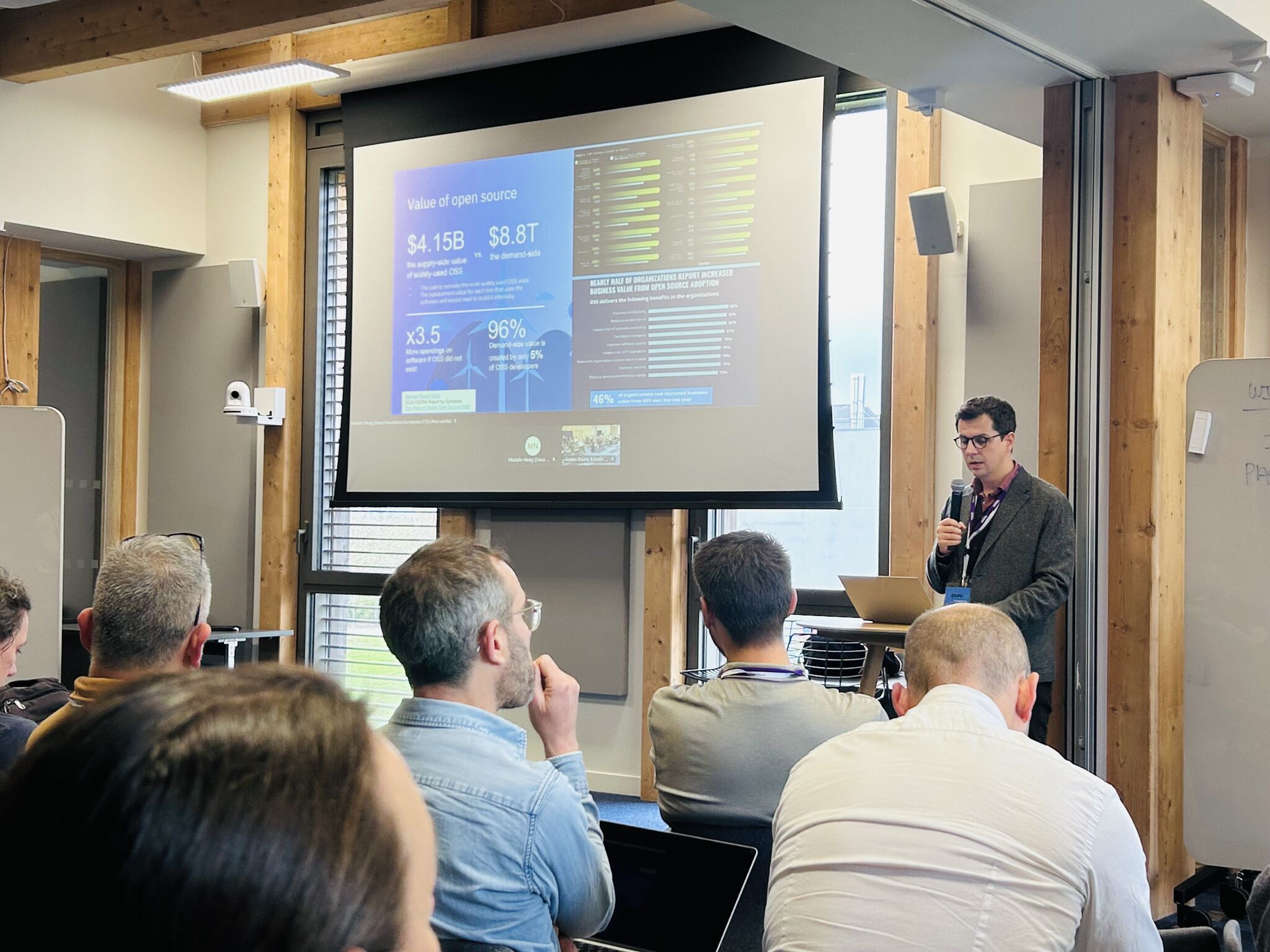
Madalin Neag, EU Policy Advisor, OpenSSF giving a talk at OSPOlogyLive Europe

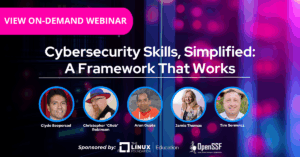
Madalin Neag, EU Policy Advisor at OpenSSF participated in OSPOlogyLive Europe, where he presented The Cybersecurity Skills Framework presentation and discussed why securing software requires investing in people and shared security knowledge, not just technology. The session highlighted OpenSSF’s leadership in building practical, role-based security capabilities across engineering teams. The framework provides a clear, actionable map for identifying security skill gaps and prioritizing capability development across the software ecosystem. It also demonstrated how organizations can use a common language for security skills to systematically improve their cybersecurity posture.”

What’s in the SOSS? An OpenSSF Podcast:

#47 – S2E24 Teaching the Next Generation: Software Supply Chain Security in Academia with Justin Cappos

On the latest episode of What’s in the SOSS, host Yesenia Yser sits down with Justin Cappos, professor at NYU Tandon School of Engineering, to discuss why software supply chain security is still missing from many university curricula and how hands on, open source first education can better prepare students for real world security work.

The conversation explores gaps in traditional computer science education, the importance of teaching open source collaboration, and how initiatives like the Linux Foundation’s Academic Computing Accreditation Program are helping institutions modernize security education.

🎧 Listen to the episode and learn more about the Academic Computing Accreditation Program: https://www.linuxfoundation.org/academic-computing-accreditation

#46 – S2E23 Securing the Future: AI, Open Source, and Collaboration with Jay White (Microsoft)

In this episode of What’s in the SOSS? Jay White from Microsoft’s Azure office of the CTO joins to talk about his path into open source and how it led him to focus on AI, machine learning, and security. He explains how model signing and transparency are becoming core to trustworthy AI, and shares ongoing work in OpenSSF and the Coalition for Secure AI (CoSAI) to build standards for AI supply chain security. The conversation touches on the challenges of cultural representation in AI models, why collaboration across companies and communities is essential, and how practitioners can get involved. Jay also reflects on the importance of community building and continuous learning as AI and open source evolve together.

News from OpenSSF Community Meetings and Projects:

In the News:

  • Dark Reading published expert commentary from Christopher Robinson after speaking to him about OpenSSF’s work categorizing 150,000 malicious npm packages. CRob notes the importance of MFA and artifact signing to verify that code is secure here: “Infamous Shai-hulud Worm Resurfaces From the Depths.”
  • In a Forbes article about the value of inclusive and resilient financial systems, Christopher Robinson of OpenSSF and Michael Lieberman of Kusari are included for their thoughts on secure fintech systems. Both suggest that open source software can play an important role in the future of finance, down to the code, and the Open Software Security Baseline is referenced in the article, “Secure By Design: Financial Systems For Climate Resilience.”
  • This month VMblog published Christopher Robinson’s cybersecurity predictions for 2026. CRob points out the importance of MLSecOps, SBOMs, and more in the article, “Five cybersecurity predictions for 2026.” 

Meet OpenSSF at These Upcoming Events!

Connect with the OpenSSF Community at these key events:

Ways to Participate:

There are a number of ways for individuals and organizations to participate in OpenSSF. Learn more here.

You’re invited to…

See You Next Month! 

We want to get you the information you most want to see in your inbox. Missed our previous newsletters? Read here!

Have ideas or suggestions for next month’s newsletter about the OpenSSF? Let us know at marketing@openssf.org, and see you next month! 

Regards,

The OpenSSF Team

November Newsletter - OpenSSF

OpenSSF Newsletter – November 2025

By Newsletter

Welcome to the November 2025 edition of the OpenSSF Newsletter! Here’s a roundup of the latest developments, key events, and upcoming opportunities in the Open Source Security community.

TL;DR:

✅ Cyber week: Free + discounted security courses to level up fast

✅ EU CRA insights and OSS security guidance from Open Source Security Week in Belgium

✅ OSS security best practices for finance from OSFF NYC

✅ New OpenSSF members, awards, and project milestones

✅ New podcast episodes (#44-45): OSPS Security Baseline and SBOM Chaos and Software Sovereignty

✅ SBOM Coffee Club reviewed OWASP AIBOM

✅ Zarf v0.65.1 adds broader K8s support & hosts Tech talk

✅ OpenBao advancing read-replication

✅ Upcoming events: FOSDEM (31 Jan & 1 Feb 2026), Open Source SecurityCon (23 March 2026), KubeCon+CloudNativeCon Europe (23-26, March 2026)

Level Up Your Open Source Security Skills for Cyber Week

Cyber week - OpenSSF

OpenSSF and Linux Foundation Education are committed to making world-class security training accessible to everyone. Whether you are securing critical open source projects, preparing for new regulations, or building foundational expertise, you can start today with free e-learning courses and earn digital badges along the way. Explore offerings like Developing Secure Software (LFD121), Security for Software Development Managers (LFD125), Understanding the EU Cyber Resilience Act (LFEL1001), Secure AI/ML-Driven Software Development (LFEL1012), and many others designed to strengthen software resilience across the ecosystem.

If you are ready to go deeper, Cyber Week kicks off December 1. This brings the biggest savings of the year from Linux Foundation Education. From certification bundles to instructor-led courses and subscription packages, you can save up to 65 percent and accelerate your career heading into 2026.

Visit LF Education starting on December 1st to grab the best savings of the year!

Start learning for free. Level up for less. Strengthen the security of the open source world.

Blogs: What’s New in the OpenSSF Community?

Recap: Open Source Security Week in Belgium – Highlights from Ghent to Brussels

Open Source Security events in Belgium - October

At the end of October, Linux Foundation Europe, OpenSSF, and CEPS hosted a week of open source security activities across Ghent and Brussels. Developers, maintainers, policymakers, and security experts came together to break down the Cyber Resilience Act, share practical readiness guidance, and align on how Europe can strengthen software security without slowing open collaboration. From technical workshops to policy-driven discussions, the week highlighted both the challenges ahead and the growing support available to the community. Read the full recap for key takeaways, reflections, and ways to get involved.

Building Security in Open Source for Financial Services: OpenSSF at Open Source Finance Forum (OSFF) NYC

OpenSSF at Open Source in Finance Forum - New York 2025 - Recap blog

OpenSSF joined the Open Source in Finance Forum (OSFF) NYC to highlight how financial institutions can confidently rely on open source while managing real security risks. Through sessions on AI security, project security baselines, and stabilizing vulnerability data pipelines, OpenSSF showed how collaboration between maintainers, regulators, and industry engineers leads to practical solutions that strengthen the software powering today’s financial systems. Read the full recap to explore the key takeaways and resources shared at OSFF.

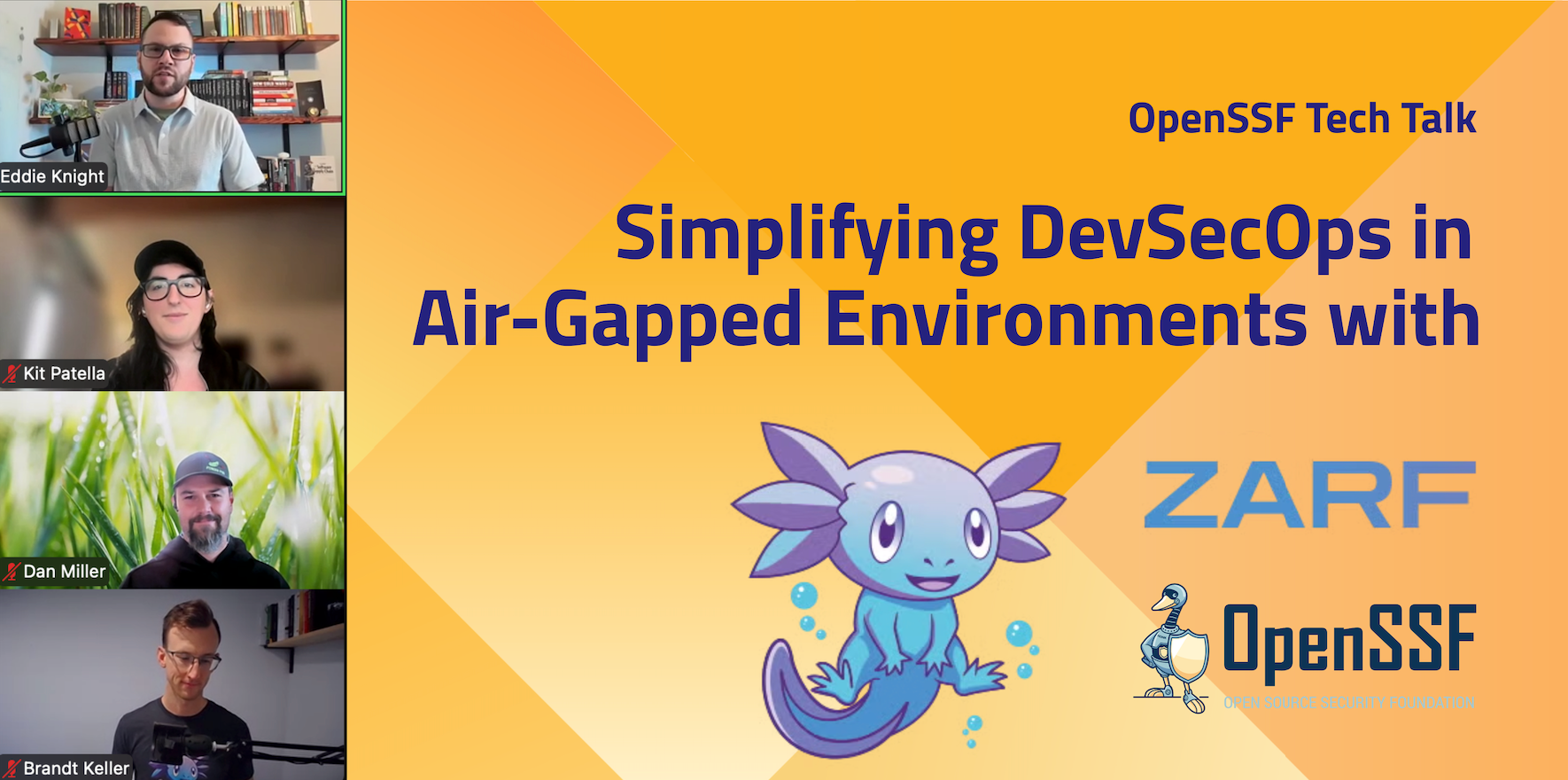
Tech Talk Recap: Simplifying DevSecOps in Air-Gapped Environments with Zarf

Tech Talk Recap: Simplifying DevSecOps in Air-Gapped Environments with Zarf

In the latest OpenSSF Tech Talk, we focused on a significant hurdle in software supply chain security: managing software delivery and upkeep within air-gapped and restricted network environments. You can now view the recording on the OpenSSF YouTube channel, and the presentation slides are accessible here.

OpenSSF Announces Key Membership Growth and Golden Egg Award Winners at Open Source SecurityCon North America

The Open Source Security Foundation (OpenSSF) announced new and expanded memberships at Open Source SecurityCon North America, welcoming Target Corporation and Thread AI, and celebrating OSTIF’s upgrade to general member status. The community also recognized standout contributors with the latest Golden Egg Awards and highlighted recent progress across learning resources, tooling, and global events. Read the blog to learn more about the membership updates, award winners, and milestones from the past quarter.

Here you will find a snapshot of what’s new on the OpenSSF blog. For more stories, ideas, and updates, visit the blog section on our website.

What’s in the SOSS? An OpenSSF Podcast:

#44 – S2E21 A Deep Dive into the Open Source Project Security (OSPS) Baseline

In this episode of What’s in the SOSS? CRob, Ben Cotton, and Eddie Knight take a practical look at the Open Source Project Security (OSPS) Baseline, a shared security checklist designed to help maintainers communicate the current state of their project’s security practices. They break down how the baseline fits into real workflows, why clear documentation builds trust, and how downstream users benefit when expectations are aligned. The conversation also explores integrations with other OpenSSF efforts, lessons from the GUAC case study, and what’s ahead as the community continues to refine the framework and expand tooling support.

#45 – S2E22 SBOM Chaos and Software Sovereignty with Canonical’s Stephanie Domas

In this episode of What’s in the SOSS, CRob talks with Stephanie Domas, Chief Security Officer at Canonical, about the hidden challenges shaping today’s open source ecosystem. Stephanie breaks down why third party patches disrupt SBOM accuracy, how software sovereignty is influencing global procurement, and what the EU CRA means for enterprises working with upstream dependencies. She also shares insights on memory safe upgrades in Ubuntu’s next LTS and why transparency, collaboration, and community support are critical to building trust in open source.

News from OpenSSF Community Meetings and Projects:

In the News:

Meet OpenSSF at These Upcoming Events!

Connect with the OpenSSF Community at these key events:

Ways to Participate:

There are a number of ways for individuals and organizations to participate in OpenSSF. Learn more here.

You’re invited to…

See You Next Month!

We want to get you the information you most want to see in your inbox. Missed our previous newsletters? Read here!

Have ideas or suggestions for next month’s newsletter about the OpenSSF? Let us know at marketing@openssf.org, and see you next month! 

Regards,

The OpenSSF Team

OpenSSF Newsletter – September 2025

By Newsletter

Welcome to the September 2025 edition of the OpenSSF Newsletter! Here’s a roundup of the latest developments, key events, and upcoming opportunities in the Open Source Security community.

TL;DR:

🎉 Big week in Amsterdam: Recap of OpenSSF at OSSummit + OpenSSF Community Day Europe.

🥚 Golden Egg Awards shine on five amazing community leaders.

✨ Fresh resources: AI Code Assistant tips and SBOM whitepaper.

🤝 Trustify + GUAC = stronger supply chain security.

🌍 OpenSSF Community Day India: 230+ open source enthusiasts packed the room.

🎙 New podcasts: AI/ML security + post-quantum race.

🎓 Free courses to level up your security skills.

📅 Mark your calendar and join us for Community Events.

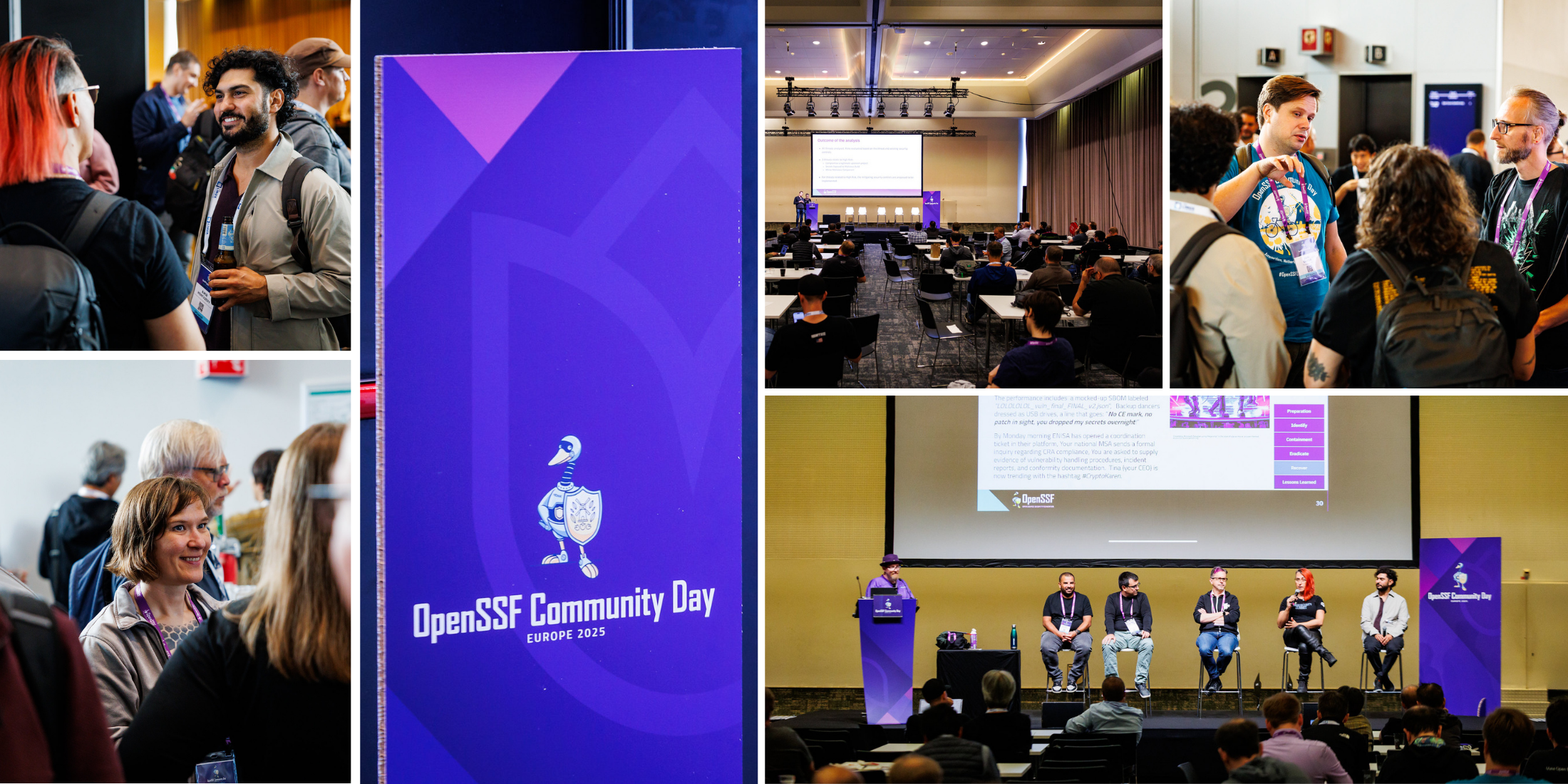
Celebrating the Community: OpenSSF at Open Source Summit and OpenSSF Community Day Europe Recap

From August 25–28, 2025, the Linux Foundation hosted Open Source Summit Europe and OpenSSF Community Day Europe in Amsterdam, bringing together developers, maintainers, researchers, and policymakers to strengthen software supply chain security and align on global regulations like the EU Cyber Resilience Act (CRA). The week included strong engagement at the OpenSSF booth and sessions on compliance, transparency, proactive security, SBOM accuracy, and CRA readiness. 
OpenSSF Community Day Europe celebrated milestones in AI security, public sector engagement, and the launch of Model Signing v1.0, while also honoring five community leaders with the Golden Egg Awards. Attendees explored topics ranging from GUAC+Trustify integration and post-quantum readiness to securing GitHub Actions, with an interactive Tabletop Exercise simulating a real-world incident response. 

These gatherings highlighted the community’s progress and ongoing commitment to strengthening open source security. Read more.

OpenSSF Celebrates Global Momentum, AI/ML Security Initiatives and Golden Egg Award Winners at Community Day Europe

At OpenSSF Community Day Europe, the Open Source Security Foundation honored this year’s Golden Egg Award recipients. Congratulations to Ben Cotton (Kusari), Kairo de Araujo (Eclipse Foundation), Katherine Druckman (Independent), Eddie Knight (Sonatype), and Georg Kunz (Ericsson) for their inspiring contributions.

With exceptional community engagement across continents and strategic efforts to secure the AI/ML pipeline, OpenSSF continues to build trust in open source at every level.

Read the full press release to explore the achievements, inspiring voices, and what’s next for global open source security.

Blogs: What’s New in the OpenSSF Community?

Here you will find a snapshot of what’s new on the OpenSSF blog. For more stories, ideas, and updates, visit the blog section on our website.

Open Source Friday with OpenSSF – Global Cyber Policy Working Group

On August 15, 2025, GitHub’s Open Source Friday series spotlighted the OpenSSF Global Cyber Policy Working Group (WG) and the OSPS Baseline in a live session hosted by Kevin Crosby, GitHub. The panel featured OpenSSF’s Madalin Neag (EU Policy Advisor), Christopher Robinson (CRob) (Chief Security Architect) and David A. Wheeler (Director of Open Source Supply Chain Security) who discussed how the Working Group helps developers, maintainers, and policymakers navigate global cybersecurity regulations like the EU Cyber Resilience Act (CRA). 

The conversation highlighted why the WG was created, how global policies affect open source, and the resources available to the community, including free training courses, the CRA Brief Guide, and the Security Baseline Framework. Panelists emphasized challenges such as awareness gaps, fragmented policies, and closed standards, while underscoring opportunities for collaboration, education, and open tooling. 

As the CRA shapes global standards, the Working Group continues to track regulations, engage policymakers, and provide practical support to ensure the open source community is prepared for evolving cybersecurity requirements. Learn more and watch the recording.

Improving Risk Management Decisions with SBOM Data

SBOMs are becoming part of everyday software practice, but many teams still ask the same question: how do we turn SBOM data into decisions we can trust? 

Our new whitepaper, “Improving Risk Management Decisions with SBOM Data,” answers that by tying SBOM information to concrete risk-management outcomes across engineering, security, legal, and operations. It shows how to align SBOM work with real business motivations like resiliency, release confidence, and compliance. It also describes what “decision-ready” SBOMs look like, and how to judge data quality. To learn more, download the Whitepaper.

Trustify joins GUAC

GUAC and Trustify are combining under the GUAC umbrella to tackle the challenges of consuming, processing, and utilizing supply chain security metadata at scale. With Red Hat’s contribution of Trustify, the unified community will serve as the central hub within OpenSSF for building and using supply chain knowledge graphs, defining standards, developing shared infrastructure, and fostering collaboration. Read more.
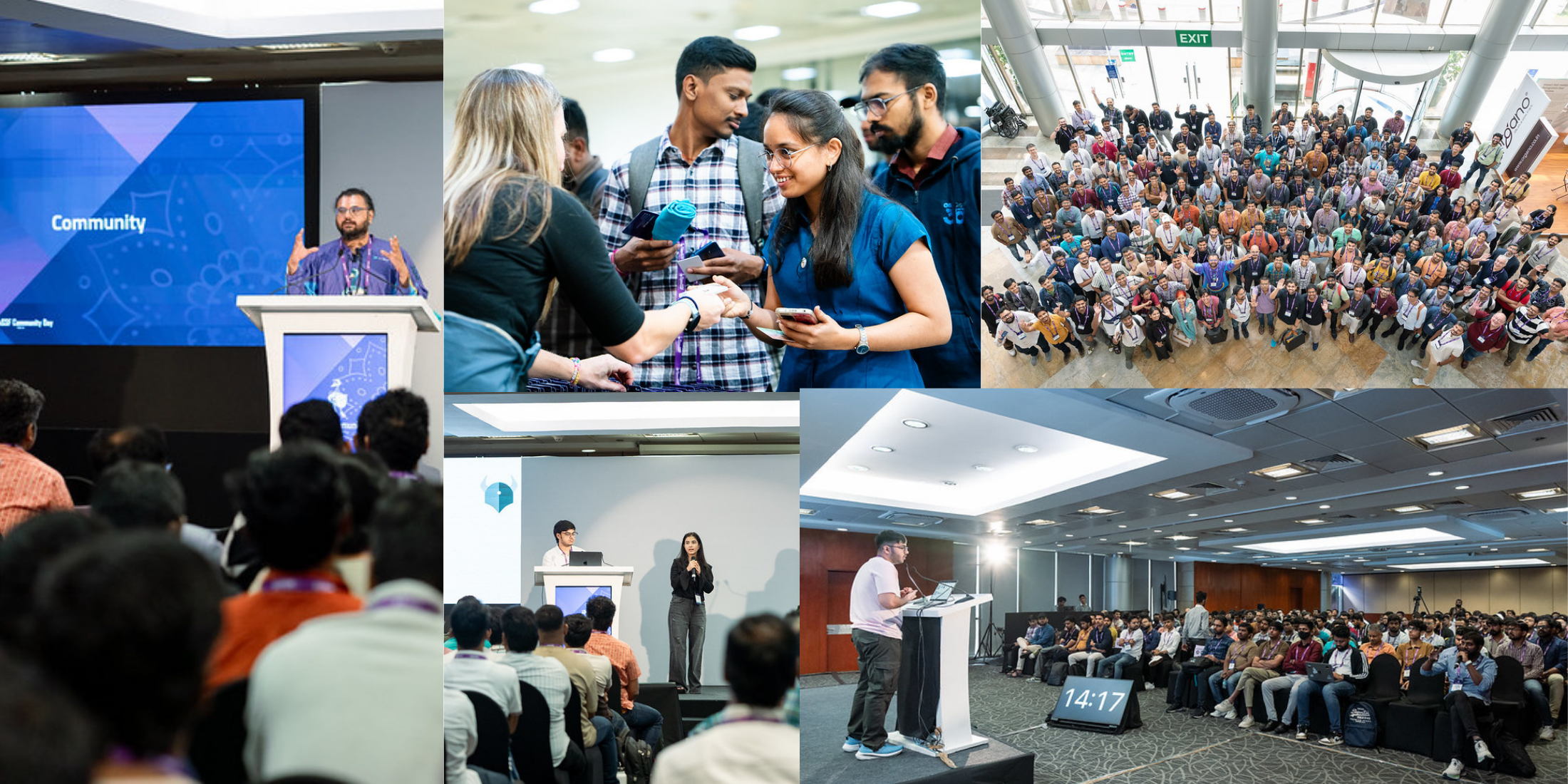
Recap: OpenSSF Community Day India 2025

On August 4, 2025, OpenSSF hosted its second Community Day India in Hyderabad, co-located with KubeCon India. With 232 registrants and standing-room-only attendance, the event brought together open source enthusiasts, security experts, engineers, and students for a full day of learning, collaboration, and networking.
The event featured opening remarks from Ram Iyengar (OpenSSF Community Engagement Lead, India), followed by technical talks on container runtimes, AI-driven coding risks, post-quantum cryptography, supply chain security, SBOM compliance, and kernel-level enforcement. Sessions also highlighted tools for policy automation, malicious package detection, and vulnerability triage, as well as emerging approaches like chaos engineering and UEFI secure boot.

The event highlighted India’s growing role in global open source development and the importance of engaging local communities to address global security challenges. Read more.

New OpenSSF Guidance on AI Code Assistant Instructions

In our recent blog, Avishay Balter, Principal SWE Lead at Microsoft and David A. Wheeler, Director, Open Source Supply Chain Security at OpenSSF introduce the OpenSSF “Security-Focused Guide for AI Code Assistant Instructions.” AI code assistants can speed development but also generate insecure or incorrect results if prompts are poorly written. The guide, created by the OpenSSF Best Practices and AI/ML Working Groups with contributors from Microsoft, Google, and Red Hat, shows how clear and security-focused instructions improve outcomes. It stands as a practical resource for developers today, while OpenSSF also develops a broader course (LFEL1012) on using AI code assistants securely. 

This effort marks a step toward ensuring AI helps improve security instead of undermining it. Read more.

Open Infrastructure Is Not Free: A Joint Statement on Sustainable Stewardship

Public package registries and other shared services power modern software at global scale, but most costs are carried by a few stewards while commercial-scale users often contribute little. Our new open letter calls for practical models that align usage with responsibility — through partnerships, tiered access, and value-add options — so these systems remain strong, secure, and open to all.
Signed by: OpenSSF, Alpha-Omega, Eclipse Foundation (Open VSX), OpenJS Foundation, Packagist (Composer), Python Software Foundation (PyPI), Rust Foundation (crates.io), Sonatype (Maven Central).

Read the open letter.

What’s in the SOSS? An OpenSSF Podcast:

#38 – S2E15 Securing AI: A Conversation with Sarah Evans on OpenSSF’s AI/ML Initiatives

In this episode of What’s in the SOSS, Sarah Evans, Distinguished Engineer at Dell Technologies, discusses extending secure software practices to AI. She highlights the AI Model Signing project, the MLSecOps whitepaper with Ericsson, and efforts to identify new personas in AI/ML operations. Tune in to hear how OpenSSF is shaping the future of AI security.

#39 – S2E16 Racing Against Quantum: The Urgent Migration to Post-Quantum Cryptography with KeyFactor’s Crypto Experts

In this episode of What’s in the SOSS, host Yesenia talks with David Hook and Tomas Gustavsson from Keyfactor about the race to post-quantum cryptography. They explain quantum-safe algorithms, the importance of crypto agility, and why sectors like finance and supply chains are leading the way. Tune in to learn the real costs of migration and why organizations must start preparing now before it’s too late.

Education:

The Open Source Security Foundation (OpenSSF), together with Linux Foundation Education, provides a selection of free e-learning courses to help the open source community build stronger software security expertise. Learners can earn digital badges by completing offerings such as:

These are just a few of the many courses available for developers, managers, and decision-makers aiming to integrate security throughout the software development lifecycle.

News from OpenSSF Community Meetings and Projects:

In the News:

Meet OpenSSF at These Upcoming Events!

Join us at OpenSSF Community Day in South Korea!

OpenSSF Community Days bring together security and open source experts to drive innovation in software security.

Connect with the OpenSSF Community at these key events:

Ways to Participate:

There are a number of ways for individuals and organizations to participate in OpenSSF. Learn more here.

You’re invited to…

See You Next Month! 

We want to get you the information you most want to see in your inbox. Missed our previous newsletters? Read here!

Have ideas or suggestions for next month’s newsletter about the OpenSSF? Let us know at marketing@openssf.org, and see you next month! 

Regards,

The OpenSSF Team

OpenSSF Newsletter – August 2025

By Newsletter

Welcome to the August 2025 edition of the OpenSSF Newsletter! Here’s a roundup of the latest developments, key events, and upcoming opportunities in the Open Source Security community.

TL;DR:

🎉 OpenSSF Turns 5.

✨ New MLSecOps whitepaper.

🔍 Case Study: GUAC security validated in <1hr w/Baseline.

📝 Blogs: OpenSSF Community and Working Groups, AI security, AIxCC wins.

🎙 Podcasts: OSTIF audits, CRA in Erlang Community.

🎓 Free security courses.

📅 Events: OpenSSF Community Day Europe, Linux Foundation Europe Member Summit, Open Source in Finance Forum New York, Linux Foundation Europe Roadshow, European Open Source Security Forum (link coming soon), OpenSSF Community Day Korea, Open Source SecurityCon 2025 

🎉 Celebrating Five Years of OpenSSF: A Journey Through Open Source Security

August 2025 marks five years since the official formation of the Open Source Security Foundation (OpenSSF). From uniting global efforts to securing open source software, to launching initiatives like Sigstore, OpenSSF Scorecard, Alpha-Omega, SLSA, and the OSPS Baseline, OpenSSF has moved from ideas to impact – shaping the future of software supply chain security.

This milestone isn’t just a celebration of what we have accomplished, but of the community we have built together. Here’s to five years of uniting communities, hardening the software supply chain, and driving a safer digital future.

Read the full blog to explore the journey, voices, and vision that continue to shape OpenSSF’s impact.

✨Community Highlight: Whitepaper: Visualizing Secure MLOps (MLSecOps): A Practical Guide for Building Robust AI/ML Pipeline Security

We want to give a shout out to Sarah Evans (Dell Technologies), Andrey Shorov (Ericsson) and the entire AI/ML Security Working Group for their outstanding contributions through OpenSSF, advancing secure AI/ML practices and delivering industry leadership in building robust AI/ML pipeline security.

Their new whitepaper, “Visualizing Secure MLOps (MLSecOps): A Practical Guide for Building Robust AI/ML Pipeline Security,” expands on Ericsson’s MLSecOps framework into a comprehensive, visual, “layer-by-layer” guide. It shows how to apply open source tools like SLSA, Sigstore, and OpenSSF Scorecard to secure the ML lifecycle offering mapped risks, security controls, reference architecture, and practical tools.

This is a must-read for anyone designing, developing, deploying, or securing AI/ML systems.

Read the whitepaper and the blog to see how OpenSSF members are shaping the future of trustworthy AI.

🔍Case Study: How LFX Insights and OSPS Baseline Validated GUAC’s Security in Under an Hour

How can a project like GUAC validate its strong security posture in under an hour?

Kusari used LFX Insights integrated with the OpenSSF OSPS Baseline to run a rapid, automated assessment of GUAC’s security posture. In less than an hour, evidence of strong security practices was compiled automatically, results were presented in a clear visual format, and findings were instantly aligned to major frameworks like NIST SSDF and the EU Cyber Resilience Act. The result was faster trust, reduced workload, and a smoother path for adoption.

Project leaders and community voices including Mike Lieberman (Kusari), Ben Cotton (Kusari), Eddie Knight (Sonatype), and Mihai Maruseac (Google) emphasized the value of this approach. They highlighted how OSPS Baseline makes security proof more visible, reduces repetitive effort, saves time for maintainers, and builds confidence among OSPO leads and end users.

Read the full case study to see how LFX Insights and OSPS Baseline created a blueprint for faster, more credible security assurance.

Blogs: What’s New at the OpenSSF Community?

Here you will find a snapshot of what’s new on the OpenSSF blog. For more stories, ideas, and updates, visit the blog section on our website.

Case Study: Google Secures Machine Learning Models with sigstore

As machine learning evolves, so do the threats-data poisoning, model tampering, and unverifiable origins are real risks. Google’s Open Source Security Team, sigstore, and OpenSSF created the OMS specification, integrating it into hubs like NVIDIA NGC and Kaggle. Models are automatically signed, tied to the author’s identity, verified for authenticity, and logged for a complete audit trail. This blueprint offers a path to a verified ML ecosystem. 

“If we reach a state where all claims about ML systems and metadata are tamperproof, tied to identity, and verifiable by the tools ML developers already use—we can inspect the ML supply chain immediately in case of incidents.” — Mihai Maruseac, Staff Software Engineer, Google

Read the case study.

What’s it like to speak, volunteer, parent, and explore nature – all in one week at OSS Summit NA 2025?

Eman Abu Ishgair shares her experience attending the Open Source Summit North America in Denver as a speaker, volunteer, and new community member during OpenSSF Community Day. From co-presenting “The Open Source SDLC Control Plane: Building the Supply Chain Security Sandwich” with Michael Lieberman, CTO and Co-founder at Kusari and Governing Board member, to volunteering at the OpenSSF booth, connecting with collaborators, attending talks on SBOM, Signing, and Securing AI pipelines, and exploring Colorado’s natural wonders with her children, Eman’s week was full of learning, community, and inspiration.

Read the full blog to experience her journey and discover how you can get involved with OpenSSF.

How does the OpenSSF welcome maintainers, security engineers, students, and others to its open, global community?

Ejiro Oghenekome and Sal Kimmich share how OpenSSF serves as the global hub for collaborative work on securing the software supply chain, with no gatekeepers and open participation for all. The blog explains how to join Slack, attend meetings, contribute via GitHub, and explore working groups like AI/ML Security, BEAR, Global Cyber Policy, Security Tooling, Vulnerability Disclosures, Securing Software Repositories, ORBIT, Securing Critical Projects, and Supply Chain Integrity. Every OpenSSF group welcomes newcomers, with many paths to contribute, no matter your background.

Read the blog to discover where your skills fit and how to start contributing today.

Securing AI: The Next Cybersecurity Battleground

The AI wave is here, and it’s only getting bigger. It ushers in a pivotal new cybersecurity battleground: securing AI. In this blog, Hugo Huang, expert in Cloud Computing and Business Models spearheading joint innovation between Canonical and Google, shares findings from a security survey. The report highlights three top challenges in 2025-lack of standardized frameworks, shadow AI, and the talent gap. Building resilient AI systems needs concrete security measures across the AI lifecycle, with open source as the pivotal enabler. 

Read the full blog.

OpenSSF at Black Hat USA 2025 & DEF CON 33: AIxCC Highlights, Big Wins, and the Future of Securing Open Source

blackhatPanel

Image source: Christopher “CRob” Robinson (OpenSSF), Stephanie Domas (Canonical), and Anant Shrivastava (Cyfinoid Research) hosted a standing-room-only “Ask Me Anything About FOSS” panel at Black Hat USA 2025

The Open Source Security Foundation marked a strong presence at Black Hat USA 2025 and DEF CON 33, engaging with security leaders, showcasing initiatives, and fostering collaboration to advance open source security. At DEF CON, the spotlight was on the AI Cyber Challenge (AIxCC), a DARPA and ARPA-H competition to develop AI-enabled software that can identify and patch vulnerabilities. Trail of Bits, an OpenSSF General Member, earned second place with Buttercup, their open source Cyber Reasoning System. 

Read the full blog for more details.

What’s in the SOSS? An OpenSSF Podcast:

#37 – S2E14 Open Source Security: OSTIF’s 10-Year Journey of Collaborative Audits – Derek Zimmer and Amir Montezari, Open Source Technology Improvement Fund (OSTIF)

In this episode of What’s in the SOSS, Derek Zimmer and Amir Montezary from the Open Source Technology Improvement Fund (OSTIF) share their decade-long mission of providing security resources to open source projects. They focus on collaborative, maintainer-centric security audits that improve project security posture through expert third-party reviews. These engagements are designed to be supportive, impactful, and efficient. Listen to the full episode to hear OSTIF’s 10-year journey and how they help projects strengthen security.

#36 – S2E13 From Compliance to Community: Meeting CRA Requirements Together – Jonatan Männchen (CISO, Erlang Ecosystem Foundation), Ulf Riehm (Product Owner, Herrmann Ultraschall), and Michael Winser (Alpha-Omega)

In this episode of What’s in the SOSS?, CRob talks with Jonatan Männchen (CISO, Erlang Ecosystem Foundation), Ulf Riehm (Product Owner, Herrmann Ultraschall), and Michael Winser (Alpha-Omega). The conversation explores the critical importance of security in open source, especially with the CRA. Hear how the Erlang community brings in experts, fosters collaboration, and builds trust. Listen to the full episode to learn why manufacturers invest in upstream projects and how other ecosystems can follow this approach.

Education:

The Open Source Security Foundation (OpenSSF), together with Linux Foundation Education, provides a selection of free e-learning courses to help the open source community build stronger software security expertise. Learners can earn digital badges by completing offerings such as:

These are just a few of the many courses available for developers, managers, and decision-makers aiming to integrate security throughout the software development lifecycle.

News from OpenSSF Community Meetings and Projects:

In the News:

Meet OpenSSF at These Upcoming Events!

Join us at OpenSSF Community Day Events in Europe and South Korea!

OpenSSF Community Days bring together security and open source experts to drive innovation in software security.

Connect with the OpenSSF Community at these key events:

Ways to Participate:

There are a number of ways for individuals and organizations to participate in OpenSSF. Learn more here.

You’re invited to…

See You Next Month! 

We want to get you the information you most want to see in your inbox. Missed our previous newsletters? Read here!

Have ideas or suggestions for next month’s newsletter about the OpenSSF? Let us know at marketing@openssf.org, and see you next month! 

Regards,

The OpenSSF Team

OpenSSF Newsletter – July 2025

By Newsletter

Welcome to the July 2025 edition of the OpenSSF Newsletter! Here’s a roundup of the latest developments, key events, and upcoming opportunities in the Open Source Security community.

TL;DR:

Submit Your Proposal: OpenSSF Community Day Korea

The Call for Proposals for OpenSSF Community Day Korea is closing Aug 3! If you have insights, tools, research, or community stories to share around open source software security, now is the time to submit your talk. The event takes place on November 4, 2025, in Seoul, South Korea, and brings together developers, researchers, and security professionals from across the open source and security ecosystems.

Whether your focus is on AI and security, vulnerability management, education, or tooling, we welcome submissions in a variety of formats, from quick 5-minute talks to extended 20-minute sessions. Deadline to submit: August 3, 2025, at 23:59 KST / 06:59 PST.

Share your expertise and help shape the future of open source security. We look forward to seeing you in Seoul!

Blogs:

New: Cyber Resilience Act (CRA) Brief Guide for OSS Developers

In our recent blog post, David A. Wheeler introduces the Cyber Resilience Act (CRA) Brief Guide for OSS Developers, a practical overview created by the OpenSSF to help open source developers understand and prepare for the EU’s new cybersecurity regulation. Although the CRA officially applies only within the EU, its global impact is significant due to the international nature of software distribution. The blog clarifies when the CRA does or does not apply to OSS, outlines potential risks for non-compliance, and highlights available resources including free training and community support to help developers build secure, compliant software. Read the full blog.

Recap: OpenSSF Community Day Japan 2025

OpenSSF Community Day Japan 2025 brought together developers, researchers, government, and industry leaders in Tokyo to advance open source software security. The event featured keynotes, technical sessions, and a live incident response exercise focused on secure development, tool adoption, and supply chain integrity.

Read the full blog for session videos, slides, and key takeaways.

Recap: OpenSSF Community Day North America 2025

OpenSSF Community Day NA 2025 brought together a diverse open source security community in Denver for a packed day of insights, tools, and collaboration. From real-world deployments of SBOM, Sigstore, and GUAC to securing AI pipelines and exploring the new AStRA control plane framework, sessions moved beyond awareness into action. 

Read the full blog for recordings, slides, key takeaways and ways to get involved.

On-Demand Webinar: Cybersecurity Skills, Simplified

The on-demand webinar Cybersecurity Skills, Simplified: A Framework That Works brings together experts from IBM, Intel, Linux Foundation Education, and OpenSSF to address a critical challenge: making cybersecurity a shared responsibility across all roles. The panel introduces the Cybersecurity Skills Framework, an open, flexible tool that helps teams identify, map, and improve security skills organization-wide. With insights on setting security OKRs, scaling training, and creating accessible learning pathways, this webinar offers practical guidance for anyone looking to strengthen their team’s security posture. Learn more.

What’s in the SOSS? An OpenSSF Podcast:

#35 – S2E12 Building India’s Open Source Security Community: From Developer Nation to Security Champions

In this episode of What’s in the SOSS?, host CRob sits down with Ram Iyengar, OpenSSF’s India community representative, to explore the evolving landscape of open source security in India. Ram shares his journey from professor to evangelist, the launch of LF India, and the challenges of inspiring a security-first mindset in one of the world’s largest developer populations. The episode covers everything from building local community momentum to hosting regional events and video series, offering listeners both practical insights and a personal look at the passionate effort behind India’s growing open source security movement.

#34 – S2E11 From Lockpicking to Leadership: Tabatha DiDomenico on Security, Open Source, and Building Community

In this episode of What’s in the SOSS? host Yesenia Yser sits down with Tabatha DiDomenico, open source security engineer, community leader, and president of BSides Orlando for a compelling conversation about her unconventional path into open source, the power of community, and the often-overlooked impact of DevRel. From her first experience with Netscape to shaping security strategy at G-Research and OpenSSF, Tabatha reflects on how curiosity, volunteering, and intentional advocacy have fueled her journey. Whether you are new to open source or a longtime contributor, this episode offers heartfelt insights, practical advice, and a powerful reminder: community is everything.

Education:

The Open Source Security Foundation (OpenSSF), together with Linux Foundation Education, provides a selection of free e-learning courses to help the open source community build stronger software security expertise. Learners can earn digital badges by completing offerings such as:

These are just a few of the many courses available for developers, managers, and decision-makers aiming to integrate security throughout the software development lifecycle.

News from OpenSSF Community Meetings and Projects:

  • The Security-Focused Guide for AI Code Assistant Instructions that is being developed by the Best practices and the AI/ML WGs is now in final draft, under PR here.
  • Zarf released version v0.58.0 including image push & pull and SDK enhancements.
  • OpenBao recently released v2.3.1 with support for namespaces, CEL for JWT authentication and PKI issuance, and SSH multi-issuer support. The community is making progress on per-namespace sealing, HSM/KMS backed key material, and horizontal scalability, and just kicked off a UI working group.

In the News:

Meet OpenSSF at These Upcoming Events!

Join us at OpenSSF Community Day Events in India, Japan, Korea and Europe!

OpenSSF Community Days bring together security and open source experts to drive innovation in software security.

Connect with the OpenSSF Community at these key events:

Ways to Participate:

There are a number of ways for individuals and organizations to participate in OpenSSF. Learn more here.

You’re invited to…

See You Next Month! 

We want to get you the information you most want to see in your inbox. Missed our previous newsletters? Read here! Have ideas or suggestions for next month’s newsletter about the OpenSSF? Let us know at marketing@openssf.org, and see you next month! 

Regards,

The OpenSSF Team

OpenSSF Newsletter – June 2025

By Newsletter

Welcome to the June 2025 edition of the OpenSSF Newsletter! Here’s a roundup of the latest developments, key events, and upcoming opportunities in the Open Source Security community.

TL;DR:

Tech Talk: CRA-Ready: How to Prepare Your Open Source Project for EU Cybersecurity Regulations

The recent Tech Talk, “CRA-Ready: How to Prepare Your Open Source Project for EU Cybersecurity Regulations,” brought together open source leaders to explore the practical impact of the EU’s Cyber Resilience Act (CRA). With growing pressure on OSS developers, maintainers, and vendors to meet new security requirements, the session provided a clear, jargon-free overview of what CRA compliance involves. 

Speakers included CRob (OpenSSF), Adrienn Lawson (Linux Foundation), Dave Russo (Red Hat), and David A. Wheeler (OpenSSF), who shared real-world examples of how organizations are preparing for the regulation, even with limited resources. The discussion also highlighted the LFEL1001 CRA course, designed to help OSS contributors move from confusion to clarity with actionable guidance. 

Watch the session here.

Case Study: OSTIF Improves Security Posture of Critical Open Source Projects Through OpenSSF Membership

The Open Source Technology Improvement Fund (OSTIF) addresses a critical gap in open source security by conducting tailored audits for high-impact OSS projects often maintained by small, under-resourced teams. Through its active role in OpenSSF initiatives and strategic partnerships, OSTIF delivers structured, effective security engagements that strengthen project resilience. By leveraging tools like the OpenSSF Scorecard and prioritizing context-specific approaches, OSTIF enhances audit outcomes and fosters a collaborative security community. Read the full case study to explore how OSTIF is scaling impact, overcoming funding hurdles, and shaping the future of OSS security.

Blogs:

✨GUAC 1.0 is Now Available

Discover how GUAC 1.0 transforms the way you manage SBOMs and secure your software supply chain. This first stable release of the “Graph for Understanding Artifact Composition” platform moves beyond isolated bills of materials to aggregate and enrich data from file systems, registries, and repositories into a powerful graph database. Instantly tap into vulnerability insights, license checks, end-of-life notifications, OpenSSF Scorecard metrics, and more. Read the blog to learn more.

✨Maintainers’ Guide: Securing CI/CD Pipelines After the tj-actions and reviewdog Supply Chain Attacks

CI/CD pipelines are now prime targets for supply chain attacks. Just look at the recent breaches of reviewdog and tj-actions, where chained compromises and log-based exfiltration let attackers harvest secrets without raising alarms. In this Maintainers’ Guide, Ashish Kurmi breaks down exactly how those exploits happened and offers a defense-in-depth blueprint from pinning actions to full commit SHAs and enforcing MFA, to monitoring for tag tampering and isolating sensitive secrets that every open source project needs today. Read the full blog to learn practical steps for locking down your workflows before attackers do.

✨From Sandbox to Incubating: gittuf’s Next Step in Open Source Security

gittuf, a platform-agnostic Git security framework, has officially progressed to the Incubating Project stage under the OpenSSF marking a major milestone in its development, community growth, and mission to strengthen the open source software supply chain. By adding cryptographic access controls, tamper-evident logging, and enforceable policies directly into Git repositories without requiring developers to abandon familiar workflows, gittuf secures version control at its core. Read the full post to see how this incubation will accelerate gittuf’s impact and how you can get involved.

✨Choosing an SBOM Generation Tool

With so many tools to build SBOMs, single-language tools like npm-sbom and CycloneDX’s language-specific generators or multi‐language options such as cdxgen, syft, and Tern, how do you know which one to pick? Nathan Naveen helps you decide by comparing each tool’s dependency analysis, ecosystem support, and CI/CD integration, and reminds us that “imperfect SBOMs are better than no SBOMs.” Read the blog to learn more.

✨OSS and the CRA: Am I a Manufacturer or a Steward?

The EU Cyber Resilience Act (CRA) introduces critical distinctions for those involved in open source software particularly between manufacturers and a newly defined role: open source software stewards. In this blog, Mike Bursell of OpenSSF breaks down what these terms mean, why most open source contributors won’t fall under either category, and how the CRA acknowledges the unique structure of open source ecosystems. If you’re wondering whether the CRA applies to your project or your role this post offers clear insights and guidance. Read the full blog to understand your position in the new regulatory landscape.

What’s in the SOSS? An OpenSSF Podcast:

#33 – S2E10 “Bridging DevOps and Security: Tracy Ragan on the Future of Open Source”: In this episode of What’s in the SOSS, host CRob sits down with longtime open source leader and DevOps champion Tracy Ragan to trace her journey from the Eclipse Foundation to her work with Ortelius, the Continuous Delivery Foundation, and the OpenSSF. CRob and Tracy dig into the importance of configuration management, DevSecOps, and projects like the OpenSSF Scorecard and Ortelius in making software supply chains more transparent and secure, plus strategies to bridge the education gap between security professionals and DevOps engineers.


#32 – S2E09 “Yoda, Inclusive Strategies, and the Jedi Council: A Conversation with Dr. Eden-Reneé Hayes”: In this episode of What’s in the SOSS, host Yesenia Yser sits down with DEI strategist, social psychologist, and Star Wars superfan Dr. Eden-Reneé Hayes to discuss the myths around DEIA and why unlearning old beliefs is key to progress. Plus, stay for the rapid-fire questions and discover if Dr. Hayes is more Marvel or DC.

Education:

The Open Source Security Foundation (OpenSSF), together with Linux Foundation Education, provides a selection of free e-learning courses to help the open source community build stronger software security expertise. Learners can earn digital badges by completing offerings such as:

These are just a few of the many courses available for developers, managers, and decision-makers aiming to integrate security throughout the software development lifecycle.

News from OpenSSF Community Meetings and Projects:

In the News:

  • ITOpsTimes – “Linux Foundation and OpenSSF launch Cybersecurity Skills Framework”
  • HelpNetSecurity – “Cybersecurity Skills Framework connects the dots between IT job roles and the practical skills needed”
  • SiliconAngle – “Linux Foundation debuts Cybersecurity Skills Framework to address enterprise talent gaps”
  • Security Boulevard – Linux Foundation Shares Framework for Building Effective Cybersecurity Teams
  • IT Daily – “Linux Foundation Launches Global Cybersecurity Skills Framework”
  • SC World – “New Cybersecurity Skills Framework seeks to bolster enterprise talent readiness”

Meet OpenSSF at These Upcoming Events!

Join us at OpenSSF Community Day Events in North America, India, Japan, Korea and Europe!

OpenSSF Community Days bring together security and open source experts to drive innovation in software security.

Connect with the OpenSSF Community at these key events:

Ways to Participate:

There are a number of ways for individuals and organizations to participate in OpenSSF. Learn more here.

You’re invited to…

See You Next Month! 

We want to get you the information you most want to see in your inbox. Missed our previous newsletters? Read here!

Have ideas or suggestions for next month’s newsletter about the OpenSSF? Let us know at marketing@openssf.org, and see you next month! 

Regards,

The OpenSSF Team