Tag

Alpha-Omega

What’s in the SOSS? Podcast #67 – S3E19 Funding the Future: Community Collaboration and the Spirit of Open Source with Mila Zhou

By Podcast

Summary

Join host Yesenia as she sits down with Mila Zhou, Open Source Program Manager at AWS, to explore the fascinating intersection of finance, strategy, and security in the open source ecosystem. Mila shares her unique journey from forensic auditing to spearheading AWS funding initiatives, breaking down how strategic financial backing transforms vulnerable “long tail” projects and empowers dedicated security champions. Discover how full-time security engineers at foundations are securing critical repositories like PyPI, why community-driven forks like Valkey represent the true spirit of collaboration, and how the OpenSSF Ambassador Program is helping close the gap between developers and security experts.

Conversation Highlights

00:25 – Welcome & Introductions
01:03 – From Accounting to AWS OSPO
06:26 – A Day in the Life of an OSPO Program Manager
09:53 – Navigating Critical Funding & The Long Tail
13:25 – Valkey and Community-Driven Innovation
15:29 – The Invisible Power of Dedicated Security Engineers
28:46 – Marketing, Non-Code Contributions, and the Ambassador Program
36:25 – Rapid Fire Fun
37:05 – Final Thoughts & Closing

Transcript

Intro Music & Promotional Soundbyte (00:00)
Free open source software, they are not free as beer, but free as puppy, right? So like, how can you make sure that they are sustained, they are secured, they have the resource to continue to build? That’s critical. Those crises like Log4j, like those are also like a wake up call to everyone that like to see how much you rely on open source. So, but in how much you are underfund it. So take action.

Yesenia (00:25)
Hello and welcome to What’s in the SOSS, OpenSSF’s podcast where we talk to interesting people throughout the open source ecosystem, sharing their journey, experiences and wisdom. So Yesenia, one of your hosts, and today I have the utmost pleasure of having Mila here. I first met Mila when we had worked on the Alpha-Omega project together and truly very excited about today’s call, knowing her background, which I won’t spoil much.

It’s really nice to see the intersection of strategy, security, and sustainability. Welcome, Mila. Please introduce yourself to the audience.

Mila Zhou (01:03)
Hello, Yesenia. Thank you for having me. And it’s a great joy. It’s a great joy to talk to the audiences here. And my journey is kind of not typical, kind of everywhere. I actually was trained as an accountant. So that’s budget planning, that’s forensic floor auditing. But then, like, there’s always a voice in my mind that’s like, you’re not going to do what you started.

So when I started to work, my first job actually is a pricing analyst. I look at the ticket price. I sold ticket for Packers, for MADS, for Bus Cable 2. And it’s from there that I got used to look at data to forecast the market trend.

And from there, I moved to AWS, become open source program manager. That was very unexpected. Probably like the focus is very different as a program manager comparing to pricing analyst or accountant, because I would say as program manager, the key there is communication. Like you talk to..the community, talk to service teams to understand the importance of open source, to understand how it’s connected with your business. And then what would allow me to leverage my background in business in accounting is that I mostly manage the funding program, the credit program and security program, and both of them have the budget management mindset inside. So that’s where like I can really use what I studied before.

Yesenia (03:04)
And I love that going from accounting to now helping us in the open source space. And from what I know is you wear a lot of hats at AWS and within OpenSSF. Can you share your origin story of how you moved into the world of OSPO and open source security?

Mila Zhou (03:30)
Uh, I feel like it kind of, I kind of spoiled a lot in my introduction. Hah! Uh, well, I think really is the mindset is the mindset really is like, I want to look for things I’m interested in. So like I was keep on switching positions, looking for areas that I found like I can keep on learning and open source is the field like ever since I took this job as open source program manager, I never got, I never got bored, but always I feel like, okay, I’m learning something new. That’s incredible. And get into this field, I think open source is like an OSPO is solving a lot of, good challenges because open source projects, a lot of time we’ll talk to them as like they’re probably goods.

So most people rely on them, use them, even without notice that. like free open source software, they are not free as beer, but free as puppy, right? So like, how can you make sure that they are sustained, they are secured, they have the resource to continue to build? That’s critical.

And that’s also a problem a lot of time people and companies don’t think about. But like I think a lot of I would say challenges, crisis, but there’s also opportunities for open source to get noticed. It’s like those crises like Log4j,

Yesenia (05:07)
Mm-hmm.

Mila Zhou (05:08)
like those are also like a wake up call to everyone that like to see how much you rely on open source. So, but in how much you are underfund it. So take action to make sure that all those things are in the right place before the next crisis come. I think all those interesting problems that we’re trying to solve is fascinating to me, what inspired me to continuously work on that and persuade me that this work is very meaningful.

Yesenia (05:42)
I love that. the open source ecosystem I know when I first got in here, it was just, like you said, it’s ever changing.

Mila Zhou (05:49)
Yes.

Yesenia (05:50)
It’s ever changing, like per week with the latest breaches, with the latest technology and everything. And you really never get bored and there’s always a challenge and there’s, you know, lot of it’s a technical challenge, but there’s also the people challenge and then there’s the financial challenges…

Mila Zhou (06:06)
Yes.

Yesenia (06:07)
Regulatory challenges. It just continues and…I love that we have you here in this space and I get a first eye view at some of the work that you do. For those that don’t know, you know, the role of OSPO and what’s involved, could you guide us through what a typical day looks like?

Mila Zhou (06:26)
I think it depends on which part of OSPO you are looking at. Mine is less about license, but more about collaboration. So a huge focus on me is to connect with the open source communities through events, through our programs. Like, I think my job, the core part is to make sure that we connect with open source communities and at the same time, make sure that we work with service teams to participate in open source in the right way, in the best way, in a way that fits into the community. Because we notice that open source communities, like they are very different.

Like you talk to Kubernetes and you talk to Python, you talk to PostgreSQL in very different ways. So a typical day of me is like we talk with service teams, understand, OK, what open source activities, upstream activities they are participating in, and we will suggest them like what else we can do. And at the same time, like we do talk with open source communities, ensure that

Um, like how we can help you to ensure that they have the resource they need to continuously to build, to innovate. And then another part of me is like, uh, talking about all those open source stories, uh, like through giving talks at events, through podcasts, through blogs and others, because especially security, I do find that like open source security oftentimes it’s less a tool issue, but more an adoption issue. And that takes you to just keep on talking about it, like nudging people. But that’s amazing, because that’s actually a low hanging fruit. And of course, a very big part is how to streamline our process, our operation, to make sure that we’d the resources we have, can maximize the impact of that and have a strategic plan that we can tie back all the impacts we have in open source to business so that we can really bridge the gap of sustainability.

Yesenia (09:01)
I love that. It’s a lot to do in a day, which I know doesn’t take a day.

Mila Zhou (09:06)
Well, like, I will probably be doing a lot more every day.

Yesenia (09:11)
Yeah, but it just goes through the multi-tier thought process that you have to flow through in your day. And I’m sure the context switching from, you know, project X to program Y to foundation W, right?

Mila Zhou (09:26)
Yeah.

Yesenia (09:27)
And really seeing it from the different layers and levels that is open source, which people don’t think about. Let’s shift gears into AWS’s OSPO. I, from my understanding, you spearhead funding programs at AWS that provide resources to open source projects. When you’re thinking about this, what are like key criteria as you’re looking for when you’re deciding which communities to support?

Mila Zhou (9:53)
Yeah. Well, I think actually Alpha-Omega kind of best describes how we look at that. Like Alpha is that we look at all those obvious ones, critical ones, like Python, Rust, No-Brainer, that you definitely need to support them. Definitely need to make sure that they have the resources to build, to fix, to sustain and secure, right?

And then the other side is you look at all those long tails because you only add secure and sustain as your shortest piece. then, so look at all those who are like, I think there are a lot of critical open source projects that rely on single maintainers or a very small group of people. Then we need to…

Also love to support those projects to ensure that like they do have the resources so we can relieve some weight or burdens on the maintainers. With the credit program, we actually take credits publicly as well as internally. We definitely prioritize those projects. They are not CV backed.

They are critically important to the ecosystem. And they do have a community. If you are a single maintainer project, that’s critical, that’s widely used, of course we are going to support. But if you are a single developer who are trying to build your brand new open source projects, then probably it’ll be hard for us to prioritize you just because there is a long tail of open source projects that we want to make sure that they can get the help.

Yesenia (11:50)
Yeah, and I know from our conversations within the Alpha-Omega group, like, there’s like a thousand that’s considered critical and there’s definitely more.

Mila Zhou (12:01)
I think the number they mentioned is like 10k or 100k something like that. So I was like, wow, that’s a lot.

Yesenia (12:10)
Yeah, every year that’s a lot. And I know there was a lot of debate in even creating that list. So it’s interesting because there’s projects that even though it’s like 10,000 projects, there’s projects that we’re not even considering or thinking about or know about really. And it’s not because we’re not thinking about it. It’s just we are thinking about the 10,000 that we already have.

Mila Zhou (12:29)
Yeah, I mean, almost with Alpha-Omega, I think a lot of conversation you also heard is like the Omega part, we actually have kind of have real challenge to connect with them, identify them and meaningfully improve their position. And I felt like we are trying to use AI or like trying to leverage all those security tools and help maintainers to use those tools. And then that comes to the adoption challenge we talked about.

Yesenia (13:10)
Yeah. So it’s interesting because you’re both in AWS and the Alpha-Omega, but I’m just curious, how do you balance AWS’s strategic goals with the need to foster neutral, community-driven innovations within open source?

Mila Zhou (13:25)
I think sitting in my role, I do have the privilege that our goal actually align pretty well. Fostering community-driven innovation wherever we can is my team’s strategic goal. So we partner with service teams to persuade them to invest on Upstream and drive the community building. That definitely put me in a kind of position where I can just focus on that, like foster the community-driven innovation. And if we take a look at all the work we have done, I would say Valkey is a very good example. Valkey is a public fork of Redis, but Valkey has been like keeping open source and community building as its core value. And I really looking forward…

I’m super excited about Valkey and I have been helping them to organize events, especially connect the community in China. I found my work is super rewarding in that part.

Yesenia (14:40)
I love that. And especially one of my favorite things about open source is, you know, it’s not just within whatever country or city or state you’re in and you know, it’s impacting different areas in the world. Like you just mentioned China…

Mila Zhou (14:55)
Yeah.

Yesenia (14:57)
So it’s pretty, I love that about it. So let’s, let’s shift gears a little bit because I think between you and me as Alpha-Omega leaders, this is probably something we can talk about all day. But AO, Alpha-Omega, invested over $7 million last year to secure open source projects. And a lot of it was beyond just patching vulnerabilities. What is the most significant, not obvious outcome that you’ve seen from your perspective from these investments in your AWS work?

Mila Zhou (15:29)
I love talking most about our investment on staffing. Like we staff Python software security for Seth, for Mike. One is the Python language security engineer in residence, and Mike is the PyPI security and safety engineer. We also sponsored before Samuel in Ruby Central.

And we sponsor a few other staff in Rust, Linux kernel, things like that. I found those work actually super meaningful. A lot of time, there is a lot of invisible work they did. This year, I have a talk that I’m giving. I talked at FOSS Backstage and OCX about the power of dedicated security engineer that’s mostly taking Seth and Mike’s work as a use case talking about the return of like staff security engineer at foundations.

I talk with Mike a lot and Seth, but Mike is easier because he’s in New York. We can just meet anytime. So Mike told me that like, example, for PyPI, they have about 300 malware every month. That’s 300.

Yesenia (16:58)
Wow.

Mila Zhou (16:59)
Yeah. And then ever since he started, added a feature to PyPI that’s quarantine packages. PyPI is one of the only major repositories that has this feature. So that allows him to drop the handle time, respond to malware reports time from days to less than a minute. And then,

Yesenia (17:31)
Oh wow.

Mila Zhou (17:32)
Yeah, and all the, because he can just quarantine them. Like it does no damage, but like people will not be able to download it. And then he investigates it and the report completely resolved before it was days, but now it just takes like within hours they will resolve the report. So, I think with the staff, you have a full-time eye on your environment. That’s unbelievable. And another very funny story he shared with me, I really love that. always, PyBI doesn’t allow you to upload package that contains obfuscated code.

But they didn’t enforce it because they didn’t have the tool for that. And Mike built a tool to detect that, to investigate. And then he found a package that’s been like that. And that’s actually someone’s side business. They were just taking PyPI’s resource to store their stuff and then they will direct their customers to come to PyPI to download the package.

Yesenia (18:51)
Oh, wow!

Mila Zhou (18:53)
Yeah. And Mike just gave them a few months to migrate. And they did that a few months later, the business was gone because they were kind of like using PyPI to compensate themselves for the cost.

Yesenia (19:10)
Of storage and transfer. Wow!

Mila Zhou (19:)
Yeah. But if you don’t have someone working full time on that, you will never see that. I feel like we actually definitely should talk more about how much the power of a dedicated security engineer on that. And adoption problem is also something they can really help a lot. Like with PyPI, like they have the, like the 2FA mediation part. was really like 2FA was there since 2019.

But in the past few years, really like no one cared about adopting it. And then Mike started. They had like email campaign. They went to podcast, write blogs, and then roll out all those programs that make sure that people are aware of that, encouraged to do that and make it as easy as possible for people to just change their habits, adopting to that.

That’s also invisible work, but very critical.

Yesenia (20:13)
Yeah, it’s a lot of the work that the Alpha-Omega does is very, I would say invisible, you from the audits, from the staffing, I think is one of the biggest. So I agree with that because the efforts and the work that the staff that has been funded through Alpha-Omega, just the impacts, like you said, it’s just a dedicated focus on security, whatever they see, whatever they find – has made one of the biggest changes, especially Seth’s work in the Python Foundation. And a lot of the information that they do, a lot of the things that they find and they fix within their own ecosystem, my favorite part is that they share it with the community. It’s not just like they do the work in silence and it’s like magic…

but they’re like – It’s like, we go: this is how I did it. These are the steps. This is the improvement. This was the impact. Go forth and conquer. And I think I agree with you on that. The staffing is one of the…

Mila Zhou (21:09)
Yeah. I think that’s really a beautiful part. Like with Python built trust publishing, and then we see Ruby started to also have the trust publishing process. And then like all those sharing, they’re actually really… That’s the spirit of open source. Like you stop to reinvent the wheel. But just learn from each other that allows us to innovate fast, that allows us to help each other, especially with security. There are too many news of attack.

Yesenia (21:43)
Yeah.

Mila Zhou (21:45)
And everyone feel that we need help. Especially like when you are the one who is attacked. It’s not that you don’t have the ability to respond, but like there is a lot on you, like emotionally, mentally and physically, and like you have to respond to all those. And it’s amazing if you can have a support. I think with Alpha Omega, we also see that we provide a space for like security experts in different ecosystems to collaborate together to solve the problem. So that’s actually amazing.

Yesenia (22:22)
Yeah, community collaboration, know, not many, not many people, maybe by the time this podcast is released, we’ll, we’ll be sharing about the corp of security engineers. It’s something I’m working on right now to share insights of that, but just that’s one of my favorites really is that corp of security engineers of folks from these different foundations and these different ecosystems coming together and trying to solve one of the bigger open source issues of like, how do we patch these vulnerabilities? How do we help a single maintainer or a volunteer maintainer with a critical project that has, you know, a massive log4j for example, or, you know, the onyx access that happened, the NPM attacks. it’s, know, it’s job security as a security professional. We’ll never, we’ll never get bored because every week there’s at least three that show up.

Mila Zhou (23:20)
Yeah, that problem sounds super exciting. Very, very interesting. is it a program that you are leading or a conference or a paper you are working on?

Yesenia (23:32)
It’s an article that we’re going to be releasing, but the group has cadence conversations about once a month, once a month every two weeks. We’re meeting to try to really solve and put together that process. And this is folks from industry, I’m not going to call out companies, from the industry and then from the foundations that are coming together.

And we’re looking at how do we manage these vulnerabilities? How do we manage these security fires that happened and how do we put things together so open source can be a little bit more proactive rather reactive.

Mila Zhou (24:09)
Well, let us know. Let us know when it’s published.

Yesenia (24:13)
Well, we’ll probably have a podcast episode. We’ll see. So moving forward, I know we talked about the power of a dedicated open source security engineer. In context of Alpha Omega, like how do we ensure security found funding, you know, goes to those that are going to help maintainers and manage the human infrastructure and not just like code fixers. Like the difference between our dedicated open source security engineers versus our volunteers.

Mila Zhou (24:45)
Yeah. I actually, I like to go back to the Python model, because in the Python model, you actually see, a set that might as the community champion, like, they are the one build a playbook. They are the one like provide suggestions and help to enable volunteers. Seth drove PAPE, I think that’s A10 – That actually make the process to become a Python security response team member process become transparent. In Seth words: before the member on the team actually are like the, like it’s more trusted group on a mail list, a private mail list.

So the same group of people doing everything like triage, fix bad patch, and then disclaim. But like that model is not sustainable because you put all the burden on a few people and you don’t have the process for people to raise hand to join you to help you. And that PEP actually built a standard process and made it transparent. So ever since that, it was approved August last year. And ever since then, they have more than four people join the team. yeah, so I think open source on one hand, we always say that, okay, we don’t have people to help. On the other hand, actually, there is a lot of people who are willing to help, but like there is not a very clear way. I think like that actually like with security staffing, you actually enable the volunteers to join you as long as like they are providing the clear process and they are doing the…cheerleader work, to encourage people to join us.

Yesenia (26:42)
I love that because it shows it more as a role model. I know when I started, there was several folks in open source that for me were role models. I was like, I want to be just like them, or I love the work that they do, or how they present themselves. So I agree with the security champion becomes that like that advocate, that visual, that role model, the inspiration for people to like, I really like the work that you do. I like how you do the work. Teach me how you work or how you do.

Mila Zhou (27:15)
Mm-hmm. Mm-hmm. Yeah, yeah, yeah. And I think they represent the spirit of like, yeah, just do it. Because a lot of time in community, people will also ask, can I, could I, do I have the permission? But they are the ones who just do it and then tell you, you can, and I can help you. I think last year when I went to…like last year when I attended the Spring Days at PyCon and then that was the first time I attended the spring today. I don’t know if you know Eric in Read the Doc. Yeah, it was super nice. It was super nice encouraging me to like it. you can commit. You can help to like improve read the doc. I was like, wow, I want to try.

So like that kind of encouraging environment and like especially security expert like Seth and Mike, they can really help you to solve your problem, understand how security works and improve your position. With them being there, that’s incredible.

Yesenia (28:13)
Yeah, it’s such a great space and the same, and it’s not just Seth and Mike, but a lot of the community members are like, you want to join? Let me show you, come. Let’s be best friends. So moving over into marketing security, I think that’s a good topic that we’ve kind of clicked on in different areas in today.

Mila Zhou (28:23)
Yes.

Yesenia (28:28)
All right, so moving over into the marketing security section of today’s talk, I know we kind of touched on it in different areas today. But why does clear conversation and clear communication matter as much as the technical work that’s within the open source space?

Mila Zhou (28:46)
Yeah, I think that’s super interesting and like a super interesting topic because in open source a lot of time our focus actually is on the code. Last year, my coworker and I, Lahari and I, we did a talk about how to attract or get more non-code contribution to a project. Because if you really think about how a open source project can grow, can become a successful community, there is a lot more work beyond code. There is documentation. There is marketing. There is community building and all those things. So if we really want to have a sustainable and secure open source project, we should focus on all the other elements. That’s not just code.

And marketing, clear messaging, communication, it’s critical for you to send your message out to let the world know who you are, what you are doing, and why they should care about it, and how can they be a part of it. Because really, open source, a core value of it is the community. If you cannot grow a successful community and enable the community to grow and to sustain itself, then probably the project will not last that long.

Yesenia (30:31)
Mmm hmm

Mila Zhou (30:32)
So then it comes back to marketing. In marketing, what’s a powerful message? It’s usually simple, short, brief, and cut to the core. When you think about Nike, you think about its slogan right away. So that’s why I definitely believe that as we are promoting the open source security work, we should pay attention on what’s the message we’re delivering and how we’re delivering it, how it can resonate with our audiences so that we can drive adoption, we can encourage funding, we can make sure that whatever we’re doing will continue to get the support.

Yesenia (31:19)
Yeah, like that. You know, it’s just, it’s interesting when I got into the open source space, it was a lot of like the technical piece. And I’m like, my technical brain’s tired from work. Like what else can I do? which is why one of the reasons I co-lead one of the BEAR working group, which is, you know, that, how do we get the word out? How do we get people in? How do we get them to stay? And a lot of it has been just marketing from public speaking engagements, getting people to post on social, that’s not just OpenSSF, you know, and really advocate for the community. It’s one of the bigger things that I drive folks towards. I’m like, you can just start with that. Just start, get on LinkedIn and talk about the projects. And hey, this week I learned about Rust and Rust is doing XYZ and I think it’s pretty cool. And you can join us on this call. It’s free, it’s public.

Mila Zhou (32:01)
Yes!

Yesenia (32:15)
So I really, I dived in to that side, even though my background’s all engineering and cybersecurity. I was like, I can go out in public stage and talk about the great work that other people are doing. Sure. You know, I’ll advocate. And then, you know, as you get in and you just get comfortable, then you find your project and dive into it further. But I think it’s great to know that the marketing piece within the open source has been growing because of folks like yourselves and others really bringing that advocacy and voice to the maintainers that are already tired. And the last thing I’m sure they want to do is like talk about their work in a marketing standpoint. Like we’ll leave you to the technical pieces.

Mila Zhou (32:54)
Yeah, definitely. That’s why we come together, to work together. You’re not alone.

Yesenia (33:01)
Yes, you’re not alone. Let me be the face and help kind of just drive people towards the great work that you’re doing.

And with that, OpenSSF recently launched an ambassador program. So for you, I would like for you to share your general thoughts about how individuals, contributors can shift a security culture with something like the ambassador program, which is somebody that’s really putting time into these projects and whatever kind of contributions that they’re doing.

Mila Zhou (33:31)
This ambassador program, I think that actually echoes what we just talked about. We need people to get on the stage to share the work. if you look at the criteria for you to apply for the ambassador program, we are looking for people who have been contributing, participating in the work group.

or who have the experience to public speaking, share the word, or organizing events like meetup, community management. And all those actually are critical criteria for an open source project to be adopted. We talked that in open source security, a huge part really is adoption.

a lot of challenges, attacks we got, it’s not too fancy. It’s just like, because you have a weakest link and the weakest link actually is kind of easy to break because you didn’t do your security hygiene because like all those basic tools available there, you’re not using them. So I think the ambassador program, like from personal perspective, like…

they will provide you the cohort that where you can have a more systematic understanding of best practices, security positions. And at the same time, like you can be the one who share the word to amplify the impact of the tools of the knowledge and help one more developers, maintainers to improve their packages, their software.

I remember last time, GitHub has a open source security, cohort. And then like they did a video record with the log4j contributors. And he talked about like when log4j come, actually they didn’t, they were not, they were not security experts. So they, they did patches after patches to fix things.

Mila Zhou (40:25.534)
because they were not expert. They don’t know the best way to solve the problem. They were just trying their best. Well, they also found the security cohort was super helpful. So that tells us there is a gap between developers and the security experts. And that ambassador program can help us.

Yesenia (40:37.997)
Mm-hmm.

Mila Zhou (40:54.506)
hopefully can help us to really close the gap or at least make the gap smaller.

Yesenia (41:34.349)
All right, well, thank you for that. Let’s move over to the rapid fire part of the interview. I’m gonna ask you serious questions. First thing that kind of pops into your mind and we’ll take it from there. What’s your favorite off of the computer activity?

Mila Zhou (41:56.383)
Reading.

Yesenia (41:58.563)
What books?

Mila Zhou (42:00.52)
I’m reading the dungeon Cruel or Carl? It’s a sci-fi,

Yesenia (42:07.244)
Nice, nice. I’ll put that one on my to read list. Sweet or sour?

Mila Zhou (42:14.859)
Sour.

Yesenia (42:17.15)
Vim or Mac or Emacs.

Mila Zhou (42:19.635)
Emacs.

Yesenia (42:21.528)
favorite open source mascot?

Mila Zhou (42:24.466)
PG elephant, “Slonik”

Yesenia (42:28.11)
Favorite nighttime treat.

Mila Zhou (42:36.126)
Fruit!

Yesenia (42:39.15)
And then best way to grow a project, social media conferences or contributors.

Mila Zhou (42:44.874)
conferences.

Yesenia (42:47.864)
There you have it folks. That is our rapid fire section. Mila, any last minute advice or thoughts for our audience?

Mila Zhou (42:58.058)
I definitely encourage everyone to be a part of open source community like find something that’s Find a project that’s like interesting or find a group of people that you like just be together with them because like Open source is so

Like we use it everywhere, but we really don’t know that we’re using that. But like it takes, it takes people to care about the thing that we’re using and make sure that it can continuously to exist. And then participating in it, to invest in it is the best way for us to…

Mila Zhou (43:44.714)
to be a part of it and to ensure that what we like will continue to exist.

Yesenia (43:50.936)
Yeah, it’s definitely needed. It’s across so many things I’ve used. Mila, thank you so much for joining us today, for all the knowledge that you shared and all the contributions that you do to the open source community. It’s greatly appreciated, seen, and admired. So thank you so much to our listeners, and we’ll catch you on the next episode.

Mila Zhou (43:55.059)
Yeah.

Mila Zhou (44:13.522)
Yeah, talk to you soon. Thank you for having me. Bye bye.
Leading Tech Coalition Invests $12.5 Million Through OpenSSF and Alpha-Omega to Strengthen Open Source Security

By Blog

Securing the open source software that underlies our digital infrastructure is a persistent and complex challenge that continues to evolve. The Linux Foundation announced a $12.5 million collective investment to be managed by Alpha-Omega and The Open Source Security Foundation (OpenSSF). This funding comes from key partners including Anthropic, Amazon Web Services (AWS), Google, Google DeepMind, GitHub, Microsoft, and OpenAI. The goal is to strengthen the security, resilience, and long-term sustainability of the open source ecosystem worldwide.

Building on Proven Success through OpenSSF Initiatives

This new investment provides critical support for OpenSSF’s proven, maintainer-centric initiatives. Targeted financial support is a key catalyst for sustained improvement in open source security. The results of the OpenSSF’s collective work in 2025 are clear:

  • Alpha-Omega invested $5.8 million in 14 critical open source projects and completed over 60 security audits and engagements.
  • Growing a Global Community: OpenSSF grew to 117 member organizations and was advanced by 267+ active contributors from 112 organizations, working across 10 Working Groups and 32 Technical Initiatives.
  • Driving Technical Impact: The OpenSSF Technical Advisory Council (TAC) awarded over $660,000 in funding across 14 Technical Initiatives, strengthening supply chain integrity, advancing transparency tools like Sigstore, and enabling community-driven security audits.
  • Measurable Security Uplift: Focused security engagements across critical projects resulted in 52 vulnerabilities fixed and 5 fuzzing frameworks implemented.
  • Expanding Education: Nearly 20,000 course enrollments across OpenSSF’s free training programs, with new courses like Security for Software Development Managers and Secure AI/ML-Driven Software Development empowering developers globally.
  • Global Policy Engagement: Launched the Global Cyber Policy Working Group and served as a challenge advisor for the Artificial Intelligence Cyber Challenge (AIxCC), ensuring the open source voice is heard in evolving regulations like the EU Cyber Resilience Act (CRA).

AI: A New Frontier in Security

The security landscape is changing fast. Artificial intelligence (AI) accelerates both software development and the discovery of vulnerabilities, which creates new demands on maintainers and security teams. However, OpenSSF recognizes that grant funding alone is not the sole solution to the problems AI tools are causing today on open source security teams. This moment also offers powerful new opportunities to improve how security work is completed.

This new funding will help the OpenSSF provide the active resources and dedicated projects needed to support overworked maintainers with the triage and processing of the increased AI-generated security reports they are currently receiving. Our response will feature global strategies tailored to the needs of maintainers and their communities.

“Open source software now underpins the majority of modern software systems, which means the security of that ecosystem affects nearly every organization and user worldwide,” said Christopher Robinson, CTO and Chief Security Architect at OpenSSF. “Investments like this allow the community to focus on what matters most: empowering maintainers, strengthening security practices across projects, and raising the overall security bar for the global software supply chain.”

Securing the Open Source Lifecycle

The true measure of success will be execution. Success is not about how much AI we introduce into open source. It is determined by whether maintainers can use it to reduce risk, remediate serious vulnerabilities faster, and strengthen the software supply chain long term. We are grateful to our funding partners for their commitment to this work, and we look forward to continuing it alongside the maintainers and communities that power the world’s digital systems.

“Our commitment remains focused: to sustainably secure the entire lifecycle of open source software,” said Steve Fernandez, General Manager of OpenSSF. “By directly empowering the maintainers, we have an extraordinary opportunity to ensure that those at the front lines of software security have the tools and standards to take preventative measures to stay ahead of issues and build a more resilient ecosystem for everyone.”

To learn more about open source security initiatives at the Linux Foundation, please visit openssf.org and alpha-omega.dev.

Linux Foundation Announces $12.5 Million in Grant Funding from Leading Organizations to Advance Open Source Security 

By Blog, Press Release

Anthropic, Amazon Web Services (AWS), GitHub, Google, Google DeepMind, Microsoft, and OpenAI Join Forces with the Foundation to Invest in Sustainable Security Solutions for the Open Source Ecosystem

SAN FRANCISCO – March 17, 2026 – The Linux Foundation, the nonprofit organization enabling mass innovation through open source, today announced $12.5 million in total grants from Anthropic, AWS, GitHub, Google, Google DeepMind, Microsoft, and OpenAI to strengthen the security of the open source software ecosystem. The funding will be managed by Alpha-Omega and the Open Source Security Foundation (OpenSSF), trusted security initiatives within the Linux Foundation, to develop long-term, sustainable security solutions that support open source communities worldwide.

As the security landscape grows more complex, advances in AI are dramatically increasing the speed and scale of vulnerability discovery in open source software. Maintainers are now facing an unprecedented influx of security findings, many of which are generated by automated systems, without the resources or tooling needed to triage and remediate them effectively. Through this investment, Alpha-Omega and OpenSSF will work directly with maintainers and their communities to make emerging security capabilities accessible, practical, and aligned with existing project workflows. The effort will support sustainable strategies that help maintainers manage growing security demands while improving the overall resilience of the open source ecosystem.

“Alpha-Omega was built on the idea that open source security should be both normal and achievable. By funding audits and embedding security experts directly into the ecosystem, we’ve proven that targeted investment works,” said Michael Winser, Co-Founder of Alpha-Omega. “Now, we’re scaling that expertise. We are excited to bring maintainer-centric AI security assistance to the hundreds of thousands of projects that power our world.”

“Grant funding alone is not going to help solve the problem that AI tools are causing today on open source security teams,” said Greg Kroah-Hartman of the Linux kernel project. “OpenSSF has the active resources needed to support numerous projects that will help these overworked maintainers with the triage and processing of the increased AI-generated security reports they are currently receiving.”

“Our commitment remains focused: to sustainably secure the entire lifecycle of open source software,” said Steve Fernandez, General Manager of OpenSSF. “By directly empowering the maintainers, we have an extraordinary opportunity to ensure that those at the front lines of software security have the tools and standards to take preventative measures to stay ahead of issues and build a more resilient ecosystem for everyone.”

To learn more about open source security initiatives at the Linux Foundation, please visit openssf.org and alpha-omega.dev

Supporting Quotes

“The open source ecosystem underpins nearly every software system in the world, and its security can’t be taken for granted. This investment reflects our belief that the best way to improve security outcomes is to work directly with maintainers and give them the resources and tooling to address threats at scale. Ensuring the world safely navigates the transition to transformative AI means investing in the foundations it runs on.” 

– Vitaly Gudanets, CISO, Anthropic

“Over the past four years, our work with Alpha-Omega has proven it can deliver real results for the open source ecosystem at scale—from helping the Rust Foundation deploy Trusted Publishing to enabling critical vulnerability fixes across Node.js and PyPI. We are excited to increase our investment in Alpha-Omega and to work with our collaborators and directly with maintainers to provide not just funding, but the right tools and expertise that projects actually need to handle AI-generated security reports at scale.” 

— Mark Ryland, Director, AWS Security 

“Building on our initial commitment alongside Google and Microsoft four years ago, we’re now confronting new security challenges as AI transforms vulnerability discovery. That’s why AWS is investing an additional $2.5 million in Alpha-Omega. We believe the same advanced models creating these challenges can also solve them through better tooling and automation, but only through collaboration between industry leaders and the open source security community.” 

— Stormy Peters, Head of Open Source Strategy and Marketing, Amazon Web Services  

“As the home for open source, GitHub knows that code is only as strong as the community behind it. Supporting the Linux Foundation’s Alpha-Omega initiative extends our longstanding commitment to securing the global software supply chain. Through funding, training, and AI-powered tools, we’re empowering maintainers to identify risks faster and prevent burnout.”


— Kyle Daigle, COO, GitHub

“Securing the open source ecosystem is a shared responsibility that requires more than just capital, it also requires giving maintainers the right tools to stay ahead of evolving threats. By combining AI-driven innovation with the proven frameworks of Alpha-Omega and OpenSSF, we are empowering the community to not just react to threats, but build systemic resilience.” 


— Evan Kotsovinos, Vice President of Privacy, Safety and Security, Google

“Securing open source is a shared responsibility, and we have to move as fast as the technology does. We’re focused on turning AI’s ability to find and patch vulnerabilities into a massive defensive advantage. Supporting Alpha-Omega and OpenSSF is an important step for us, right alongside our work on OSS-Fuzz, Big Sleep and CodeMender. We’re going to keep building on this to put these capabilities into the hands of maintainers, leveraging AI to help scale society’s collective resistance to cyber attacks.” 

— Four Flynn, VP, Security and Privacy, Google DeepMind

“Open source software is a critical part of the modern technology landscape. As AI accelerates both software development and the discovery of vulnerabilities, the industry must step up to protect this shared infrastructure. This collaboration represents an important step in democratizing AI-powered defenses, and we’re proud to support Alpha-Omega and the OpenSSF in delivering scalable, maintainer-first solutions that secure the code powering our digital society.” 


— Mark Russinovich, CTO, Deputy CISO and Technical Fellow, Microsoft Azure

“This is a critical moment for global cybersecurity that requires unprecedented levels of collaboration across the industry, and sustained commitment. For artificial intelligence to benefit us all, we need to listen closely to maintainers and strengthen the open source foundations we all depend on. Maintainers make an extraordinary contribution, and this program is an important step in providing them the support they need.”

— Dane Stuckey, CISO, OpenAI

About Alpha-Omega

Alpha-Omega protects society by funding and catalyzing sustainable security across open source software. With over 70 grants totalling over $20M across major ecosystems, package registries, and individual projects, Alpha-Omega has an established track record of “turning money into security.” Backed by Anthropic, AWS, Citi, GitHub, Google, Google DeepMind, Microsoft, and OpenAI, Alpha-Omega partners with maintainers, security experts, and communities to invest where it can have the greatest impact. For more information, visit us at alpha-omega.dev.

About the OpenSSF

The Open Source Security Foundation (OpenSSF) is a cross-industry organization at the Linux Foundation that brings together the industry’s most important open source security initiatives and the individuals and companies that support them. The OpenSSF is committed to collaboration and working both upstream and with existing communities to advance open source security for all. For more information, please visit us at openssf.org

About the Linux Foundation

The Linux Foundation is the world’s leading home for collaboration on open source software, hardware, standards, and data. Linux Foundation projects, including Linux, Kubernetes, Model Context Protocol (MCP), OpenChain, OpenSearch, OpenSSF, OpenStack, PyTorch, Ray, RISC-V, SPDX and Zephyr, provide the foundation for global infrastructure. The Linux Foundation is focused on leveraging best practices and addressing the needs of contributors, users, and solution providers to create sustainable models for open collaboration. For more information, please visit us at linuxfoundation.org

Media Contact
Grace Lucier
The Linux Foundation

pr@linuxfoundation.org

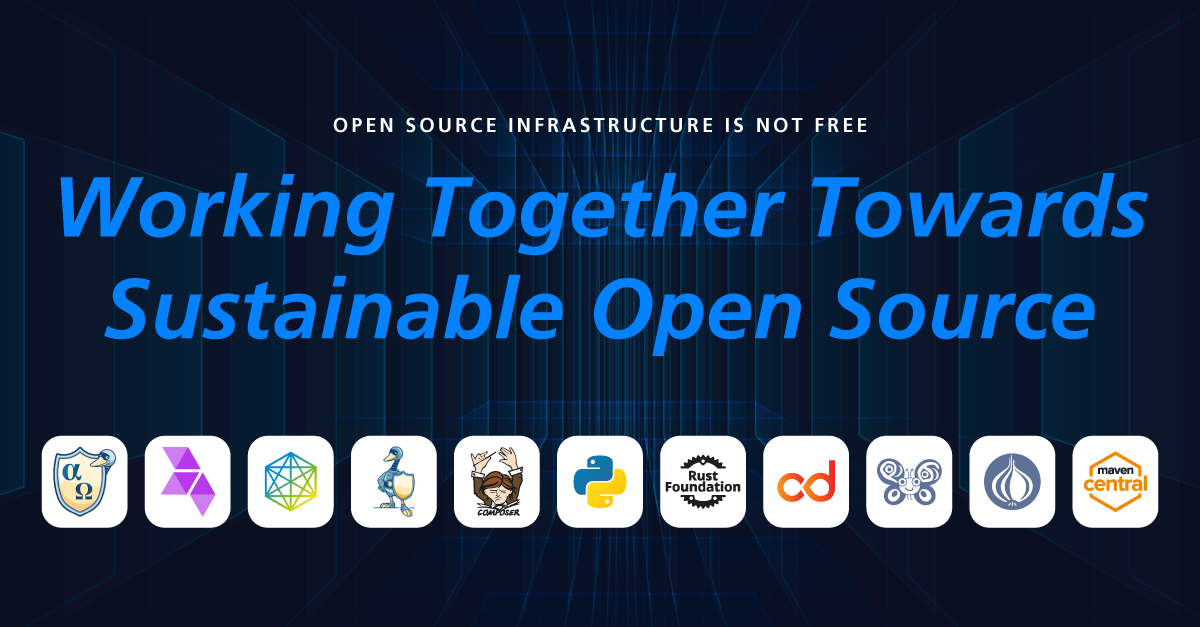
Open Infrastructure is Not Free: A Joint Statement on Sustainable Stewardship

By Blog

An Open Letter from the Stewards of Public Open Source Infrastructure

Over the past two decades, open source has revolutionized the way software is developed. Every modern application, whether written in Java, JavaScript, Python, Rust, PHP, or beyond, depends on public package registries like Maven Central, PyPI, crates.io, Packagist and open-vsx to retrieve, share, and validate dependencies. These registries have become foundational digital infrastructure – not just for open source, but for the global software supply chain.

Beyond package registries, open source projects also rely on essential systems for building, testing, analyzing, deploying, and distributing software. These also include content delivery networks (CDNs) that offer global reach and performance at scale, along with donated (usually cloud) computing power and storage to support them.

And yet, for all their importance, most of these systems operate under a dangerously fragile premise: They are often maintained, operated, and funded in ways that rely on goodwill, rather than mechanisms that align responsibility with usage.

Despite serving billions (perhaps even trillions) of downloads each month (largely driven by commercial-scale consumption), many of these services are funded by a small group of benefactors. Sometimes they are supported by commercial vendors, such as Sonatype (Maven Central), GitHub (npm) or Microsoft (NuGet). At other times, they are supported by nonprofit foundations that rely on grants, donations, and sponsorships to cover their maintenance, operation, and staffing.

Regardless of the operating model, the pattern remains the same: a small number of organizations absorb the majority of infrastructure costs, while the overwhelming majority of large-scale users, including commercial entities that generate demand and extract economic value, consume these services without contributing to their sustainability

Modern Expectations, Real Infrastructure

Not long ago, maintaining an open source project meant uploading a tarball from your local machine to a website. Today, expectations are very different:

  • Dependency resolution and distribution must be fast, reliable, and global.
  • Publishing must be verifiable, signed, and immutable.
  • Continuous integration (CI) pipelines expect deterministic builds with zero downtime.
  • Security tooling expects an immediate response from public registries.
  • Governments and enterprises demand continuous monitoring, traceability, and auditability of systems.
  • New regulatory requirements, such as the EU Cyber Resilience Act (CRA), are further increasing compliance obligations and documentation demands, adding overhead for already resource-constrained ecosystems.
  • Infrastructure must be responsive to other types of attacks, such as spam and increased supply chain attacks involving malicious components that need to be removed.

These expectations come with real costs in developer time, bandwidth, computing power, storage, CDN distribution, operational, and emergency response support. Yet, across ecosystems, most organizations that benefit from these services do not contribute financially, leaving a small group of stewards to carry the burden.

Automated CI systems, large-scale dependency scanners, and ephemeral container builds, which are often operated by companies, place enormous strain on infrastructure. These commercial-scale workloads often run without caching, throttling, or even awareness of the strain they impose. The rise of Generative and Agentic AI is driving a further explosion of machine-driven, often wasteful automated usage, compounding the existing challenges. 

The illusion of “free and infinite” infrastructure encourages wasteful usage.

Proprietary Software distribution

In many cases, public registries are now used to distribute not only open source libraries but also proprietary software, often as binaries or software development kits (SDKs) packaged as dependencies. These projects may have an open source license, but they are not functional except as part of a paid product or platform. 

For the publisher, this model is efficient. It provides the reliability, performance, and global reach of public infrastructure without having to build or maintain it. In effect, public registries have become free global CDNs for commercial vendors.

We don’t believe this is inherently wrong. In fact, it’s somewhat understandable and speaks to the power of the open source development model. Public registries offer speed, global availability, and a trusted distribution infrastructure already used by their target users, making it sensible for commercial publishers to gravitate toward them. However, it is essential to acknowledge that this was not the original intention of these systems. Open source packaging ecosystems were created to support the distribution of open, community-driven software, not as a general-purpose backend for proprietary product delivery. If these registries are now serving both roles, and doing so at a massive scale, that’s fine. But it also means it’s time to bring expectations and incentives into alignment.

Commercial-scale use without commercial-scale support is unsustainable.

Moving Towards Sustainability

Open source infrastructure cannot be expected to operate indefinitely on unbalanced generosity. The real challenge is creating sustainable funding models that scale with usage, rather than relying on informal and inconsistent support. 

There is a difference between:

  • Operating sustainably, and
  • Functioning without guardrails, with no meaningful link between usage and responsibility.

Today, that distinction is often blurred. Open source infrastructure, whether backed by companies or community-led foundations, faces rising demands, fueled by enterprise-scale consumption, without reliable mechanisms to scale funding accordingly. Documented examples demonstrate how this imbalance drives ecosystem costs, highlighting the real-world consequences of an illusion that all usage is free and unlimited.

For foundations in particular, this challenge can be especially acute. Many are entrusted with running critical public services, yet must do so through donor funding, grants, and time-limited sponsorships. This makes long-term planning difficult and often limits their ability to invest proactively in staffing, supply chain security, availability, and scalability. Meanwhile, many of these repositories are experiencing exponential growth in demand, while the growth in sponsor support is at best linear, posing a challenge to the financial stability of the nonprofit organizations managing them.

At the same time, the long-standing challenge of maintainer funding remains unresolved. Despite years of experiments and well-intentioned initiatives, most maintainers of critical projects still receive little or no sustained support, leaving them to shoulder enormous responsibility in their personal time. In many cases, these same underfunded projects are supported by the very foundations already carrying the burden of infrastructure costs. In others, scarce funds are diverted to cover the operational and staffing needs of the infrastructure itself.

If we were able to bring greater balance and alignment between usage and funding of open source infrastructure, it would not only strengthen the resilience of the systems we all depend on, but it would also free up existing investments, giving foundations more room to directly support the maintainers who form the backbone of open source.

Billion-dollar ecosystems cannot stand on foundations built of goodwill and unpaid weekends.

What Needs to Change

It is time to adopt practical and sustainable approaches that better align usage with costs. While each ecosystem will adopt the approaches that make the most sense in its own context, the need for action is universal. These are the areas where action should be investigated:

  • Commercial and institutional partnerships that help fund infrastructure in proportion to usage or in exchange for strategic benefits.
  • Tiered access models that maintain openness for general and individual use while providing scaled performance or reliability options for high-volume consumers.
  • Value-added capabilities that commercial entities might find valuable, such as usage statistics.

These are not radical ideas. They are practical, commonsense measures already used in other shared systems, such as Internet bandwidth and cloud computing. They keep open infrastructure accessible while promoting responsibility at scale.

Sustainability is not about closing access; it’s about keeping the doors open and investing for the future.

This Is a Shared Resource and a Shared Responsibility

We are proud to operate the infrastructure and systems that power the open source ecosystem and modern software development. These systems serve developers in every field, across every industry, and in every region of the world.

But their sustainability cannot continue to rely solely on a small group of donors or silent benefactors. We must shift from a culture of invisible dependence to one of balanced and aligned investments.

This is not (yet) a crisis. But it is a critical inflection point.

If we act now to evolve our models, creating room for participation, partnership, and shared responsibility, we can maintain the strength, stability, and accessibility of these systems for everyone.

Without action, the foundation beneath modern software will give way. With action — shared, aligned, and sustained — we can ensure these systems remain strong, secure, and open to all.

How You Can Help

While each ecosystem may adopt different approaches, there are clear ways for organizations and individuals to begin engaging now:

  • Show Up and Learn: Connect with the foundations and organizations that maintain the infrastructure you depend on. Understand their operational realities, funding models, and needs.
  • Align Usage with Responsibility: If your organization is a high-volume consumer, review your practices. Implement caching, reduce redundant traffic, and engage with stewards on how you can contribute proportionally.
  • Build With Care: If you create build tools, frameworks, or security products, consider how your defaults and behaviors impact public infrastructure. Reduce unnecessary requests, make proxy usage easier, and document best practices so your users can minimize their footprint.
  • Become a Financial Partner: Support foundations and projects directly, through membership, sponsorship, or by employing maintainers. Predictable funding enables proactive investment in security and scalability.

Awareness is important, but awareness alone is not enough. These systems will only remain sustainable if those who benefit most also share in their support.

What’s Next

This open letter serves as a starting point, not a finish. As stewards of this shared infrastructure, we will continue to work together with foundations, governments, and industry partners to turn principles into practice. Each ecosystem will pursue the models that make sense in its own context, but all share the same direction: aligning responsibility with usage to ensure resilience.

Future changes may take various forms, ranging from new funding partnerships to revised usage policies to expanded collaboration with governments and enterprises. What matters most is that the status quo cannot hold.

We invite you to engage with us in this work: learn from the communities that maintain your dependencies, bring forward ideas, and be prepared for a world where sustainability is not optional but expected.

Signed by

Alpha-Omega

Continuous Delivery Foundation (CDF) 

Eclipse Foundation (Open VSX)

OpenJS Foundation

Open Source Security Foundation (OpenSSF)

Packagist (Composer)

Perl and Raku Foundation

Python Software Foundation (PyPI)

Ruby Central

Rust Foundation (crates.io)

Sonatype (Maven Central)

Organizational signatures indicate endorsement by the listed entity. Additional organizations may be added over time.

Acknowledgments: We thank the contributors from the above organizations and the broader community for their review and input.

🎉 Celebrating Five Years of OpenSSF: A Journey Through Open Source Security

By Blog

August 2025 marks five years since the official formation of the Open Source Security Foundation (OpenSSF). Born out of a critical need to secure the software supply chains and open source ecosystems powering global technology infrastructure, OpenSSF quickly emerged as a community-driven leader in open source security.

“OpenSSF was founded to unify and strengthen global efforts around securing open source software. In five years, we’ve built a collaborative foundation that reaches across industries, governments, and ecosystems. Together, we’re building a world where open source is not only powerful—but trusted.” — Steve Fernandez, General Manager, OpenSSF

🌱 Beginnings: Answering the Call

OpenSSF was launched on August 3, 2020, consolidating earlier initiatives into a unified, cross-industry effort to protect open source projects. The urgency was clear—high-profile vulnerabilities such as Heartbleed served as stark reminders that collective action was essential to safeguard the digital infrastructure everyone depends on.

“From day one, OpenSSF has been about action—empowering the community to build and adopt real-world security solutions. Five years in, we’ve moved from ideas to impact. The work isn’t done, but the momentum is real, and the future is wide open.” — Christopher “CRob” Robinson, Chief Architect, OpenSSF

🚀 Milestones & Major Initiatives

Over the past five years, OpenSSF has spearheaded critical initiatives that shaped the landscape of open source security:

2021 – Secure Software Development Fundamentals:
Launching free educational courses on edX, OpenSSF equipped developers globally with foundational security practices.

“When we launched our first free training course in secure software development, we had one goal: make security knowledge available to every software developer. Today, that same mission powers all of OpenSSF—equipping developers, maintainers, and communities with the tools they need to make open source software more secure for everyone.” — David A. Wheeler, Director, Open Source Supply Chain Security, Linux Foundation

2021 – Sigstore: Open Source Signing for Everyone:
Sigstore was launched to make cryptographic signing accessible to all open source developers, providing a free and automated way to verify the integrity and provenance of software artifacts and metadata.

“Being part of the OpenSSF has been crucial for the Sigstore project. It has allowed us to not only foster community growth, neutral governance, and engagement with the broader OSS ecosystem, but also given us the ability to coordinate with a myriad of in-house initiatives — like the securing software repos working group — to further our mission of software signing for everybody. As Sigstore continues to grow and become a core technology for software supply chain security, we believe that the OpenSSF is a great place to provide a stable, reliable, and mature service for the public benefit.”
Santiago Torres-Arias, Assistant Professor at Purdue University and Sigstore TSC Chair Member 

2021-2022 – Security with OpenSSF Scorecard & Criticality Score:
Innovative tools were introduced to automate and simplify assessing open source project security risks.

“The OpenSSF has been instrumental in transforming how the industry approaches open source security, particularly through initiatives like the Security Scorecard and Sigstore, which have improved software supply chain security for millions of developers. As we look ahead, AWS is committed to supporting OpenSSF’s mission of making open source software more secure by default, and we’re excited to help developers all over the world drive security innovation in their applications.” — Mark Ryland, Director, Amazon Security at AWS

2022 – Launch of Alpha-Omega:

Alpha-Omega (AO), an associated project of the OpenSSF launched in February 2022, is funded by Microsoft, Google, Amazon, and Citi. Its mission is to enhance the security of critical open source software by enabling sustainable improvements and ensuring vulnerabilities are identified and resolved quickly. Since its inception, the Alpha-Omega Fund has invested $14 million in open source security, supporting a range of projects including LLVM, Java, PHP, Jenkins, Airflow, OpenSSL, AI libraries, Homebrew, FreeBSD, Node.js, jQuery, RubyGems, and the Linux Kernel. It has also provided funding to key foundations and ecosystems such as the Apache Software Foundation (ASF), Eclipse Foundation, OpenJS Foundation, Python Foundation, and Rust Foundation.

2023 – SLSA v1.0 (Supply-chain Levels for Software Artifacts):
Setting clear and actionable standards for build integrity and provenance, SLSA was a turning point for software supply chain security and became essential in reducing vulnerabilities.
At the same time, community-driven tools like GUAC (Graph for Understanding Artifact Composition) built on SLSA’s principles, unlocking deep visibility into software metadata, making it more usable, actionable and connecting the dots across provenance, SBOMs and in-toto security attestations.

“Projects like GUAC demonstrate how open source innovation can make software security both scalable and practical. Kusari is proud to have played a role in these milestones, helping to strengthen the resiliency of the open source software ecosystem.”

Michael Lieberman, CTO and Co-founder at Kusari and Governing Board member

2024 – Principles for Package Repository Security:

Offering a voluntary, community-driven security maturity model to strengthen the resilience of software ecosystems.

“Developers around the world rely daily on package repositories for secure distribution of open source software. It’s critical that we listen to the maintainers of these systems and provide support in a way that works for them. We were happy to work with these maintainers to develop the Principles for Package Repository Security, to help them put together security roadmaps and provide a reference in funding requests.” — Zach Steindler, co-chair of Securing Software Repositories Working Group, Principal Engineer, GitHub

2025

OSPS Baseline:
This initiative brought tiered security requirements into the AI space, quickly adopted by groundbreaking projects such as GUAC, OpenTelemetry, and bomctl.

“The Open Source Project Security Baseline was born from real use cases, with projects needing robust standardized guidance around how to best secure their development processes. OpenSSF has not only been the best topical location for contributors from around the world to gather — the foundation has gone above and beyond by providing project support to extend the content, promote the concept, and elevate Baseline from a simple control catalog into a robust community and ecosystem.” — Eddie Knight, OSPO Lead, Sonatype

AI/ML Security Working Group: 

The MLSecOps White Paper from the AI/ML Security Working Group marks a major step in securing machine learning pipelines and guiding the future of trustworthy AI.

“The AI/ML working group tackles problems at the confluence of security and AI. While the AI world is moving at a breakneck pace, the security problems that we are tackling in the traditional software world are also relevant. Given that AI can increase the impact of a security vulnerability, we need to handle them with determination. The working group has worked on securing LLM generating code, model signing and a new white paper for MLSecOps, among many other interesting things.” — Mihai Maruseac, co-chair of AI/ML Security Working Group, Staff Software Engineer, Google

🌐 Growing Community & Policy Impact

OpenSSF’s role rapidly expanded beyond tooling, becoming influential in global policy dialogues, including advising the White House on software security and contributing to critical policy conversations such as the EU’s Cyber Resilience Act (CRA).

OpenSSF also continues to invest in community-building and education initiatives. This year, the Foundation launched its inaugural Summer Mentorship Program, welcoming its first cohort of mentees working directly with technical project leads to gain hands-on experience in open source security.

The Foundation also supported the publication of the Compiler Options Hardening Guide for C and C++, originally contributed by Ericsson, to help developers and toolchains apply secure-by-default compilation practices—especially critical in memory-unsafe languages.

In addition, OpenSSF has contributed to improving vulnerability disclosure practices across the ecosystem, offering guidance and tools that support maintainers in navigating CVEs, responsible disclosure, and downstream communication.

“The OpenSSF is uniquely positioned to advise on considerations, technical elements, and community impact public policy decisions have not only on open source, but also on the complex reality of implementing cybersecurity to a diverse and global technical sector. In the past 5 years, OpenSSF has been building a community of well-informed open source security experts that can advise regulations but also challenge and adapt security frameworks, law, and regulation to support open source projects in raising their security posture through transparency and open collaboration; hallmarks of open source culture.” — Emily Fox, Portfolio Security Architect, Red Hat

✨ Voices from Our Community: Reflections & Hopes

Key community members, from long-standing contributors to new voices, have shaped OpenSSF’s journey:

OG Voices:

“Microsoft joined OpenSSF as a founding member, committed to advancing secure open source development. Over the past five years, OpenSSF has driven industry collaboration on security through initiatives like Alpha-Omega, SLSA, Scorecard, Secure Software Development training, and global policy efforts such as the Cyber Resilience Act. Together, we’ve improved memory safety, supply chain integrity, and secure-by-design practices, demonstrating that collaboration is key to security. We look forward to many more security advancements as we continue our partnership.” — Mark Russinovich, CTO, Deputy CISO, and Technical Fellow, Microsoft Azure

OpenSSF Leadership Perspective: 

“OpenSSF’s strength comes from the people behind it—builders, advocates, and champions from around the world working toward a safer open source future. This milestone isn’t just a celebration of what we’ve accomplished, but of the community we’ve built together.” — Adrianne Marcum, Chief of Staff, OpenSSF

Community Perspectives:

“After 5 years of hard work, the OpenSSF stands as a global force for securing the critical open-source that we all use. Here’s to five years of uniting communities, hardening the software supply chain, and driving a safer digital future.” Tracy Ragan, CEO, DeployHub

I found OpenSSF through my own curiosity, not by invitation, and I stayed because of the warmth, support, and shared mission I discovered. From contributing to the BEAR Working Group to receiving real backing for opportunities, the community consistently shows up for its members. It’s more than a project; it’s a space where people are supported, valued, and empowered to grow.” Ijeoma Onwuka, Independent Contributor

🔮 Looking Forward

As we celebrate our fifth anniversary, OpenSSF is preparing for a future increasingly influenced by AI-driven tools and global collaboration. Community members across the globe envision greater adoption of secure AI practices, expanded policy influence, and deeper, inclusive international partnerships.

“As we celebrate OpenSSF’s 5th Anniversary, I’m energized by how our vision has grown into a thriving global movement of developers, maintainers, security researchers, and organizations all united by our shared mission. Looking ahead we’re hoping to cultivate our community’s knowledge and empower growth through stronger collaboration and more inclusive pathways for contributors.” – Stacey Potter, Community Manager, OpenSSF

📣 Join the Celebration

We invite you to share your memories, contribute your voice, and become part of the next chapter in securing open source software.

Here’s to many more years ahead! 🎉

What’s in the SOSS? Podcast #36 – S2E13 From Compliance to Community: Meeting CRA Requirements Together

By EU Cyber Resilience Act, Podcast

Summary

In this episode of ‘What’s in the SOSS” CRob dives deep into the Erlang ecosystem with Jonatan Männchen (CISO, Erlang Ecosystem Foundation), Ulf Riehm (Product Owner, Herrmann Ultraschall), and Michael Winser (Alpha-Omega). This episode explores the critical importance of security in open source, particularly in light of regulations like the CRA. Hear how the Erlang community is proactively addressing security concerns by bringing in experts, fostering collaboration, and building trust. Discover why manufacturers are investing in upstream projects and how other ecosystems can learn from their approach. This conversation highlights the value of community, transparency, and the essential role of ‘stewards’ in the open source world.

Conversation Highlights

00:00 Welcome
00:57 Meet the Guests
02:56 Jonatan’s Journey into Erlang
06:16 The Alpha-Omega Connection
09:07 Ulf’s Perspective as a Product Manager
13:09 Funding Security in Open Source
18:58 Challenges in Implementing Security
24:54 Becoming a CNA and Normalizing Security
28:18 Jonatan’s role as CISO
32:01 Calls to Action & Advice
36:49 Wrap Up

Transcript

CRob (00:14)
Welcome, welcome, welcome to What’s in the SOSS, the OpenSSF’s podcast where we meet interesting people that are in and around the upstream open source ecosystem. My name’s CRob. I’m the chief security architect for the foundation, and I also do security stuff upstream to help protect that open source software we all know and love. And today I have an amazing collection of gentlemen here, and we’re talking about a very important topic. It’s about the value of bringing experts in.

So I would like to pass the microphone around. I’ll start off with Jonatan. Let’s introduce ourselves and kind of talk about what brought you here today to talk about this interesting topic.

Jonatan Männchen (00:57)
Yeah. Hi, I’m Jonathan Männchen. I’m the Chief Information Security Officer at the Erlang Ecosystem Foundation. And the reason I’m here today is that we’ve started implementing a lot of functionality in the security and in the compliance sector, mostly focused on the CRA. And based on that, I’ve met CRob and Michael, these lovely gentlemen in the Alpha and Omega call and was invited to come here and talk about it all.

CRob (01:31)
Ulf

Ulf (01:33)
Yeah, I’m a product owner with Herman Ultrasonics. We are a German machine builder, like a small company, 500 people only, not one of the big tech companies. And we have decided, arbitrary for a weird Swedish tech stack, including Erlang, to do our automation, to do our machine controls. And as a product owner, I had to make decisions whether how we would tackle security in the longer run. And that brought me here.

CRob (02:09)
Excellent. And our friend, Mr. Windsor.

Michael Winser (02:12)
Hi everyone. So I’m here for the free cookies. I was promised cookies. I think, you know, working in Alpha Omega, one of the surprising and the continuous benefits is that we end up finding community. find people and people find us and then that creates these connections. And so when Jonathan showed up in one of the public meetings and started chatting, I’m like, who are you? What are you doing? And we started talking more and that sort of led to more conversations and we’re still talking about things. that has spread to other parts of the airline community as well. And so the learnings continue. And for me, that’s just, it’s amazing what happens when you put people in a room and start talking together. So now here’s another room, let’s talk.

CRob (02:56)
Excellent. let’s start off. Jonathan, you’re here representing Erlang. Could you maybe talk to us about how you got into open source and maybe talk a little bit about what Erlang is all about?

Jonatan Männchen (02:56)
Mm-hmm. I think I started out quite the normal route, let’s say, just doing some side stuff from my corporate job, essentially. And as these things normally go, you kind of feel responsible for them and they grow and you get more and more of these kind of side projects going on. Some of them getting successful, others you decide to cut the loss at some point. And…

Yeah, I really started in the PHP ecosystem a long time ago, doing some pull requests on Symfony. And I published a library that does a SIP streaming from the server to the browser and that kind of thing. And around 10 years ago, I actually read a book on Elixir specifically and Phoenix, which a roommate at the time bought and I don’t think he ever read it himself, but I did. And yeah, I had to try it out. We had like the perfect project of like a, it was essentially like a bit, an online game essentially with money involved where we would play the game via web sockets and we had to have the state on the server to make sure people don’t cheat.

CRob (04:30)
Mm-hmm.

Jonatan Männchen (04:31)
And that was kind of like the perfect use case because that’s basically the first thing you read always about Erlang can handle that many millions of sockets at the same time. And yeah, kind of figured out at that point that basically I don’t have to wait for the unicorn project where this is the perfect solution, but rather in the end, it’s a technology

that is complete, you can build things with it. I don’t have to stick with PHP for the normal stuff. And yeah, over the time I got more more involved into Elixir itself, also with other open source projects. And I think around three years ago, I’m not quite sure, could be two, could be four. I got involved in the Erlang Ecosystem Foundation and the Security Working Group as well.

Working together with a lot of people trying to make Erlang secure. And maybe as a side note here, Erlang, Elixir, Gleam, and also a few other languages are all languages based on Erlang. So kind of like what’s Scala to Java, for example. And towards the end of last year,

I was talking a lot to Alistair, which is one of the board members of the foundation. And he raised for a long time that the CRA is a topic that we need to be very careful about. And the stars lined up, my last job was ending and in the end, yeah, everything lined up perfectly. And since the start of the year, I’m at the CISO trying to implement all of that.

CRob (06:16)
Awesome. So let’s talk about this new stage that you’re in. You mentioned that you and Michael and I met together at an Alpha and Omega community meeting. Can you, you and Michael maybe talk a little bit about how you two got introduced and how you discovered this amazing community that AO is nurturing.

Jonatan Männchen (06:40)
Yes. I mean, wait, where do I start? So yes, we haven’t really talked at FOSDEM, but I got to know you just from speaking at FOSDEM. But yeah, let’s start there. So I was at…

Michael Winser (06:40)
I think it starts with you, Jonathan. I don’t know how you came to the meeting.

Was it it FOSDEM? I gave a talk at. OK, yeah.

Michael Winser (07:04)
Yeah, so I’ll go. At FOSDEM, I had a couple of talks, one of which was in a room that was partly organized by the folks from the STA and talking about funding and open source. And as you might imagine, it was a crowded room. A lot of people, a lot of questions, lot, and you know,

Mirko and I Mirko’s from the STA Tried to put together a presentation even to sort of explain what we are and how we do things or whatever And in 15 20 minutes, we obviously compressed a lot of thoughts and time into that But it worked as intended right that we got lots of good questions and people who didn’t even know What we did or why or whatever sort of started coming out of the woodwork and and it’s been really great and John is over to you:

Jonatan Männchen (07:52)
Yeah, it was actually the day before. It was the FOSDEM Fringe event. I was not present at your talk. I knew that it happened. But it was the SBOM Fringe event where you were also speaking. I also didn’t… I mean, I read through a lot of the OpenSSF stuff on a high level of what the OpenSSF is doing. And I saw Alpha and Omega, but I didn’t really go into details there. just knew that it existed. yeah, you talking actually brought it up in my mind. And we, as the foundation, we are in this spot where we now have some financing, which basically just extends to myself. But really to implement all of this, we need more help than we currently have. And so I thought it would be good to reach out. And that’s also why I joined the call.

CRob (08:22)
Mm-hmm.

Michael Winser (08:49)
I remember now, and that of course was completely unplanned. I was at that event as just a participant, and then Philippe asked me to come up and just say a few words, and I babbled some stuff, and here we are. So it’s always the sort serendipity things that really drive interesting outcomes.

CRob (08:49)
Excellent.

Ulf (09:05)
Okay.

CRob (09:07)
This is a really interesting topic and let me pull Ulf in for a moment. As a product manager, kind of selecting components that are going to go into a product that your organization sells. How important is it to know that these upstream projects you’re relying on have support and do take security seriously?

Ulf (09:33)
Well, I’m here as an antidote to a poison, is vendor lock-in. So the bigger part of my life, I’ve been part of industrial automation and we were running factories for automotive supplies or plastics or whatsoever. And as part of this company, we were building machines and we were using open source, but we were using it in a, I wouldn’t call it un-moral, but in a weird way that we were just using it, you know, and didn’t, we didn’t take care about what you say, whether it is maintained or safe, it’s just there and you download it and you make a dependency and that’s it. And the antidote is number one, that at one day we stumbled over Alistair as well on a, on a … That was actually… What was that? It was in Berlin. Yeah, Elixir event in Berlin. And we realized that there’s a huge foundation behind it. And that was the cornerstone. And later when the CRA requirements came down to us and we started to wrap our minds how we would fulfill these requirements and make safe software for our customers, then only we realized how important these foundations may become to us. And we were lucky in a way that previously for other reasons, for reasons of resilience and reasons of resource management and reasons of development speed and whatever, know, we have chosen for Erlang slash Alexia stack. And so we were kind of enthusiastic about it, but we never choose it in the first place for security reasons. Then later, we realized that we are in front of a huge challenge of complying with these requirements, which are from you, but basically the United States are doing very similar stuff under different naming and many of them requirements, they overlap. And then we realized, lucky we are that we have chosen a pond rather than an ocean. And that pond is so concise and kind of personal and kind of streamlined, I would say. That gave us the confidence that if we use it to address these challenges, we would possibly have a very concise community to which we can reach out and meet real people, talking real talks and tackling real problems.

CRob (12:22)
Hmm.

Ulf (12:26)
So that is kind of how we ended up here. And this is also what made us finally, which convinced also my owner, we have a company owner and my CEO and also my development officer that we would fund such a foundation to a degree which is maybe not much in comparison to what probably Intel or Meta is doing, but you have to put it into relation to what our annual turnover is. And in that measure, it is a considerable amount of money and we are willing to continue to do so.

CRob (13:09)
Nice.

Michael Winser (13:10)
I just want jump in. I think you would be surprised comparing yourself to what other corporations are doing. And I just, want to start by celebrating the several things here. One is sort of the pragmatic taking control of your destiny approach, right? And it’s always, you know, it’s open source. There’s a lot of stuff that happens and it’s like free as in beer. It’s like someone shows up and gives you beer. But as I like to say, it’s really more like free as in puppies and they need care and they need love. And Organizations that understand that and make that investment Find out all kinds of interesting things such as you now actually have a lot more like you can train your puppies to go in the right direction and not not You know pee in the kitchen, for example Metaphorically, we’re going to stop with that particular direction But I think it’s also an example of how in a competitive landscape regulation even sometimes ham-fisted regulation, I would certainly not attribute anything to one regulation or the other, but regulation is hard. But any kind of regulation essentially creates better incentives and it rises. Like everybody has to pay a little bit more attention to these things because, you know, in a competitive landscape, every dollar you spend on feeding your supply chain and taking care of your puppies is a dollar you’re not spending on marketing or development or whatever. But, you know,

It’s your code, even though you’re not the ones writing it, it’s in your business, it’s in your product. And so the care of that investing in that has a return. So first of all, kudos to you and your organization. I think it’s amazing. and it’s a pattern I would love to see sustained and repeated as more organizations can find ways to do so. And I think you’ve also shown it’s not that hard. You just show up and say, we’d like to make sure that this gets done properly and things happen.

Ulf (15:04)
Yeah, and I would like to add that it becomes even a rational choice. There’s not, I mean, when we talk about puppies, there’s a lot of love and care and all of that, right? But you can also see the case I have been describing as a very rational choice, because especially if you look into the alternatives.

One alternative would have been we would have developed security by our own. Yeah. Okay. And, and obviously that, that is a monstrous task and we would have needed competences, which clearly we do not have. And it would have taken a lot of time probably and would have been expensive. So that has been ruled out in the first place. And the second option would have been that we would have outsourced it to some contractor.

Ulf (13:19)
I mean, there are specialist companies out there. You can tell them what to do. They have the competencies and they will do it in a proper timing and for a proper cost. But still there is a downside to that, which is trust. Because if we go to our customers and tell them about security and we tell them, the security we are selling to you is actually the one we bought from this other guy. And, and he’s a specialist, I tell you.

Then our customer would say, who’s that? And what is he doing exactly? And how do you know? And all of that good questions from a customer point of view, that’s a proper question. And then no matter whether he was doing wrong or right, to build trust is very difficult. In turn, if we kind of outsource that, it’s not a real outsourcing because we don’t have a mandate here, right? We are just funding it.

Ulf (14:09)
But if this is done by somebody else which we do not influence directly, there’s two benefits. There’s never a smell of influencing in turn. So we can tell them what they’re doing is trustworthy because we are not influencing them. There’s no conflict of interests. And also if they are doing it and we are not mandating them directly, they would look for a bigger community, which was foster a more resilient solution landscape. I’m very convinced that this would happen. And both of them mechanisms, I can go back to my customer and tell them, look, and because of these two mechanisms, you can trust them guys a lot more than you can trust either us or a contract that we have bought. So if you look at down that road, it’s probably a very rational choice to kind of outsource things to people you’re not influencing. It sounds contradictious in the first place, but it’s not that much contradictions if you think it to the end.

CRob (15:10)
And the behavior you’re describing – how a manufacturer gets value out of these upstream projects and you have taken the very conscious decision that we’re going to try to support them. That is exactly the behavior that the CRA has explicitly written in is they’ve asked manufacturers like if you’re using upstream components, you should give back and participate. And I really applaud you all for making that choice very early on.

Ulf (18:33)
Yeah and also look into CRA. You have three choices. You’re a consumer, a manufacturer or a steward.

Michael Winser (18:40)
Yeah.

Ulf (18:41)
I don’t want to be a manufacturer in key matters. I would love to be a steward, but I can’t. It’s not in our competencies. So to say, I love to be a steward, I can’t, so I’m going to fund one.

CRob (18:58)
Let me turn the next question to Mr. Windsor. Why is it so hard for a lot of projects to implement good security practices and how does funding help that?

Michael Winser (19:12)
I love this question. So somewhat Ulf talked about starts with competency. know, not everybody is a, you know, well, let’s start with the problem of software supply chain security, right? As I love to say, it’s like the Y2K problem without the same clarity of problem solution or timeline. Right. Everyone is still learning a lot about this and we have decades of technical debt. So expecting, you know,

Mary and Joe, software developers working on a cool open source project to have competency in all the risks that they are essentially carrying forward is unreasonable. It’s just not practical. And any solutions we do are not going to be magically by teaching everybody to become security engineers at the same time, any more than everybody knows how to do front end, back end, or use airline as a language or rust or whatever. There are competencies that take real time and energy to acquire.

And that’s a big deal. The other aspect is it actually goes back to the same competitive pressures that corporations are feeling at the of deepest end of the supply chain or the furthest out to the right end of the supply chain. Open source projects are, you know, like have different reward mechanism. At the end of the day, being used, being valuable is something people care about.

And a lot of the signal that they receive from their downstream dependencies, right, is somewhat abstract, but it’s about usage. How many people are using me? How many, you know, GitHub stars, which please do not use GitHub stars as an indicator of popularity. but, know, and so they’ll do things that people are asking them to do. And invariably, what do people want to do? Like I’m building some software and somebody has built a module that does something for me.

CRob (20:46)
Stars and likes.

Michael Winser (21:00)
If I can shift the work onto them, so could you add a feature that does X, right? Says every enterprise customer ever, and says every open source project. Software developers want somebody else to do the things that they’re not good at, right? So I’m using some HTTP client library. It does some really cool. There’s now an edge case on dealing with streaming over HTTP 3, blah, blah, blah, blah. Could someone do that for me, rather than me having to add that to my application code, which is trying to plug tab A into slot B and make an NCP talk to Zapier, for example.

Michael Winser (21:30)
And so that’s a big part, right? There’s a lot of pressure and signal towards adding new features. There’s a competency they already have, which creates a fluency and ease of work around the feature set they’ve developed. So you have this hard hill to climb of security of things I don’t really know about, an easy and rewarding hill to climb, which is things I do know about and people are asking for, right? Those choices are too easy, right? It’s too easy to go down the path of doing more of that.

And unfortunately, that problem is bigger than that because the people who are downstream who would benefit from the security and might benefit from the feature sets, they don’t know more about the security. They don’t know more about the code. So who is going to do that work? How’s it going to happen? And, you know, this is where I think what’s awesome about what Ulf and company have done, right, is saying, look, we need to bring some experts here. And what I love about it too is the point of leverage, right?

So you could go and look at all the supply chain things and fix all the individual pieces, or you can make it someone’s job in an entire ecosystem to reason and think about that ecosystem and to make changes that are going to benefit all of them. And that’s the alpha of Alpha Omega is all about that scale.

Ulf (22:45)
And we would not have done it if we would not have faith in the fact that it can be done in that ecosystem. And we have faith it can be done in that specific ecosystem. Yeah. Because it’s so streamlined and so concise and so complete in it’s so feature complete that it helps us a lot. Yeah.

Michael Winser (23:06)
I think that’s really key. And I think that the other thing that comes out of this, I think we’re starting to see these in other ecosystems and I fully expect them to become like significant factors in the airline ecosystem as well, which is you’re normalizing security. So when you think about software engineers and the set of skills that they all think are common, right? There’s a certain subset of things.

CRob (23:23)
Mm-mm.

Ulf (23:23)
Yes.

Michael Winser (23:31)
what we’re starting to do is to normalize a broader set of things around security concerns. So not everybody’s going to become a security expert, but if everybody’s aware of security and like, I should do this. it, mean, some of these things aren’t even about implementing more secure code, right you could probably talk for days on how maybe you should handle reports around vulnerability and just having process around vulnerabilities in your projects. And when somebody does tell you, whoopsie, you actually even have a process to handle that.

CRob (23:54)
Exactly.

Michael Winser (24:01)
That is a significant gap for an awful lot of open source projects.

CRob (24:04)
Mm-hmm.

Jonatan Männchen (24:05)
Which is, the way, also a gap we’re very specifically addressing. We’re in the process of becoming a CNA [CVE Numbering Authority]. We’re currently in the onboarding workflow, not done yet. But we’re actually becoming a CNA for every package that is in the package manager, if they’re not covered somewhere else. Just because we think that we have more tools available to do the correct decisions in the whole thing and also reach the

Michael Winser (24:13)
Yes.

CRob (24:26)
Nice.

Jonatan Männchen (24:34)
Correct people than MITRE ever could just because they’re not part of that ecosystem specifically. yeah, so we really want to cover this as a CNA and also build in all the vulnerability reporting into the default tooling so everybody gets the benefits of that.

CRob (24:41)
Exactly.

That’s awesome.

Michael Winser (24:54)
This is, this is, mean, this is a pattern we’re seeing more and more, right? And, know, there’s now documentation well written by other parts of the Alpha Omega family on how to be a CNA. This is what we did, how it worked out or whatever. It’s worth stating to the perhaps, you know, less CNA obsessed listener, right? That one of the things that happens here is that the community can have a more curated control over what is being reported as a vulnerability and the process gets centralized. And this is not to impugn our

CRob (25:20)
Mm-hmm.

Michael Winser (25:24)
Esteemed colleagues in the security research industry, right? But they have incentives to find vulnerabilities and want to push them out and like that and when you push them either straight up to MITRE or directly to the individual project there is none of that curation happening and this allows an Esteemed set of experienced people in the airline community to make sensible decisions about is this really a vulnerability? What severity it has and so forth and there’s still a dialogue and should be a dialogue with the researcher, but it’s not

Sort of like the problem is that there’s no dialogue with MITRE or it just happens. There you go. And then it’s very hard to undo that later on. And it drags around creating, you know, imperfect signal for people consuming things.

CRob (26:03)
Right. So, I see you as representing kind of a really exciting new trend that we’ve witnessed over the last few years, where communities are reaching out and bringing in subject matter experts to become this developer, security developer in residence, kind of having this role. From your perspective, and your role as CISO for Erlang, what do you see your role is in helping your community?

Jonatan Männchen (26:34)
I think the biggest part is to figure out what should we actually be doing. Because there’s lots of regulation from lots of different countries. Nothing is harmonized. And then even, for example, the open SSF, there is so many things in there just sifting through what does actually apply to us. And there’s other organizations than the open SSF as well. So just figuring out what should we be doing, I think is the biggest part.

CRob (26:39)
Mm-hmm.

Right.

Jonatan Männchen (27:04)
And yeah, I’ve started putting together essentially a roadmap of things that we want to implement. Also, there’s some stuff that I can directly tackle myself just because they’re in a size that makes sense for me to invest that in my time. For example, we just did the open chain certification for Elixir or the CV numbering authority, which is talked about.

CRob (27:22)
Very nice.

Jonatan Männchen (27:34)
And we also just implemented the best practices batch for Elixir as well. So there’s lots of different things going on and there’s lots of them, yeah, where I can just look at them, do them, get it done. But there’s also bigger ones like for example, implementing SLSA throughout the whole package manager, where we’re more at the point where we need additional help just because it doesn’t make sense for me to focus on that for that long time right now. And so.

CRob (27:53)
Mm-hmm.

Jonatan Männchen (28:04)
I’m trying to figure out a way of organizing all of that and getting the funding and figuring out what is exactly we’re trying to do. And yet just put together a plan that actually could work essentially.

CRob (28:18)
Michael?

Michael Winser (28:20)
I’m glad you mentioned SLSA and You and I should chat offline for some specifics but I’ve been working within the SLSA working group for a while and one of the members out Tom Hennan has created there’s one of the tracks we’re working on this the build track there’s a less developed thing called the build environment track which manages the sort of Security of the environment which run the Maturing nicely is something called the source track around dealing with the provenance of the source code and the environment in which the source was created, right? And so being able to say you have branch protection on and things like that, and there’s a set of requirements. Well, Tom has produced a very simple little workflow. There’s still in sort of prototype phase that makes getting to SLSA level three of source level three provenance, where you have this continuous from a date, point in time forward chain of trust for all the commits to your repo incredibly easy to achieve.

And so would love to work with you and the Erlang and the Elixir space and the package manager space to do that and then Connected back to trusted publishing depending upon the workflow from there to publishing into the package manager You can start to see an end-to-end provenance story. That is very interesting and You know last week I had a chat with some of your colleagues from Erickson who work on the OTP stuff and I was asking them about what what’s their interest to the package manager versus the other parts of the ecosystem and

They build from source, use the force, build the source. And so that eliminates a lot of tampering threats in the build space, but they still care about the provenance and authenticity of the source. And by the way, they also say they very much care about the health of the ecosystem as well. And so they’re to help out in various ways. So there are dots to connect there that I hope are, and this is part of what we’re funding at Alpha Omega, that reduce the toil for someone like you and your ecosystem to kind of take those next steps.

CRob (30:16)
And I bet as a product manager, Ulf, this would be a really compelling story if you knew that the components that you were putting integrating into your products had this pedigree and provenance that had that chain of custody and they were untampered with.

Jonatan Männchen (30:16)
Mm-hmm.

Ulf (30:31)
Absolutely, and that even if I knew that would be the case then still there’s tons of work to do for security so I’m offloading a part of the problems we are facing and still Previously we mentioned that or I mentioned that probably we do not have the competencies in security and Probably under rating our company. Of course, we have experts in that matter but not to that extent what Jonatan can do for us number one or the community can do for us, number two, or foundation can do for us, or CNA can do for us. And the processes you’re mentioning about making the correct ratings and making the correct proceedings in how to handle these vulnerabilities, all of that we can definitely not do. And still there’s tons of work to do to provide safe software or secure software to our customers from operating systems and good habits and proceedings in the pipelines and management of quality. All of that’s still down to us. And even there, we benefit from Jonatan providing best practices. Simply as that. It’s undisputed, right? Somebody calls out a best practice, it goes into our development rules, and here we go. So it’s simple. You don’t need to spend or wrap your brain around how to do that the best way. It’s a matter of trust.

At the end of the day, for us, it’s a matter of trust.

CRob (32:00)
Awesome. So as we wind down, I would like to talk about, you know, what is all your individual calls to action? You know, what if there are other communities, whether it’s a project or another language ecosystem, and they hear about this amazing story that the three of you are weaving together, you know, what advice would you give these communities and how they can enter in and become these, good stewards and good participants in these types of situations.

Jonatan Männchen (32:36)
Yeah, thinking a second what to say.

Michael Winser (32:39)
Why don’t I start? Because I’ve got the easiest thing to offer right up front. Whether you are an expert in coding, an expert in the problem space, an expert in the language or the package that you’re using in your business, the first and simplest thing to do is to engage, to contact the organizations upstream of yours and say, hello, my name is Michael, and I am benefiting from your work. I would like to make hello and say, how’s it going? Introduce myself so that when you have a problem later on, whether it is an audit finding out that your CRA compliance is at risk because of some practice or whether it’s a silly little bug or whether it’s a vulnerability has surfaced and you’re not sure whose fault it is or what to do or how to do something or what the importance of it is. If you already have a working relationship, even if it’s just purely social, if it’s just literally love in the human sense of like love is a verb, hello, how are you today?

I care about your work, right? You’re already so much better off than you would be otherwise. And so the first thing to do is to engage and to listen, and then you will have a very clear path of opportunities forward, or at least the connection when you need them.

Jonatan Männchen (33:53)
What I could add, a lot of people in an ecosystem don’t really look outside of that ecosystem. So it’s really important that you’re not trying to do everything by yourself. There’s lots of smart people from lots of different places that already thought about these things, but they haven’t thought about it in your specific programming language probably. But yeah, looking around what others are doing and actually connecting beyond the borders of your own ecosystem is probably one of the most important things to do.

Ulf (34:39)
And from a user perspective, of the other end of the food chain, whatever, I wish that more people would be honest about their usage of open source and their contribution and, know, distinguish clearly what is their added value with what they have developed and they willing to sell to their customers and what they have just, you know, grabbed as a base for what they want to offer as a customer value. And if that would be a more honest and a more transparent way of doing business, then automatically more people would join an initiative like we have been doing and that base would become a lot more resilient and even a lot.

And it will be worth the living, you know, for the people who are doing it. mean, currently, most of or many of them projects are maintained by enthusiasts and not for living. And sounds sounds wrong, kind of wrong. Yeah, I would like I can’t see why we should not distinguish between our added value and somebody else’s added value and make that very transparent. Transparency.

CRob (35:37)
Excellent. Well, gentlemen, I really appreciate your actions, both in your businesses and upstream and in your communities. And I thought this was a really insightful conversation. And I know we’ll be having more like this as items like the Cyber Resilience Act in Europe or legislation around the globe continues. This is going to be a matter of great importance that downstream has generated an unimaginable amount of value from the work of upstream. And there needs to be a way to be more participatory and to give back and to show that love that Mr. Windsor noted back to those developers that have given you so much. So gentlemen, thank you. I appreciate your time. And with that, happy open sourcing. That’s a wrap for us.

Case Study: OSTIF Improves Security Posture of Critical Open Source Projects Through OpenSSF Membership

By Blog, Case Studies

Organization: Open Source Technology Improvement Fund, Inc. (OSTIF)
Contributor: Amir Montazery, Managing Director
Website: ostif.org

Problem

Critical open source software (OSS) projects—especially those that are long-standing and widely adopted—often lack the resources and systematic support needed to regularly review and improve their security posture. Many of these projects are maintained by small teams with limited bandwidth, making it challenging to conduct comprehensive security audits and implement best practices. The risk of undetected vulnerabilities in these projects presents a growing concern for the broader software ecosystem.

Action

To address this gap, OSTIF leverages its OpenSSF membership to conduct rigorous security audits of critical OSS projects. Using a curated process rooted in industry best practices, OSTIF delivers structured security engagements that improve real-world outcomes for maintainers and users alike.

Through active participation in OpenSSF’s Securing Critical Projects working group and Alpha-Omega initiatives since their inception, and through strategic partnership with organizations like Eclipse Foundation, OSTIF receives targeted funding and support to carry out its mission. These collaborations help prioritize high-impact projects and streamline audit administration—despite the inherent complexity of managing funding approvals and coordination. 

It’s pivotal that these important projects receive customized work. Each open source project is unique and so are its security needs, making standardization of audits difficult. OSTIF is able to invest time and expertise in scoping and organizing engagements to be tailored to the project’s best interests, necessities, and budget to generate effective investment in open source security.

OSTIF also incorporates other OpenSSF tools and services such as the OpenSSF Scorecard and the broader Securing Critical Projects Set, which complement its robust audit methodology and offer additional layers of insight into project health. In an ecosystem that is varied and complex, having security resources that can be applied to all projects contextually to generate impactful and sustainable security outcomes is incredibly valuable to all stakeholders, especially OSTIF.

Results

OSTIF’s work has demonstrated the effectiveness of formal security audits in strengthening OSS project resilience. As a member of OpenSSF, OSTIF has been able to expand its reach, increase audit throughput, and reinforce the security practices of some of the open source community’s most essential projects. Since 2021, OSTIF has facilitated numerous engagements funded by OpenSSF. In March of 2025, OSTIF published the results of the audit of RSTUF with OpenSSF’s funding and support. Additionally, 2 more Alpha-Omega funded engagements will be published later this year.

“OSTIF is grateful for the support from OpenSSF, particularly for funding security audits both directly and via Project Alpha-Omega, to help improve the security of critical OSS projects.”
— Amir Montazery, Managing Director, OSTIF

In addition to the technical improvements achieved through audits, OSTIF’s OpenSSF membership has fostered valuable connections with project maintainers, security experts, and funders—creating a collaborative ecosystem dedicated to open source security. Building a community around security audits is a goal of OSTIFs; by sharing resources and providing a platform for researchers to present audit findings through meetups, their goal is to grow expertise and access to security knowledge of the average open source user. 

Key Benefits

  • Enhanced security posture of widely-used OSS projects.
  • Strategic collaboration with OpenSSF working groups.
  • Access to funding and expert networks.
  • Improved audit administration through community support.

Biggest Challenge

  • Navigating administrative processes and funding approval cycles for new audit projects.
  • Funding multi-year programs and engagements. 

To learn more about OSTIF’s work, visit their 2024 Annual Report. Visit their website at ostif.org or follow them on LinkedIn to stay up to date with audit releases.

Alpha-Omega 2024 Annual Report

By Alpha-Omega, Blog

This post originally appeared on Alpha-Omega and has been revised for the OpenSSF.

By Alpha-Omega

We’re pleased to share our 2024 annual report. In it we try to convey the great progress in securing open source and our joy in seeing the increased security across so many open source ecosystems.

Open source software isn’t just another piece of technology—it’s the digital bedrock that supports everything from major government operations to the smartphone apps we use every day. Its strength lies in the global network of passionate, too-often-unpaid volunteers who pour their time and expertise into writing and maintaining open source projects. Yet, as we rely on these individuals to secure vital infrastructure, we must acknowledge the immense responsibility they carry and ensure we’re not merely shifting more unpaid work onto their shoulders. By investing in resources, offering support, and creating pathways for sustainable contribution, we can protect and strengthen open source software without placing undue burdens on the very people who make it possible.

To everyone who created, maintained, or contributed to an open source project in 2024, thank you.

In 2024, Alpha-Omega issued nearly $6 million in grants to improve security in key open source projects. Notably we:

  • Helped staff security teams at 10 of the most important open source organizations, such as the Python Software Foundation, OpenJS, and RubyGems.
  • Provided grants to harden critical infrastructure, such as the Linux kernel, and Homebrew.
  • Paid for security audits of foundational technologies.
  • Experimented with scaled approaches to finding and fixing vulnerabilities and supported Rust implementations of TLS and the AV1 codec.
  • Hosted four roundtable discussions with grant recipients to cross-pollinate expertise and to shape strategies for 2025.

Alpha-Omega is funded by generous and significant donations from Amazon Web Services (AWS), Google, and Microsoft. These grants made it possible to address longstanding security challenges, improve processes, and harden infrastructure within many of the world’s most important open source projects and ecosystems. More importantly, we’ve been able to establish a sustainable culture of security within the communities we work with.

The combination of Alpha-Omega’s grants and the energy, leadership, and commitment of the recipients is a formula that worked and we will continue applying it in 2025.