

At OpenSSF, securing the open source software supply chain isn’t just about writing code or establishing policies. It is about growing the community of developers who build, maintain, and innovate…
Read More
In this episode of Big Thoughts, Open Sources, host CRob sits down with Jamie Thomas, IBM Enterprise Security Executive and OpenSSF Governing Board Member (former Chair!), to tackle the vital shifting dynamics of enterprise open source engagement. From IBM’s historical “billion-dollar bet” on Linux to modern supply chain wake-up calls like SolarWinds and Log4j, Jamie pulls back the curtain on what it truly means to move from accidental consumption to intentional stewardship. Tune in to discover how active participation in neutral foundations like the OpenSSF acts as a fast track for engineering career trajectories, why soft skills like “the art of influence” are critical for upstream collaboration, and how organizations can protect their crown jewels while implementing a powerful “give-back strategy.”
00:00 – Intro Music + Promo Clip
00:21 – Introduction & Welcoming Luminary Jamie Thomas
01:32 – Wearing the Enterprise Security Hat at IBM
02:10 – Supply Chain Wake-up Calls: From SolarWinds to Log4j
03:14 – Unlocking Open Ecosystems: IBM’s Early History with Java and Linux
05:21 – Mainframe Debates and Portability: The Evolution of Open Source Adoption
06:24 – The Red Hat Acquisition and Monetizing the Developer Ecosystem
08:20 – The Myth of “Free” Software: Securing Regulated Enterprise Deployment
10:15 – Why a Seat at the Table Matters: The Value of Neutral Foundations
11:29 – The Art of Influence: Upstream Contributions as a Career Catalyst
13:50 – Moving Innovation from Open Source Kernels to Commercial Value
16:12 – Storming, Norming, and Conversation: Lessons from the Kubernetes Era
17:38 – Pitching Upstream Time: Helping Developers Sell Open Source to Management
19:30 – Beyond Code: Bringing Domain Expertise and Soft Skills Upstream
21:40 – Conquering the Chasm: Automating CI/CD Pipelines and Testing at Scale
22:56 – Consuming with Intent: Active Stewardship and the OpenSSF Scorecard
25:21 – Rapid Fire Round: Mainframes, AI-Generated Code, and Star Trek nostalgia
27:53 – Call to Action: Crafting Your Organization’s “Give-Back Strategy”
Music & Intro/Promo clip (00:00)
If you’re a direct consumer of open source, do it with intent. And intent means that you’re responsible for what that means to your organization, both from a productivity perspective, but also from a security perspective and what you can expect from an investment point as well. You have to be an active steward in the maintenance of your open source strategy, just like you would have to be a steward of the maintenance of your own home.
CRob (00:26)
Welcome, welcome, welcome to Big Thoughts Open Sources. My name’s CRob. I’m your host today. This is a special video series where we’re talking to some of the leaders within open source. And today we have an amazing treat. We have Jamie Thomas from IBM. It’s a little company you might’ve heard of. And she’s here today to kind of talk about maintaining a career and influence within open source. Welcome, Jamie.
Jamie Thomas (00:54)
Thanks, Crob. Thanks for having me.
CRob (00:56)
I think we’re going to have a pretty amazing conversation today. For those of you that might be unfamiliar with kind of the luminaries that exist within our little slice of open source security heaven, Jamie has been alongtime contributor and member to the OpenSSF, predominantly through influence through our Governing Board. You actually were our Governing Board Chair for a period of time. So for those that may be unfamiliar with you, could you maybe talk about what your current role is at IBM and kind of what you do within the OpenSSF?
Jamie Thomas (01:32)
Absolutely, and thanks for having me again. I think this is a really interesting topic. At IBM, I have a couple of hats, but the main hat that is important to this discussion today is IBM Enterprise Security Executive. And I’m therefore responsible for the protection of the IBM company. It includes our CISO office, our Cybersecurity Operations, as well as our Product Security, which has to span a number of our units, including our software, hardware, our consulting unit. So it’s an interesting job.
CRob (02:05)
Really big job.
Jamie Thomas (02:10)
Yeah, and you know, as you know, CRob, I got involved in OpenSSF from the very beginning of the Governing Board. And I remember when I got involved in enterprise security, someone told me, by the way, it’s all quiet, there’s not much going on right now. And, and the first thing that I recall happening not long after that was SolarWinds, which was one of the first interesting supply chain attacks. And then of course, we had Log4j, which is another whole realm of fun.
But certainly I felt that joining OpenSSF has been important for us, the IBM company, to stay abreast of what’s happening in the industry and to be a participant in this open source security realm. It continues to be an ever changing landscape.
CRob (02:53)
Absolutely, a blink and it totally changes. It’s a pretty wild space we get to live in. Thinking back through your career here, was there a moment or something that really sparked your interest that kind of drew you towards more open source perspectives, participation?
Jamie Thomas (03:14)
Yeah, yeah, absolutely. I mean, when I started IBM, I did start as a programmer in the software organization. And at that time, of course, we worked on, like all of the industry, probably at that time, closed source systems. But at some point in IBM, we got very involved in something called Java. As part of…
CRob (03:32)
I’ve heard of it.
Jamie Thomas (03:34)
Haha, yeah you’ve heard of Java…As part of Java, we wanted to engender an open ecosystem around the Java programming model.
And to that end, we realize we’re not going to attract developers at scale without a different approach.
And so we made some concerted decisions at that time. One was that we would invest in Linux. There was something called Linux at that time. And we made a decision to put into the corporation Linux Technology Center to invest in Linux, be open source contributors to the Linux operating system. And the other big decision we made is that we would outsource some of our Java development tooling to something called the Eclipse Foundation.
CRob (04:16.691)
Mm-hmm, oh yeah.
Jamie Thomas (04:17)
So it seems like, you know, tribal knowledge at this point, but to say the least, embarking on some of these endeavors was quite unique for the IBM company at the time. And getting people to understand their role within an open source community as opposed to what we had always traditionally done in terms of how we provided software to clients was very, different.
And I had the pleasure of being involved in both the Java effort and the Eclipse Foundation effort through our Rational Software Division. And at that time, I actually owned all of the folks that were contributing to Eclipse and got to see that evolve for a period of time. You know, that was very, very fascinating times for IBM and also, I think, important for the evolution of open source that we have today.
CRob (05:09)
Well, in thinking further downstream, the folks, the organizations that would be your customers, Java was probably one of their, also their entry points into the open source ecosystem.
Jamie Thomas (05:21)
Mm-hmm. It absolutely was because you found through the eyes of lot of our enterprise clients as they adopted Java, they were naturally then adopting Eclipse. And over a period of time, they certainly became very strong supporters of the Linux operating system. And in fact, I remember one of the first meetings we had where we actually were in a room with all these clients and there became this huge argument, this huge argument about whether we should put on the IBM mainframe.
And you can imagine, there were a variety of opinions in that room. But what made sense, if you thought about it, is that Linux would give us portability. And if folks developed on Linux, of course, then ultimately portability to different hardware platforms, of course, would be gained through Linux. And that’s exactly what did happen.
But at that time it was a very, very novel concept that we should embrace this new operating system. And so it was fun, fun stories.
CRob (06:24)
Speaking of fun stories, several years back, IBM made the air quotes, billion dollar bet on Linux and kind of looking back at kind of IBM’s initial involvement with the ecosystem and Java, and then through the acquisition of Red Hat, kind of thinking about what was the most difficult part kind of moving these massive enterprises towards an open source first mindset.
Jamie Thomas (06:53)
Well, I think that by the time we made that multi billion dollar bet on something called Red Hat, our perspective of open source had matured quite a bit. We had then already discovered and learned that we did.
CRob (07:02)
Mm-hmm.
Jamie Thomas (07:03)
We had then already discovered and learned that we did. monetize quite well the Java ecosystem and part and parcel to what we did around Eclipse and Linux. We’d also adopted scale Linux on our platforms on both the Z platform in particular and Power and also we were stewards of Linux on x86 for our clients. So we had a different perspective. And I think at the time we acquired Red Hat though, we did understand the needle had moved quite a bit on the developer ecosystem. In that period of time since we had first started some of these efforts and that Red Hat would enable us to have a bigger stake in the open source community as well as the ability to reach developers at scale.
And that was part of the motivation for the acquisition and I think that it definitely served us well. I believe that what Red Hat does, curated open source is something that’s really important for the industry to have a competent enterprise level open source provider, but that once again,has their finger in the pie around the open source community because that’s where everything happens. It happens in the community and then it has to bubble upstream and be effective for the enterprises that are consuming it.
CRob (08:20)
I know we’ve talked many times that you get the opportunity to talk to a lot of business and cyber leaders at firms that you partner with. Kind of when you’re providing advice and counsel to these leaders, how do you kind of reassure them that they’re not going to be contributing to open source isn’t going to be giving away their secret sauce or their crown jewels? How do you encourage them in engaging more and more effectively with open source?
Jamie Thomas (08:50)
Well, I think there’s two different perspectives. And when you talk when I talked to a lot of the client organizations, I think they have pretty much accepted that open source is a valuable asset to them. What they’re then looking for is who can help me ensure that I’ll have operational fidelity, security around this open source. And that’s when they then start to say, should I have a trusted vendor to work with on that point? Or am I going to consume it directly?
And, and certainly, Isee that early on in the acquisition of technology that many enterprises just take the open source and try it out. I mean, that’s one of the benefits, right? You can try it out. You can test drive it, you can decide if it works for you. But then normally, if you go into enterprise deployment, you do want someone that’s going to be there. In many cases I’m going to provide the care and feeding for you, particularly if you’re in a regulated industry. And of course, we deal with a lot of regulated firms and in our environment.
I also also make sure that I remind everybody involved, including ourselves and our ecosystem, that open source is really not totally free. I mean, it’s something that we all have an obligation to support. So if we’re consuming it, we need to understand what that means and we need to be stewards of ensuring that the open source communities are successful going forward.
CRob (10:15)
That’s an interesting point that leads me to my next question. How vital is it for enterprises to participate in neutral bodies like the OpenSSF or Eclipse or CNCF, rather than just trying to take all these amazing tools and kind of assemble it themselves, how does that neutral collaboration help them?
Jamie Thomas (10:36)
Well, I think it’s very important for you to, as an organization to have a seat at the table, if you will, realizing that in today’s world, you know, software doesn’t stay in the boundaries of one company. I mean, there’s an extensive ecosystem out there, we’re all somewhat interconnected. And if you’re at the table, you have an ability to influence the direction of a lot of these projects, you had the ability to contribute uniquely, but most importantly, to make sure that the projects understand your unique point of view. Certainly there’s a point of view of technology organizations like IBM. There’s a there’s a the the point of view of the startups out there that are so critical to the ecosystem. And there’s the point of view of the consuming enterprises, the downstream enterprise, I think all of those play a critical role in having that seat at the table.
CRob (11:29)
I absolutely agree. So as we continue our conversation here and getting more to, think, is one of your true areas of passion.
From your perspective, you’ve seen a lot of engineers in your career and you’ve seen them become kind of strong speakers and potentially global influencers through this open source ecosystem. From your perspective, do you see active participation in like open source projects as some type of a fast track towards leadership for engineers?
Jamie Thomas (12:04)
I think it’s one of those many facets that can really improve your career trajectory. The reason I think this is that for any accomplished computer science engineer today, you really have to have the ability to influence others. You have to have the ability to influence networks. Maybe that’s outside of your organization or inside of your organization. You have to have the ability to influence your customers.
And so how do you build that kit bag of resources and skills that allow you to do that? And I think participation in an open source community gives you a lot of industry perspective.
You know, when I go to the OpenSSF, I don’t just go there and understand, of course, what my point of view is, I’m understanding the collective point of view. And that collective point of view is very interesting and fascinating. Learning from others and then having that ability to share your unique perspective with clients and even in your internal organization is a skill that many people often underestimate.
The skill of influence is something that’s really important in today’s world. And I think that you can build that. You can also strengthen your own personal presentation skills.
I’ve seen many people presenting in a lot of these forums, whether they’re presenting at one of the conferences or presenting in a governing board or presenting at one of the breakouts. And it really is, once again, an opportunity for you to build your own personal presentation skills, understand how you can represent your ideas more effectively to another organization or set of organizations. And that is something I think is critical for a lot of individuals that are pursuing a different career trajectory.
CRob (13:50)
Mm-hmm. I really appreciate that insight. If thinking about this, how important is it for an engineer to have kind of this open source pedigree, whether it’s like a recognition, like your IBM Open Innovation Awards or other types of awards? How does participating in those things help that individual stand out, especially in this age where organizations are rapidly changing and pivoting?
Jamie Thomas (14:19)
Well, thanks for bringing that up IBM does have an open innovation award that we give to individuals every year who are standouts in the participation of open communities. And I think that’s really important. And we have both executive contributions as well as non-executive contributions and I always recognize those individuals in my all hands meetings to make sure they get their name in lights a bit internally. But I think that this is particularly important for individuals who once again want to take the learning from these kind of communities and use that to more broadly influence the direction of organizations. In many cases and I was just on one of these today in fact a lot of the innovation does start in an open source format because once again it’s very easy to get your ideas out there to start seeing them scale understand what really appeals to clients and what is not then how do you take the open source kernel and then create something that is of commercial value right.
You either have to have the concept like we did with Eclipse that it’s going to enable developers to use other products more effectively, or you have to take the kernel and then become an enterprise open class support organization like what Red Hat did eventually…
CRob (15:41)
Mm-hmm.
Jamie Thomas (15:42)
Very accomplished open source curation organization. So I think for individuals to help companies like IBM or to help their team to help their little asset that they created become more successful, then this participation is absolutely critical. And without a few individuals along the way that really understand how to do this, then I think many, many rewarding projects will not get from point A to point B and be as successful as they could have been.
CRob (16:12)
Right, Yeah, I definitely agree with that. So how…
Jamie Thomas (16:17)
I mean, look at things like probably, you know, Kubernetes or many of the things that we recognize today is just we take for granted without that kind of vested participation support would they have become what they are today? I mean, Linux is the best example, of course.
CRob (16:36)
I absolutely agree. Kubernetes is another example of where we had an organization that had an idea and there were some competing ideas at the same time. And then that project was donated to a neutral foundation where all these fierce competitors could get together and work together in that space to help make the technology itself far more impactful than it ever would have been.
Jamie Thomas (17:00)
Yes. And I hear I hear behind the scenes, even though I was not part of all of that directly, that there was a little bit of storming and norming and maybe a few disagreements along the way and everything.
CRob (17:10)
Yep.
Jamie Thomas (17:11)
But eventually, you know, some really good things came out of that. And, you know, it’s like anything when you nothing, nothing really good is achieved in my mind without conversation, you know, without really having a human dialogue to understand what’s working and what’s not. Certainly big things are not achieved typically through subterfuge and so I think that is the value of a lot of these communities.
CRob (17:38)
I agree. So when you’re thinking about, again, from the developer maintainer perspective, what’s advice you would give to give a developer to pitch to their manager about spending some part of their time working upstream, hopefully in security, but participating in an upstream project? How do you help them sell that to their management?
Jamie Thomas (18:01)
Well, I think in many cases, the individual needs to take a point of view of what’s in it for my manager, right? I mean, it’s kind like when you’re trying to sell anything, right? There are certainly clear attributes that help you as an individual, right? Can improve your leadership skill, your ability to help the manager from that perspective, I think is quite valuable. Problem solving is something we often take for granted today, but it’s not always there, right? But then the other thing is what what particular.
But will the participation aid from a business perspective? And I think there’s a lot of different aspects of that. If someone’s working in the security domain, I think there’s really clear outcomes.
where their participation will benefit for the enterprise you learn so much right in terms of what you need to do. If you’re working in a particular project that is going to have downstream impacts possibly to the organization I think there’s a clear linkage there. But first of all never take for granted that everyone does understand open source.
I find that even in today’s environment, there’s a lot of upline management or senior executives perhaps don’t understand the importance of open source and open source participation. It’s kind of like the water that’s running in our house and we just think it’s gonna always be there. It’s always gonna be on, right? So building that cell package is important. It’s important.
CRob (19:30)
So from, again, your perspective, outside of having some coding skills or some other technical ability, what other types of specific things should people think about when they’re going to go engage upstream? Are there other abilities or skills they might be able to bring to bear to help upstream?
Jamie Thomas (19:52)
Well, I think that coding skills are one but don’t underestimate just basic ability to influence basic ability to bring technical perspectives together and drive a conclusion. I mean, we’ve certainly seen a lot of that in the OpenSSF right where the technical committees have really had to come together and you’ve been a big part of that to render a recommended outcome right that’s influence and getting people to agreements really important back to your Kubernetes point. Somebody had – a group of people had to get some level of agreement to move forward. So influence is really important. Having domain knowledge of things like security, of secure CICD practices, sharing that with organizations I think is really, important. That’s one of the things you know that we’re really focused on is not how do we just create best practices and tools, but how do we help other projects consume those tools at a faster rate and pace.
So individuals that have that passion, who have the ability to help teams be more successful, those are maybe some soft skills that I think a lot of projects really need.
CRob (21:04)
And I think that that’s, hear this a lot from non-developer folks that are interested in contributing is, you what could I possibly bring to the table? I’m not a coder. I don’t understand C or Rust or Go. And I tell them, you have value, you have domain expertise, you understand networking or like CI systems far better than most software engineers do because software engineers are studying the language or a particular community. They don’t necessarily have a lot of these additional skills like program management and communication.
Jamie Thomas (21:40)
Yeah, and one of the things I remember the most about, you know, one of the IBM projects I worked on WebSphere is one of the most fundamental investments we made was automating the CI-CD pipeline in a really cool way. And of course, this was 20 years ago. But I’ll remember that point, like it was yesterday, because our lives change when we achieve this automation at scale. And so I think that that kind of thing can have a huge impact on the projects today. One of things we’ve been talking about as you know with all the AI mania that’s out there these days is one thing to find the defects but how do you fix the defects and actually test them at scale?
So we all know the secret of many software projects is while we have a lot of software out there, testing them in an automated fashion even is quite a challenge for many organizations and many projects. So those people that are able to conquer those leaps across the chasm help with that CI/CD automation, help infuse security, or help create a different perspective of how to automate the test associated with not only remediating but making sure that we’re not breaking everything that’s out there that uses that particular asset. Small thing.
CRob (22:58)
Yeah, very small. So again, let’s pivot back to your conversations with enterprises and leaders broadly. How do we help move the industry from thinking about open source is something that’s consumed to something that is more of your steward? Your participant in this shared infrastructure?
Jamie Thomas (23:21)
Well, I think we have to continue what we’re doing here in this session. Really, we have to continue to provide a lot of education and perspective about what happens when you don’t do that. Right. This is, you know, it’s like, you know, my house, I do wake up every day and I expect the plumbing, the water and electricity to run. But on the other hand, if I’m not a good steward of the basic underpinnings of some of that capability, it might not always be that way. And I think there’s the same can be said about open source.
So when you consume it, you have to consume it, I think, with a recognition that it’s a critical part of your infrastructure investment. You should understand what you’re consuming. should typically I don’t think it should be accidental consumption unless you’re depending on perhaps a packaged app vendor to provide it to you. And then that could be something that you’re unaware of, right? S bombs and things like that are particularly making that more apparent, of course.
But I think if you’re a direct consumer of open source, do it with intent. And intent means that you’re responsible for what that means to your organization, both from a productivity perspective, but also from a security perspective and what you can expect from an investment point as well. One of the things that we’ve learned through the OpenSSF is not every project maintains a healthy state over a period of time. And so that’s why we’ve created this scorecard that gives organizations a perspective of whether the project is healthy.
And I think today, if you’re consuming open source, you need to be using those kind of assets to understand, are you consuming healthy projects? If not, what do you want to do about that? Right? So it’s you have to be an active steward in the maintenance of your open source strategy, just like you would have to be a steward of the maintenance of your own home.
CRob (25:21)
I love that. participating with intent and having a strategy. That’s excellent advice.
Jamie Thomas (25:25)
Yeah, it shouldn’t be an accidental consumption approach. It should be with intent.
CRob (25:36)
Right. Well, let’s move on to the rapid fire part of our talk. I have a couple wacky questions. I would just like the first answer off the top of your head, please. Blue suits or blue jeans?
Jamie Thomas (25:53)
I think both. I have a blue jacket on today. What am I supposed to say?
CRob (25:55)
Both very nice. That was kind of a leading question. Next question, mainframe or microservice?
Jamie Thomas (26:10)
Oh, both. Oh, I’m cheating on this quiz. But you know, I do have the fondness for mainframes. Here’s my little mainframe chip, you know, the chip package here. It’s like a little paperweight, right? This one is z 16. I don’t have z17. But anyway, and then microservices, I think the world does depend on microservices. Very, very important part of the architecture.
CRob (26:33)
And I heard you can run open source microservices on a mainframe.
Jamie Thomas (26:37)
That’s right, that is true.
CRob (26:40)
AI generated or hand coded?
Jamie Thomas (26:44)
Well, I think in today’s environment AI generated is becoming quite prevalent, but I do believe that developers who are standouts are gonna be those individuals that go back in there and use it to their advantage. So I think there will be humans in the loop or humans somewhere in many cases, and it’s up to the human to decide how do I use this cool innovation to my personal advantage.
CRob (27:12)
That’s amazing. And then finally, most importantly, Star Trek or Star Wars?
Jamie Thomas (27:19)
Now I have to confess that I was a Star Trek person growing up, right? I watched those cool Star Trek episodes and everything so I guess I’m more partial to Star Trek.
CRob (27:34)
There are no wrong answers, both are good, but it’s just kind of fun. I love both. I grew up on Star Wars and then Star Trek and then Star Wars changed my life in 77.
Jamie Thomas (27:43)
Well, I do like Princess Leia, of course. Being a woman, Princess Leia was a hero for all of the young ladies out there. Quite good. Good stuff.
CRob (27:53)
Absolutely. Well, and so as we wind down, Jamie, thank you for playing along. Your call to action. So if we have an enterprise that’s only consuming open source today, what’s one thing that you would suggest to them to get them to start participating?
Jamie Thomas (28:12)
I would ask everybody to think about what is your give back strategy?
Because if you’re consuming open source, but you’re not participating in open source projects, maybe with your developers, you’re not participating in an organization in terms of lending your unique perspective of your strategy and how the foundation or the open source project could help you with your strategy. You could do that even through maybe just the use of open source and beta testing, but be an active participant.
Think about consuming with intent. And what does consuming with intent mean for you as an organization?
CRob (28:54)
I love it. Thank you, Jamie Thomas, for participating in Big Thoughts Open Sources. This was a delight. Thank you very much.
Jamie Thomas (29:06)
And thank you very much, CRob. It’s always good to talk with you.
CRob (29:09)
Absolutely – and to those of you listening today, please check out the transcript, we’re gonna have some really great links and you know, stay cyber safe and sound. Bye everybody
Jamie Thomas (29:20)
Bye.
Securing the open source software ecosystem is a monumental task, and it is not one we can tackle alone. It requires collaboration, education, and passionate advocates who are willing to share their knowledge across the globe.
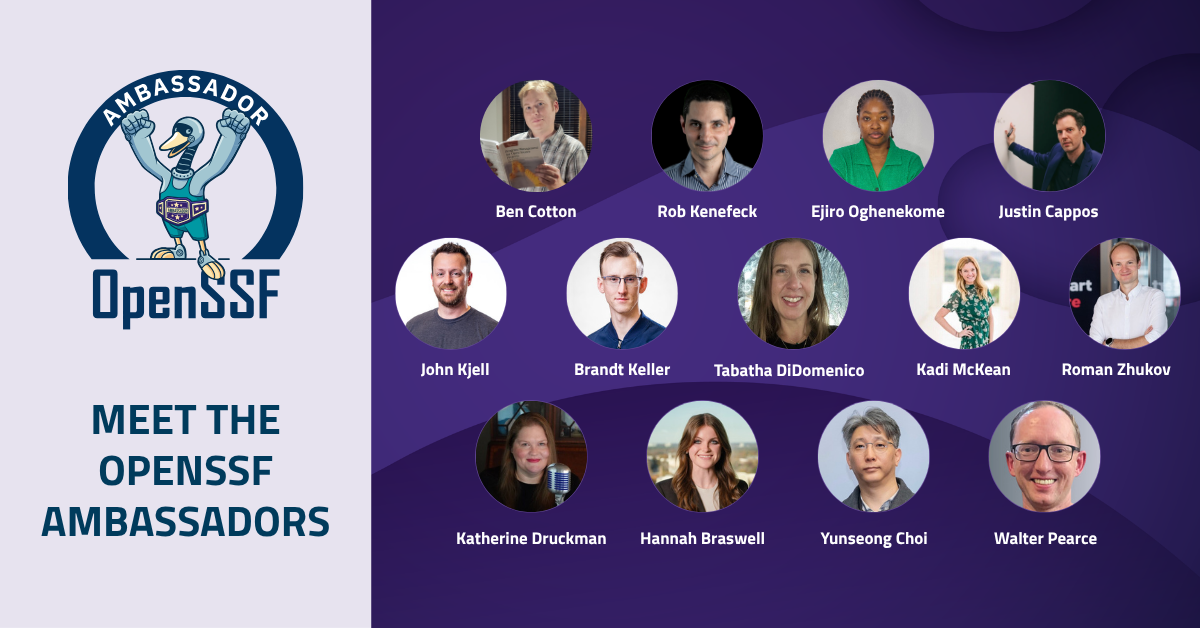
Today, at OpenSSF Community Day, we are beyond excited to announce the launch of the OpenSSF Ambassador Program and to introduce the 13 incredible community leaders who make up our First Cohort!
Earlier this year, we put out a call for community leaders to apply to become OpenSSF Ambassadors. The response was incredible, and reviewing the impressive backgrounds of our applicants reinforced just how dedicated our community is to open source security.
The OpenSSF Ambassador Program was created to empower passionate open source security advocates. Our Ambassadors are recognized leaders who share the OpenSSF vision of a future where open source software is secure by default.
Whether they are writing thought leadership articles, speaking at global conferences, contributing to critical working groups, or mentoring the next generation of security professionals, our Ambassadors are the dedicated champions of our community.
Over the past couple of weeks, you may have noticed the reveal of our amazing Ambassadors. Today, we are happy to present the complete lineup. These individuals bring a diverse wealth of knowledge spanning supply chain security, policy, community building, and engineering.
Please join us in welcoming:
Ben Cotton is the Open Source Community Lead at Kusari. He has been active in Fedora and other open source communities for over a decade. His career has taken him through the public and private sector in roles that include desktop support, high-performance computing administration, marketing, and program management. Ben is the author of Program Management for Open Source Projects.
Rob Kenefeck is a Field CTO at ControlPlane. He likes to talk about how Security is fundamental to DevOps and how Kubernetes often isn’t the best answer to your reliability problem. A CNCF Ambassador and organizer of KCD Melbourne and CloudCon SYD, he has spent the last several years helping enterprises navigate the intersection of platform engineering, security, and cloud transformation. He participates in the CNCF TAG Security APAC group and brings a community-first perspective to his work believing that open source is how the industry levels the playing field on security.
Ejiro Oghenekome is a Cybersecurity Professional and Open Source Advocate passionate about open source security, cloud technologies, and digital resilience in Africa and globally. She contributes to open source projects like OpenSSF, focused on strengthening awareness and collaboration around secure open source ecosystems. Her interests include cybersecurity research, open source security, and security awareness within the African tech ecosystem, with a growing focus on deepening her technical expertise and contributing to real-world security solutions.
Justin Cappos is a NYU Professor and a Creator of five Linux Foundation projects: TUF, in-toto, Uptane, SBOMit, and gittuf. His research advances are adopted into production use by Google, RedHat/IBM, VMware, Docker, Amazon, Palantir, Lockheed Martin, Datadog, Bloomberg, millions of automobiles, and other IoT devices, and are also used to protect the legal code across a variety of jurisdictions, including Washington DC, Baltimore, and the State of Maryland.
John Kjell is a Principal Consultant at ControlPlane, where he helps some of the world’s most security-conscious organizations build and assure mission-critical platforms. He is a maintainer of the Witness and Archivista sub-projects under in-toto and serves as a co-chair of the CNCF’s TAG Security. John is also actively involved in several initiatives within the OpenSSF. Prior to joining ControlPlane, he was the Director of Open Source at TestifySec and held engineering leadership roles at VMware.
Brandt Keller is a Staff Software Engineer with a passion for Open Source. He serves as a Maintainer and Technical Lead for the CNCF Security & Compliance Technical Advisory Group, a Cloud Native Ambassador, and a project maintainer within the OpenSSF for the Zarf Project. He has led and contributed to multiple foundation working groups, to include publishing artifacts to enhance end-user security.
Tabatha DiDomenico is an Open Source Security Engineer and Advocate focused on the people and practices that keep open source secure and sustainable. She’s president of Security BSides Orlando, co-hosts the GR-OSS Out podcast, and contributes to OpenSSF and FINOS projects and working groups. At G-Research, she’s part of the Open Source team, working on supply chain security, secure open source practices, and community and developer relations.
Kadi McKean is passionate about the DevOps / DevSecOps community and has been since her days of working with COBOL development and Mainframe solutions. At ReversingLabs she collaborates with developers and security researchers to help entities prioritize their open source risk, reduce technical debt, and meet compliance objectives. When she’s not working with the developer community, she loves running, traveling, and hanging out with her dog Milo.
Roman Zhukov is a Cybersecurity Expert, Engineer, and Leader with over 20 years of hands-on experience securing complex systems and products at scale. Currently Principal Architect at Red Hat, he leads open source security strategy, upstream collaboration, and cross-industry initiatives focused on building trusted software ecosystems. Previously, Roman led Product Security & Privacy for Data Center and AI software at Intel. He is a Security Champion for several open source projects and an active contributor to working groups under the OpenSSF, Eclipse Foundation, and other global initiatives.
Katherine Druckman is a senior technologist, speaker, and longtime advocate for open ecosystems. Currently Head of Community and Partnership Engagement at JetBrains, she specializes in developer experience, combining software ecosystem strategy, content strategy, and community building, grounded in a foundation of hands-on software engineering experience and proven leadership. She is a long-time open source advocate, developer, and podcaster, and is currently the host of the Reality 2.0 podcast.
Hannah Braswell is an Associate Product Security Engineer at Red Hat, focusing on proactively securing complex open source systems. With a B.S. in Computer Engineering from NC State University, she brings a deep background in microarchitecture and embedded systems to her work in the open source ecosystem. As an active contributor to several projects and Working Groups within the OpenSSF, she is passionate about pragmatic development and using automation to enhance security workflows. She currently serves as the Community Manager for the OpenSSF Gemara Project and excels at making technical concepts digestible for all audiences. Outside of her work, she enjoys traveling, hiking, and exploring art exhibitions.
Yunseong Choi Yunseong Choi is a cybersecurity strategist dedicated to resilient open source ecosystems. An adjunct Professor at Kyonggi University and lecturer at Korea University, he bridges the gap between academic research and pragmatic open source security practices. As a member of the Presidential Council on National AI Strategy in South Korea, he spearheads national initiatives for SBOM/VEX standardization and compliance automation. He actively promotes global collaboration within the OpenSSF to ensure secure, sustainable open source ecosystems for developers worldwide.
Walter Pearce is a key Leader of the Rust Foundation’s Security Initiative. Walter comes from a 14-year career in security. For the past seven years, he has specialized in offensive security in the gaming industry, leading efforts to find and mitigate vulnerabilities affecting tens of millions of players at Epic Games and Blizzard Entertainment. Before that, he was a security consultant providing penetration testing, red teaming, and code review services for many Fortune 100 companies whose foci included operating systems, languages, and embedded systems. Walter has always had a passion for technical security problems and has built his career helping craft novel solutions to new, challenging issues in security. In his spare time, Walter enjoys playing open source games. He was previously a contributor and member of the Amethyst Game Engine and a lead contributor on other open source game development projects.
You will see our Ambassadors representing OpenSSF at upcoming industry events, hosting local meetups, and creating content to help developers secure their code. Be sure to follow them on socials, and say hello if you see them in the OpenSSF Slack!
Interested in becoming an Ambassador in the future? Sign up for our Newsletter for announcements regarding our next cohort application window.
By Nigel Douglas
By now a bunch of people in the OpenSSF community might already be aware of the Malicious Packages repository, but are you using it as part of your day-to-day software supply chain security?
The OpenSSF Malicious Packages repo is the first open source system for collecting and publishing cross-ecosystem reports of malicious packages – such as dependency and manifest confusion attacks, typosquatting, offensive security tooling, protestware and more.
In the past months we have seen a rise in targeted attacks on open source upstream registries like npm and PyPI – most notably Axios and LiteLLM. These compromised, misleading or outright malicious open source software packages are the focus for this project. A centralised source-of-truth repository for shared intelligence helps the open source community understand the complete range of threats, but ultimately to prevent developers consuming software dependencies that are essentially just backdoors in your codebase.
The reports in the Malicious Packages repo use the Open Source Vulnerability (OSV) format. OSV was, as the name suggests, originally created for classifying open source software packages in JSON-formatted output for known vulnerabilities, fix availability and other security advisory information. By using the OSV format for malicious packages it is possible to make use of existing integrations, including the OSV.dev API, the osv-scanner tool, deps.dev, and build your own tools on top of these open source data sources.
A good place to start is understanding how malicious packages or malware is classified in OSV. Similar to how vulnerabilities start with “CVE-” (ie: CVE-2025-3248), malicious packages start with “MAL-” (ie: MAL-2025-6812). You can simply curl the existing vulns endpoint for api.osv.dev, but instead of using a CVE ID, use the Malicious Packages ID.
curl -s "https://api.osv.dev/v1/vulns/MAL-2025-6812" | jq .
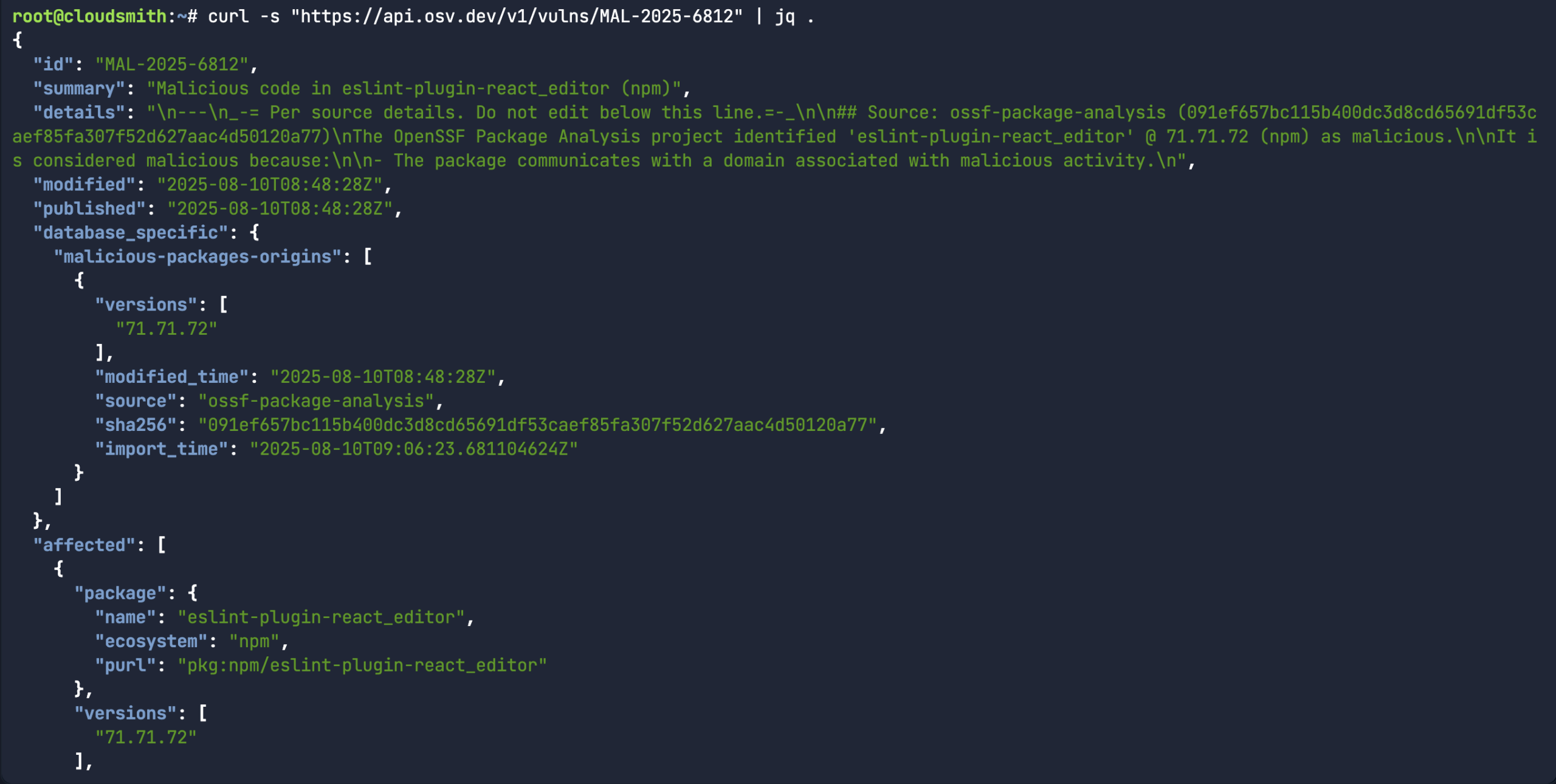 While the above command does return a bunch of information about a specific malicious package record, it would assume you already knew what the malicious package ID was in the first place. A more common use-case for the API is to look for a specific package name/version and the associated open source upstream source (ie: npm) to see if there’s a malicious package record associated with it.
curl -s -d   '{"package": {"name": "axios", "ecosystem": "npm"}}'   "https://api.osv.dev/v1/query" | \

  jq '.vulns[] | select(.id | startswith("MAL-"))'
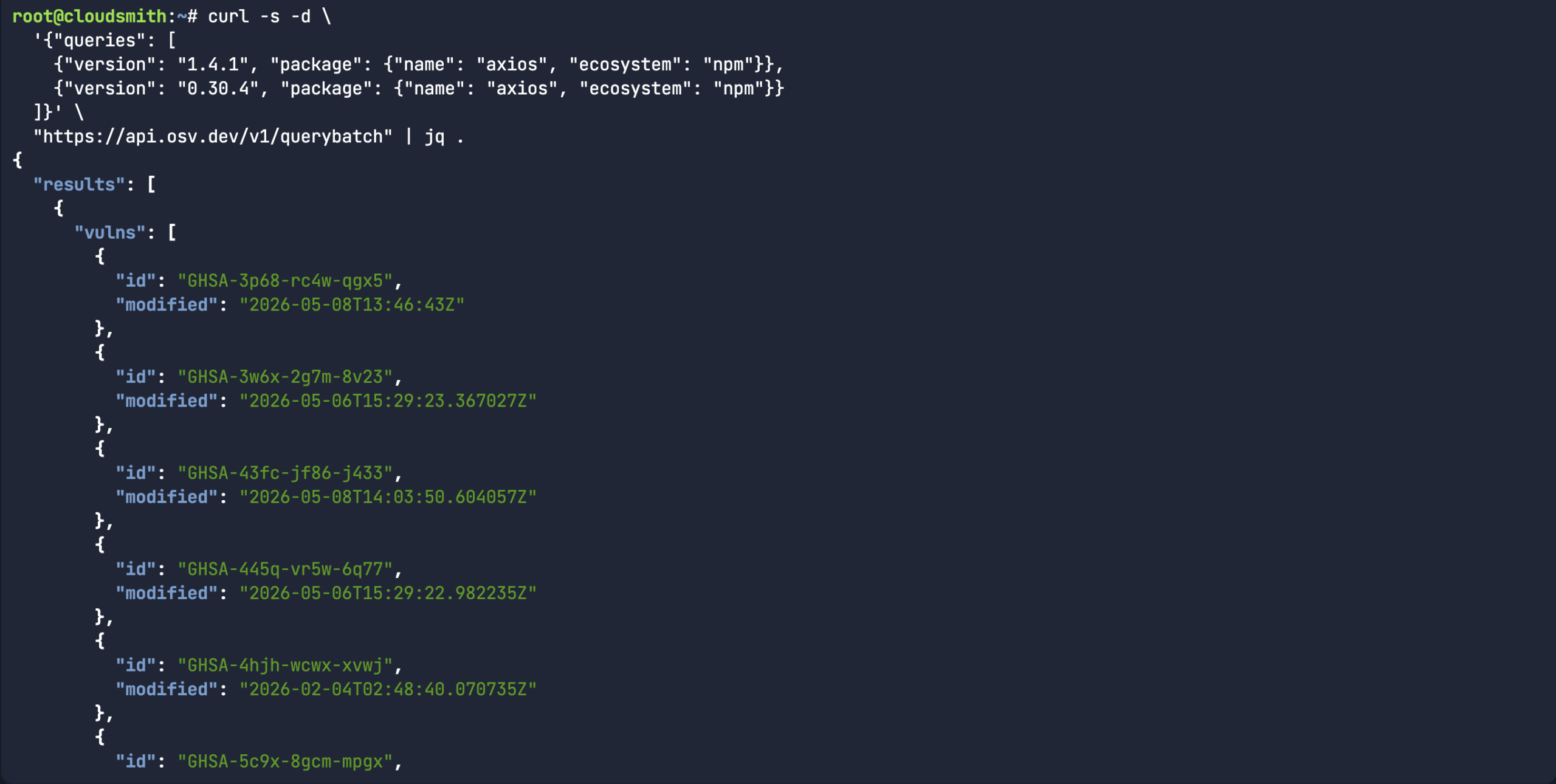
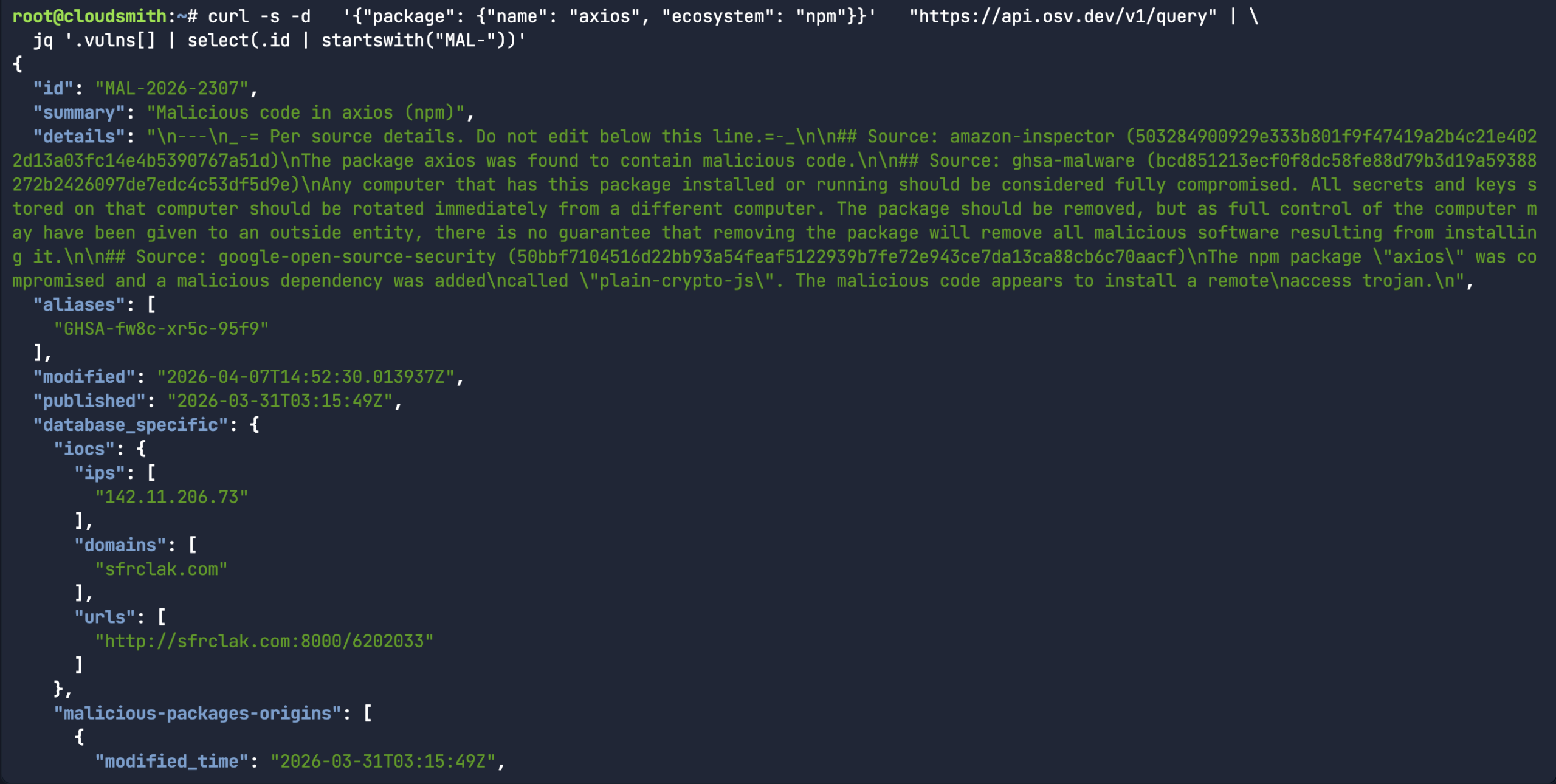 Or in the case of the Axios compromise, there were two different affected versions. Rather than scanning each version separately, you can use the querbybatch endpoint to handle multiple packages, versions and even ecosystems. In the case of MAL-2026-2307, both package versions carry the same malicious package ID.
curl -s -d \

  '{"queries": [

    {"version": "1.4.1", "package": {"name": "axios", "ecosystem": "npm"}},

    {"version": "0.30.4", "package": {"name": "axios", "ecosystem": "npm"}}

  ]}' \

  "https://api.osv.dev/v1/querybatch" | jq .
I came up with a simple osv-kubernetes.py scanner. The thought process here is that I could create a simple python-based Kubernetes deployment manifest. This pod has a list of Python packages in the filesystem of the pod, as seen when I run the pip list command.
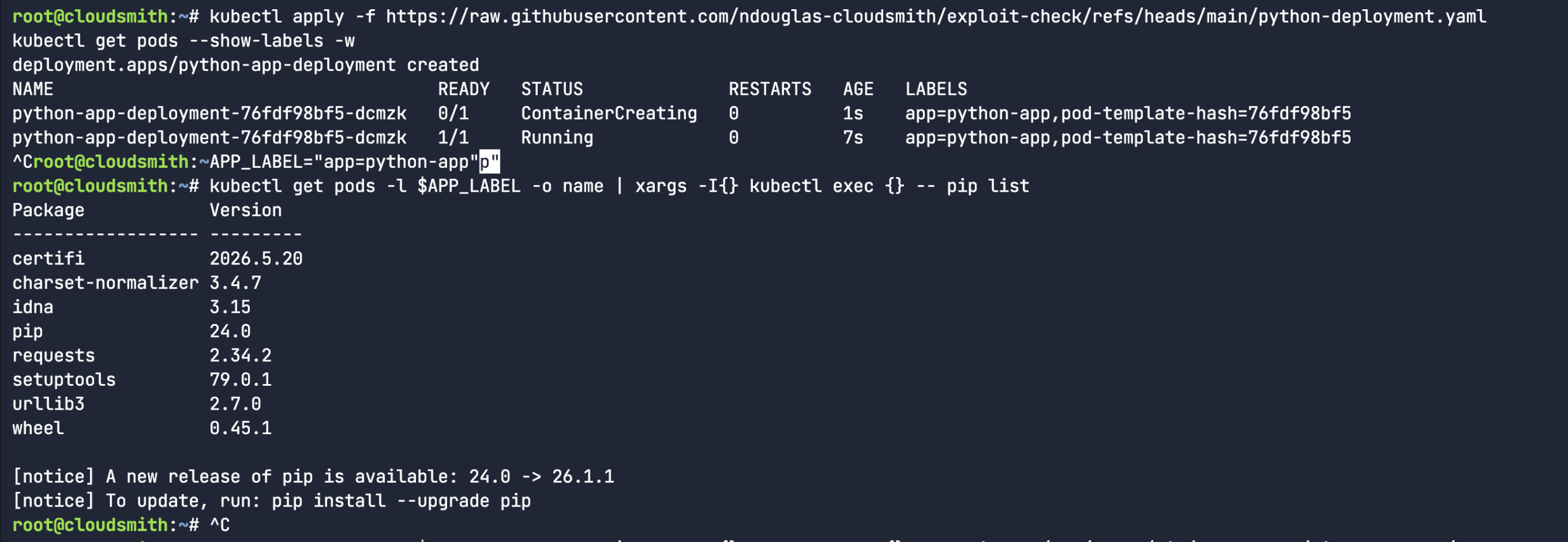 So, I proceeded to create a fake python library (rather than downloading an actual malicious software package). I mean, the package name and version were real, but I fabricated the entire content of the package. It’s a totally dummy package – as you can see from the below echo commands. Let’s see if our custom osv-kubernetes scanner script will pick it up.
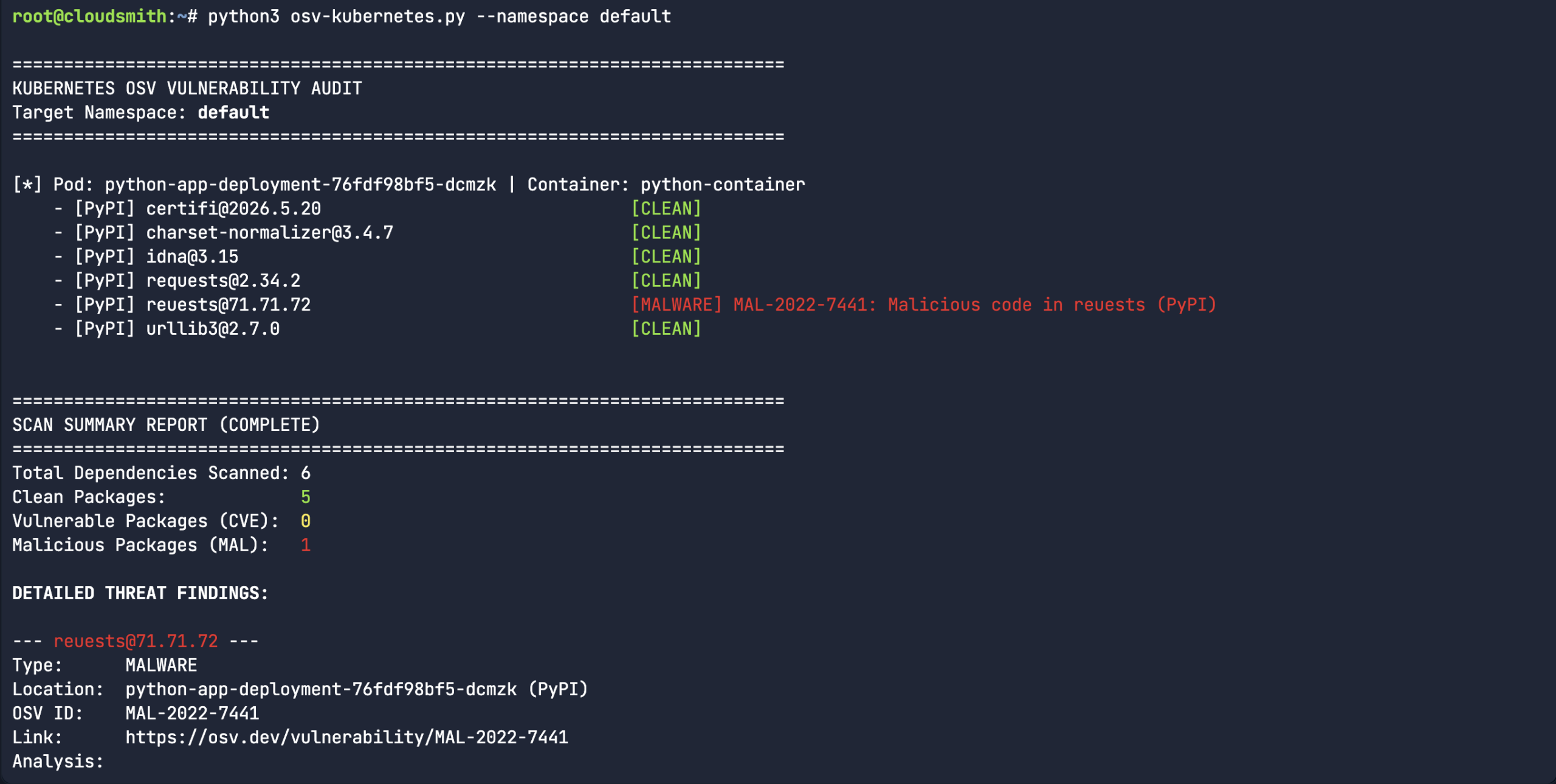 So, we created a fake typosquatted Python package. “Reuests” instead of the legitimate “Requests” library. All versions of the typosquatted Reuests library are tracked under MAL-2022-7441. While this is a simple experiment, it takes us beyond the manual process of scanning each library name and version, and automates it by piping the output of the pip list command into the API query. There are many ways that users can use the OSV API, this was purely an experiment for Kubernetes workloads.
While there are certainly use-cases for building your own custom scanners, like what we did with the Kubernetes pod scanner earlier, I would recommend using the official OSV-Scanner to find existing vulnerabilities and malicious code injection affecting your project’s dependencies. OSV-Scanner provides the officially supported frontend to the OSV database and CLI interface to OSV-Scalibr that connects a project’s list of dependencies with the vulnerabilities that affect them.
In the below scenario, I used syft to create a simple Software Bill of Materials (SBOM) in JSON output based on an existing Python requirements.txt file. As we found out earlier, the OSV API is entirely JSON-structured, so we wouldn’t scan unstructured .txt files. The most common file to scan would be the SBOM or lock files (ie: osv-scanner –lockfile=package-lock.json).
syft packages requirements.txt -o cyclonedx-json=sbom.cdx.json
osv-scanner -L sbom.cdx.json
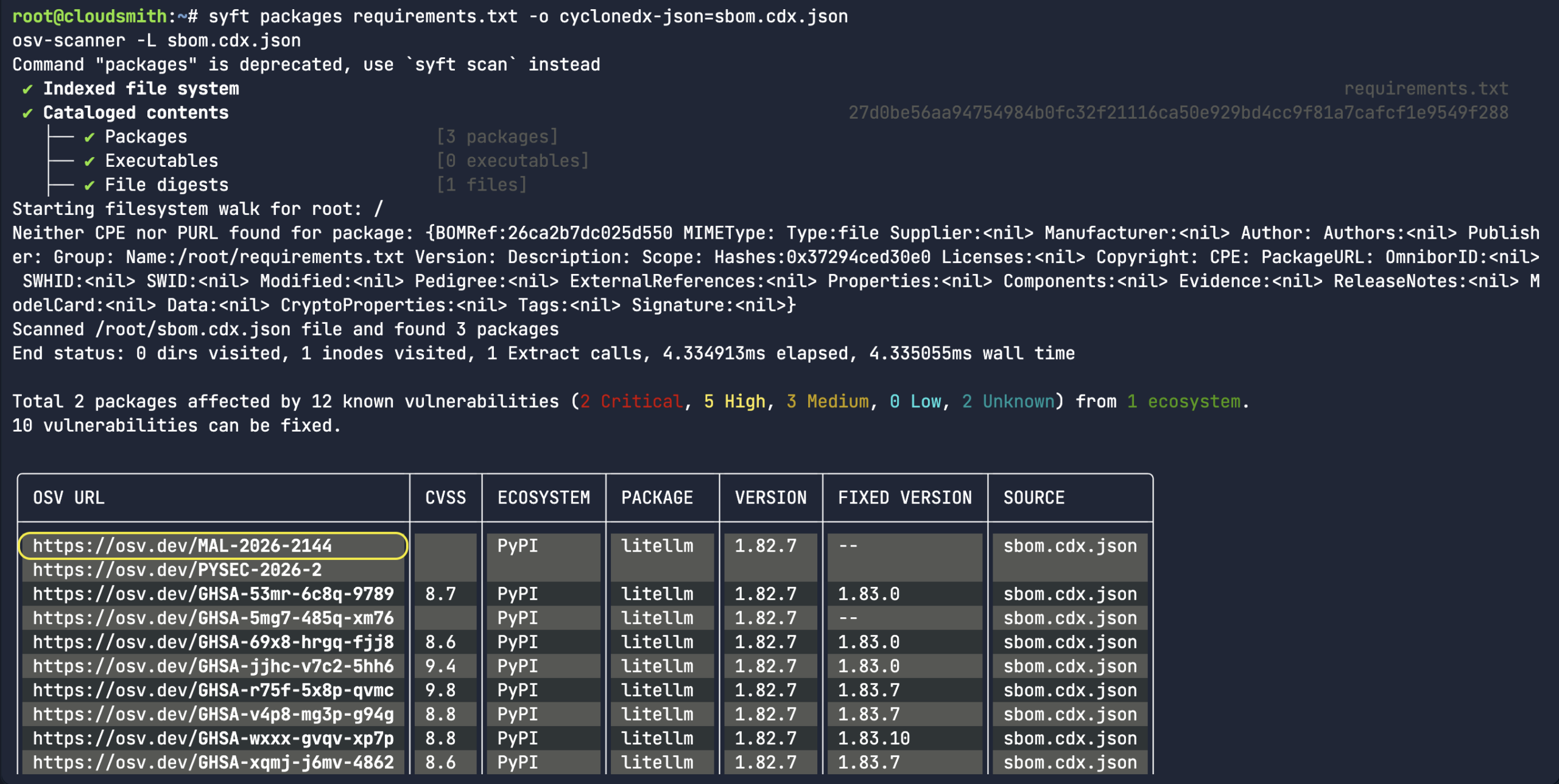
As you can see from the screenshot, the CycloneDX SBOM is successfully sourced. The packages LiteLLM and requests were correctly identified as being from the PyPI ecosystem since the Python requirement.txt file was converted into SBOM. As well as having multiple security advisories related to an upstream compromise, LiteLLM was corrected marked as malicious – MAL-2026-2144.
Again, this process is good and all, but you really need to integrate it into the CI/CD process. The OSV-Scanner Github Action leverages the malicious packages repository and the OSV-Scanner CLI tool to track and notify you of known malicious packages across the existing languages and ecosystems. The most common workflow for Github triggers a scan with each pull request and will only report new instances of malware introduced through the PR. The Github Action compares a scan of the target branch to a scan of the feature branch, and will fail if there are new vulnerabilities or malicious packages introduced through the feature branch. Alternatively, this process can be achieved on Scheduled Scans using a cron job.
I say this a lot, but in light of the recent axios@1.14.1 compromise, please make sure you always commit your npm project with the package-lock.json file. It is the only version-locking enforcement mechanism that exists in npm today. Developers should be using npm ci instead of blindly using npm install on Javascript libraries sourced from npm. The npm ci command will only work if a package-lock.json file exists. These lockfiles can also be easily scanned, as seen with osv-scanner.
Likewise, if you need to update or pull new packages from open source registries like npmjs.com, it’s also worth using the –min-release-age flag (available since npm v11.10.0) to make sure you only install updates, which are at least 3 days old (ie: npm install –min-release-age=3). Most open source malicious packages end up getting classified by OSV.dev within the first 3 days, so configuring a cooldown period is perfect to help prevent consumption of unknown or new variants of malware campaigns.
You can literally hardcode this setting (min-release-age=7) into your .npmrc file. There will always be more malicious actors attacking popular npm and PyPI packages in the future. Thankfully, most will get caught in the first 24 hours, in part due to the fantastic work going on within the OpenSSF Malicious Package packages project. I’m not trying to say that the Javascript (npm) and Python (PyPI) ecosystems are broken by design, but we certainly cannot apply blind trust to the software supply chain.
Get Involved: Help Us Secure the Ecosystem
The strength of the OSV project lies in its community. You can help protect the open source landscape by:
 Nigel Douglas is the Head of Developer Relations at Cloudsmith. He champions Cloudsmith’s developer ecosystem by creating compelling educational content, engaging with developer communities, and promoting software supply chain security best practices. Nigel helps build and shape the DevOps community through events, tutorials, and innovative programs.
By Tracy Ragan
Over the past decade, the IT community has made significant progress in improving pre-deployment vulnerability detection. Static analysis, Software Composition Analysis (SCA), container scanning, and dependency analysis are now standard components of modern CI/CD pipelines. These tools help developers identify vulnerable libraries and insecure code before software is released.
However, security does not end at build time.
Every successful software attack ultimately exploits a vulnerability that exists in a running system. Attackers can and do target code repositories, CI pipelines, and developer environments; these supply chain attacks are serious threats. But vulnerabilities running in live production systems are among the most dangerous because, once exploited, they can directly lead to persistent backdoors, system compromise, lateral movement, and data breaches.
This reality exposes an important gap in how organizations manage vulnerabilities today. While significant attention is placed on detecting vulnerabilities before deployment, far fewer organizations have effective mechanisms for identifying newly disclosed CVEs that affect software already running in production.
Across the industry, most development teams today run some form of pre-deployment vulnerability scanning, yet relatively few maintain continuous visibility into vulnerabilities impacting deployed software after release. This imbalance creates a dangerous blind spot: the systems organizations rely on every day may become vulnerable long after the code has passed through security checks.
As the volume of vulnerability disclosures continues to increase, the industry must rethink how post-deployment vulnerabilities are detected and remediated.
Modern software systems depend heavily on open source components. A typical application may include hundreds, or even thousands, of transitive dependencies. While security scanning tools help identify vulnerabilities during development, they cannot predict vulnerabilities that have not yet been disclosed.
New CVEs are published daily across open source ecosystems. When a vulnerability is disclosed affecting a widely used package, thousands of deployed applications may suddenly become vulnerable, even if those applications passed every security check during their build process.
This creates a persistent challenge: software that was secure at release can become vulnerable later without any code changes.
In many organizations, the detection of these vulnerabilities relies on periodic rescanning of artifacts or manual monitoring of vulnerability feeds. These approaches introduce delays between vulnerability disclosure and detection, extending the window of exposure for deployed systems.
Because attackers actively monitor vulnerability disclosures and quickly develop exploits, this detection gap creates significant operational risk.
Organizations today use several methods to identify vulnerabilities affecting deployed software. While each approach has value, they are often costly and introduce operational complexity.
One common strategy involves rescanning previously built artifacts or container images stored in registries. Security teams periodically run vulnerability scanners against these artifacts to identify newly disclosed CVEs. Although this approach can detect vulnerabilities that were unknown at build time, the process cannot identify where the containers are running across system assets.
Another approach relies on host-based security agents or runtime inspection tools deployed on production infrastructure. These tools identify vulnerable libraries by inspecting installed packages or monitoring application behavior. In practice, these solutions are most commonly implemented in large enterprise environments where dedicated operations and security teams can manage the operational complexity. They often require significant infrastructure integration, deployment planning, and ongoing maintenance.
Agent-based approaches also struggle to support edge environments, embedded systems, air-gapped deployments, satellites, or high-performance computing clusters, where installing additional runtime software may not be feasible or permitted. Even in traditional cloud environments, deploying and maintaining agents across thousands of systems can be a substantial operational lift.
This complexity stands in sharp contrast to pre-deployment scanning tools, which can often be installed in CI/CD pipelines in just minutes. Integrating a software composition analysis scanner into a build pipeline typically requires only a small configuration change or plugin installation. Because these tools are easy to adopt and operate earlier in the development lifecycle, they have seen widespread adoption across organizations of all sizes.
Post-deployment solutions, by comparison, often require significantly more effort to deploy and maintain. As a result, far fewer organizations implement comprehensive post-deployment vulnerability monitoring. While most development teams today run some form of pre-deployment vulnerability scanning, relatively few maintain continuous visibility into vulnerabilities impacting software already running in production. This leaves a critical visibility gap in the environments where vulnerabilities are ultimately exploited: live operational systems.
A more efficient model for detecting post-deployment vulnerabilities already exists but is often underutilized.
Software Bill of Materials (SBOMs) provide a detailed inventory of the components included in a software release. When generated during the build process using standardized formats such as SPDX or CycloneDX, SBOMs capture critical metadata, including component names, versions, dependency relationships, and identifiers such as Package URLs.
SBOM adoption has accelerated in recent years due in part to initiatives such as Executive Order 14028 and ongoing work across the open source ecosystem. Organizations increasingly generate SBOMs as part of their software supply chain transparency efforts.
Yet in many environments, SBOMs are treated primarily as compliance documentation rather than operational security tools. Instead of being archived after release, SBOMs can serve as persistent inventories of the components running in deployed software systems.
When SBOMs are available and associated with deployed releases, detecting newly disclosed vulnerabilities becomes significantly simpler.
Vulnerability intelligence feeds, such as the OSV.dev database, the National Vulnerability Database (NVD), and other vendor advisories, identify the packages and versions affected by each CVE. By correlating this vulnerability information with stored SBOMs and release metadata, organizations can quickly determine whether a deployed asset includes an affected component.
Because the SBOM already describes the complete dependency graph, there is no need to reanalyze artifacts or rescan source code. Detection becomes a metadata correlation problem rather than a compute-intensive scanning process.
This model enables organizations to continuously monitor deployed software environments and identify newly disclosed vulnerabilities almost immediately after they are published.
To operationalize this approach at scale, organizations need systems capable of continuously tracking the relationship between software releases, deployed environments, and their associated SBOMs. One emerging concept is the creation of a software digital twin, a continuously updated model that represents the software components running across operational systems.
A digital twin maintains the relationship between deployed endpoints and the SBOMs that describe the software they run. By synchronizing these SBOM inventories with vulnerability intelligence sources such as OSV.dev or the NVD at regular intervals, organizations can automatically detect when newly disclosed CVEs impact running systems.
Rather than waiting for scheduled scans or relying on agents installed on production infrastructure, this model enables continuous vulnerability awareness through metadata synchronization.
Once an affected component is identified, remediation workflows can also be automated. Modern development platforms already rely on dependency manifests such as pom.xml, package.json, requirements.txt, or container Dockerfiles. By automatically updating these dependency files and generating pull requests with patched versions, organizations can rapidly move fixes back through their CI/CD pipelines.
This type of automation has the potential to reduce vulnerability remediation times from months to days, dramatically shrinking the window of exposure. And, it is easy to scale, giving developers more control and visibility into the production threat landscape.
Efforts across the Open Source Security Foundation (OpenSSF) ecosystem have helped establish the foundational infrastructure needed for this approach.
The OSV.dev vulnerability database provides high-quality vulnerability data tailored to open source ecosystems. Standards such as SPDX and CycloneDX enable consistent representation of SBOM data across tools and platforms. Projects like OpenVEX provide mechanisms for communicating vulnerability exploitability context, helping organizations determine which vulnerabilities require immediate attention.
Together, these initiatives create the building blocks for a more efficient and scalable vulnerability management model, one that relies on accurate software inventories and continuous vulnerability intelligence rather than repeated artifact scanning.
Pre-deployment security scanning will continue to play an important role in software development. Identifying vulnerabilities early in the development lifecycle reduces risk and improves software quality.
But the security landscape is evolving. As software ecosystems grow more complex and vulnerability disclosures increase, organizations must also strengthen their ability to detect vulnerabilities that appear after software has already been deployed.
Rethinking post-deployment vulnerability detection means shifting away from repeated artifact scanning and toward continuous monitoring of software composition.
SBOMs provide the foundation for this shift. When combined with digital twin models that track deployed software, continuous synchronization with vulnerability databases, and automated dependency remediation, organizations can dramatically improve their ability to defend operational systems.
One thing is certain: attackers ultimately focus on exploiting vulnerabilities running in live systems. Gaining clear visibility into the attack surface, understanding exactly what OSS packages are deployed, where they are running, and how quickly they can be remediated, is essential to securing live systems from cloud-native to the edge.
 Tracy Ragan is the Founder and Chief Executive Officer of DeployHub and a recognized authority in secure software delivery and software supply chain defense. She has served on the Governing Boards of the Open Source Security Foundation (OpenSSF) and currently serves as a strategic advisor to the Continuous Delivery Foundation (CDF) Governing Board. She also sits on both the CDF and OpenSSF Technology Advisory Committees. In these roles, she helps shape industry standards and pragmatic guidance for securing the software supply chain and advancing DevOps pipelines to enable safer, more effective use of open-source ecosystems at scale.
With more than 25 years of experience across software engineering, DevOps, and secure delivery pipelines, Tracy has built a career at the intersection of automation, security, and operational reality. Her work is focused on closing one of the industry’s most critical gaps: detecting and remediating high-risk vulnerabilities running in live, deployed systems, across cloud-native, edge, embedded, and HPC environments.
Tracy’s expertise is grounded in decades of hands-on leadership. She is the Co-Founder and former COO of OpenMake Software, where she pioneered agile build automation and led the development of OpenMake Meister, a build orchestration platform adopted by hundreds of enterprise teams and generating over $60M in partner revenue. That experience directly informs her current mission: eliminating security blind spots that persist long after software is released.
In this episode, CRob talks with Mike Lieberman from Kusari about the current state of open source security. They discuss the growing burden on maintainers from the “deluge” of noisy, low-quality vulnerability reports, often generated by AI tools, and the vital role of “a human in the loop.” Mike introduces Kusari’s tool, Inspector, explaining how it uses codified security expertise to process data from tools like OpenSSF Scorecard and SLSA, effectively filtering out false positives and giving maintainers only high-quality, actionable reports. They also dive into the design philosophy of “don’t piss off the engineers” and share a vision for the future of security tooling that focuses on dramatically better user experience and building security primitives that are “secure by design”.
00:06 Introduction: The Biggest Challenge in Security Tooling
01:12 Overwhelmed Maintainers: The Deluge of Low-Quality AI Reports
04:00 Introducing Kusari’s Inspector: How it Filters False Positives
08:40 The Secret Sauce: Security Expertise and the Need for Reproducible Tests
12:03 Meeting Engineers Where They Are: Design Choices to Reduce Maintainer Burden
18:16 The Future of Open Source Security Tooling: Focusing on Better UX
22:19 Call to Action: The Responsibility of Large Organizations
(0:00) Intro Music
Mike Lieberman (00:06)
I think the biggest thing in security tooling is better user experience. I think that to me is one of the biggest challenges.
CRob (00:25)
Welcome, welcome, welcome to What’s in the SOSS?, the OpenSSF’s podcast where I talk to developers, maintainers, security experts, and people in and around this amazing open source ecosystem. Today, again, we have a real treat. Friend of the show, Mike Lieberman from Kusari is joining us again after – I don’t know if your podcast was toppled from its place of the most listened to before, but we’re gonna see if we can make another hit for us. But we’re here today to talk about some interesting developments that you and your crew are involved in and just things going on in open source security. So how have you been, sir?
Mike Lieberman (01:07)
Well, thank you for having me back and yeah, things are going pretty well.
CRob (01:12)
Well, let’s dive right into it. Recently, and this is a topic that I’m actually dealing with this very moment while we’re recording this podcast, that open source maintainers are just currently overwhelmed by just this deluge of noisy, low quality reports, a lot of them generated by AI tools. So kind of thinking about it with your, many hats you wear, as you know, business owner, a community member, and a long time developer, a security expert. From your perspectives, what is actually creating the most burden today? And think about it through the lens of this project you’re going to share with us in a moment.
Mike Lieberman (01:57)
Yeah, sure. So I think to kind of start, the problem has been the same problem since, know, throughout human history, it is a combination of either bad actors or just lazy people that are I would say the biggest issue here. Right. We have a lot of things like AI reports generating awful sort of vulnerability, know, fake vulnerabilities or whatnot. But if we kind of look at it through the lens of like history through tech, we saw the same thing with any sort of automation, right? When, yeah, exactly. When people could kind of create scripts, hey, let me go in spam this one project with my script. Let me spam a whole bunch of projects with my sort of automation or whatever. And, you know, the same thing sort of happened when people, when we started moving away from mailing lists to sort of GitHub and those sorts of things as well. So I think it’s really to kind of take a step back. It’s kind of how people are using the tools more so than the tools themselves. But I do think when it comes to a lot of the security reports, yeah, it is folks who are just kind of asking an LLM.
Hey, find me find me some zero day. And of course, that’s never going to work because the LLMs don’t have that information. And it’s just it kind of comes back to you need people who understand what they’re doing, using the tools in the right way in order to kind of figure out some of this stuff.
CRob (03:42)
Yeah, human in the loop. Our dear friend, Dr. David Wheeler has a saying, he says, a fool with a tool is still a fool. So again, having those experts in there, helping out is critical. So let’s…
Mike Lieberman (03:43)
Yeah.
CRob (04:00)
You’ve been in this space for a long time, focusing in on supply chain security, and you’ve written or contributed to a ton of tools. And most recently, you all helped create over at Kusari a tool called Inspector. So from just a high level TLDR, how do you see things like Inspector kind of changing this dynamic of getting more people involved or getting more expert knowledge in?
Mike Lieberman (04:26)
Sure. I think like the things. So actually to take a step back, right? There’s a lot of great tools that are being built. The challenge with those tools is, and the way I kind of think about it is like, you know, home security, right? It’s, hey, there’s a ton of tools out there that are helping out with open source security the same way that there’s a ton of tools out there for, you know, a smarter lock. A better security system.
CRob (04:59)
A doorbell that can find your dog.
Mike Lieberman (05:02)
There’s privacy concerns on that one. think, you know, we can all agree on that. But I think to that extent, when it comes to sort of these tools, it’s in how they’re used. And also, the expertise that’s required in how to use them. And also, when building the tools, what sort of expertise went into building the tools? And I think that to me is where the big gap is with just sort of some of the AI related things is you have folks using a very generic system like an LLM. And just saying, hey, LLM become a security expert and do this stuff. And of course the LLM makes a lot of mistakes and whatever. But if you were to kind of say through things like MCP and LLM skills and all these other things, if you have a way of codifying, run open SSF scorecard, run, you know, SLSA and run all of these various things and put all of this together and generate me an SBOM using these tools and whatnot. And then you can take all that, then hand the output to the LLM and say, hey, here’s everything I discovered. Here’s also the code. Help me make sense of it. And I think that to me is kind of where a lot of the benefit is. And again, what I just described is essentially inspector, right?
We’re running all of these various tools, again, that we understand because we’ve contributed to those tools, we’ve helped maintain some of those tools, we have been users of these tools for years. So we understand how they’re supposed to be used. We understand how a human who is, before the age of AI would be using these tools. And we recognize the burden of that expertise. And we’ve sort of encoded it. Had the LLM kind of come in at the last mile and then take all that information, and say, hey, if there is a finding, a vulnerability, great. Where does that vulnerability live? Is that a vulnerability in a core piece of my code, which yes, I need to address right now, or is it like, it’s in a test? Yes, it’s probably something I should fix, but maybe not the biggest issue right this second. And so I think tools like that are really helping because the thing that we found, and again, a user of inspector told us this, and I won’t call out the exact AI tool they were using, but they were using a generic LLM with some stuff. And then they were using inspector. And one of the things that they had said was, wow. Yeah. Like inspector is actually catching the issue with all of the, the, uh, it detected that a particular issue was essentially a, um, a false positive because it looked at a potential remote code execution and looked at all the stuff alongside the code and said, you are clearly have an allow list. So given that you have this allow list, we recognize it’s not a remote code execution, or rather arbitrary code sort of execution attack. And I think it’s stuff like that, that we’re seeing starting to get developed more and more. Whereas a lot of the tradition, I want to say traditional with AI, even though it’s been, you know, like in the past year, everything shifts. Yeah.
When we look at sort of how folks were using LLMs even just a year ago, a lot has shifted and we’re seeing less of these false positives coming out of AI because people are using AI the way it should be used, where it’s you’re supplementing all these other tools that are out.
CRob (08:40)
That’s awesome.
And this might lead into this next question. AI and automation are finding a lot more potential issues, but they’re not always better. And is that what you think that secret sauce of having that security expertise and that helps kind of balance out finding a vulnerability and then kind of sharing that information with the maintainer effectively?
Mike Lieberman (09:08)
Yeah, so I mean, I think when it comes to stuff like that, the way I, you know, I was actually having a conversation with a friend just a few days ago about this issue and I’m reminded of issues just even before AI. And one of the big things that maintainers would ask is, give me a way to reproduce this. If you’re not gonna give me a way to reproduce this, I’m not gonna, you know, I’m not gonna accept your report here and I’m not gonna do a ton of investigation to figure out what you intended to mean.
And I think it’s the same way with AI here, where we’re starting to see with some of the stuff coming out of AI XCC and some other places, we are starting to see tools that are being built that are actually generating the tests and whatnot that can reproduce these vulnerabilities that the LLMs are claiming, or AI tools are claiming. And I think that to me is important because when I look at Daniel from Curl or some of these other folks who are like,
I am so sick of all of these AI reports. It’s like every single one that they’re claiming is an AI report, it’s like they didn’t give me a way to reproduce it. Or even worse, the AI said, here’s a list of steps to reproduce. folks are coming out and saying, that function that you were claiming needs to get run doesn’t exist. And so I’m just thinking to myself, well, why not just write a test that does that thing, you know, and have the LLM write the test, whatever, but prove out that like, hey, an AI tool generated a test and I can run that test and I could see, yep, that is an exploit. That is actually a vulnerability. Now I can go and take that and package it up, it over to, you know, hand it over to the maintainer. And I think if I’m as a maintainer of various open source projects,
If I received something that said, hey, here is a test, you can run that test. And again, by the test, mean like an actual test, a test that makes up other code and tries to do whatever, but an actual test. If you have that, I as a maintainer would say, absolutely, that is a real vulnerability. But I think the thing that we’re seeing right now is we’re seeing all this sort of slop, which is.
Again, it’s just similar to the slop we saw years ago with other sort of automated vulnerability reporting and just generally in tech. And I think the problem here is still kind of comes back to lazy maintainer or sorry, not lazy maintainers, but lazy submitters and just other sort of bad actors who are just like, yeah, I’m just gonna throw a thing out there and hopefully one of these is right. And I’m gonna get it, make a name for myself.
CRob (11:58)
A wise man once said that knowing is half the battle.
Mike Lieberman (12:01)
Yes.
CRob (12:03)
And thinking about it from this maintainer developer perspective, almost always maintainers are volunteers first. They’re there because they have amazing idea they wanna share, they have a problem they’re trying to solve. Some people are paid to do a specific thing, but the majority of folks are volunteers first. And security experts 12th, 18th, security is not necessarily a core skill that most developers have. what design choices, kind of thinking about when you were looking at Inspector, what design choices did you make to help meet the maintainers where they are, where they are experts in languages or frameworks or kind of these techniques or algorithms? But how are you helping them where they are rather than expecting them to become a full-time securityologist like you or I?
Mike Lieberman (12:58)
So we have a mantra here at Kusari, which is essentially just don’t piss off the engineers, right? As engineers ourselves, as folks who, myself, I am a software engineer first, or really more of a dev ops, dev sec ops engineer first, became more of a software engineer over time. But one of the big sort of mantras was, one of the things that always frustrated me was you have to do all the security stuff.
And they were burdens to my daily job, right? Where I was not being, you know, again, this is me both as a maintainer of open source projects and also just, hey, I get paid as an engineer or whatever. What, but at the end of the day, I wasn’t incentivized to do secure things. I might’ve been yelled at. I might’ve been told thou shalt do this security thing, but my incentives were getting out this new feature, making my customer or my user happy, right?
And so when it comes to those sorts of things, that’s kind of how we’ve encoded all of this, where if somebody told me, hey, Mike, you put in a potential remote code execution attack or arbitrary code, whatever it is, like you put a SQL injection attack or some other, you’re not handling this off thing correctly. If you told me, yeah, that’s the thing. And you told me what I might need to look at. yeah, let me get on that. Let me fix that.
If you were to tell me, hey, you’re using a library that isn’t maintained and that everybody has mostly moved over to this other library, cool. I’ll, I’ll work on that, but don’t make the burden. Hey, there’s a, this library is unmaintained. Okay. What am I, what am I supposed to do about it? I don’t know what I’m supposed to do about it. Help me with suggestions. So when it comes to inspector, those are the sorts of things that we sort of baked in is we’re not just telling you this project. Is it maintained?
We’re telling you, hey, this project isn’t maintained, but it’s used in just one test. So maybe it’s not the immediate thing that needs to be fixed versus, hey, this thing is completely unmaintained and it’s potentially vulnerable. And this is something new you’re adding. Like this isn’t something that already exists. This is just bad practice. Like you should probably not include this new thing. Or, you know, and again, providing the suggestions to the user on what to actually do about it.
And some of those things can then be, know, know, inspector has a CLI tool that you can use. And I use it myself with Claude where, Hey, I run it kind of come in and, you know, uh, fix it. And like, it works pretty well. So I think again, it’s, it’s having, um, it’s, it’s the combination of things to sort of make sure that it, as an engineer, you know, you’re not being asked to become an expert in this thing, right? Uh, it’s okay to ask an engineer.
You are a database expert, you should be reasonable at securing databases, but securing the underlying OS and yada yada, hey, maybe you don’t need to be an expert in that. And that’s where tools like Inspector I think really help is they’re the ones who are being experts. Again, kind of going back to that, the home analogy, right? If I run a house, if I have a house, I don’t need to know the inner mechanics of know, a pin tumbler lock and yada, yada and, and, and how the various cameras, you know, that that are looking at the outside of my house, how they all interoperate. No, I just need to know, are they working if something kind of, you know, the battery died on this, I know how to change your battery, let me kind of focus on that. But if they were kind of come in and say, No, no, you need to understand the innards of the networking and you need to understand audio visual processing, I’d be like, No, just not gonna work.
So again, make sure that developers can focus just on what their experts in, and what their primary responsibility is, which is usually to the user. And yes, security is a responsibility there, but they’re not going to be generic security experts. And so what can we do to help them hold their hand and tell them what needs to be done in a way that they can kind of say, yeah, you’re asking me to do two or three small little things. Awesome. By the way, we here at Kusari have made Inspector free for open source, but not just open source, specifically for CNCF and open SSF. You have full sort of unfettered access, no rate limits, no quotas. And love to see folks sign up. The website is kusari.cloud. And yeah, yeah, I want to see folks using it.
CRob (17:45)
It’s really interesting and I love the focus on again, because you’re all you grew up through this. are in software engineer. So I love the focus on trying to how to relieve that burden from these, this army of volunteers. So let’s do something else we do often in cybersecurity. Let’s get our crystal ball out and, you know, thinking ahead from your perspective, what do you think, you know, good security tooling for open source looks like in three to five years?
Mike Lieberman (18:16)
I think the biggest thing in security tooling is better user experience. think that to me is one of the biggest challenges. And right today, and I think that’s where a lot of folks are focusing their efforts, it’s, you we need to some extent, you know, and I know, like, the first thing that came to mind, is Kubernetes, but for security, right? And I recognize that Kubernetes, depending on who you talk to, you know, YAML files,
But no, it really did democratize and make simpler the orchestrating complex container workloads, right? And I think when it comes to security, user experience is often kind of a secondary concern compared to just the, did I prevent the security, you the issue, but that’s kind of, as our world continues to get more complex and complicated and things are scaling up and we’re having AI and all these different things. The need for security continues to increase more and more every day. But with that said, if the answer is using these security tools requires, you know, tons of certifications and whatnot for just to use the security tool, right? Not to become an expert, but just to use the security tool, if you need to be an expert in all these different things, it becomes super difficult, nobody’s gonna do it. So I think we’re gonna start to see to some extent, more tools like Inspector, but also in addition to that, more tools like, and I know we’re working on this in OpenSSF, tools that make adopting of Salsa trivial for the average project. Tools that help just sort of generally with security build out that UX, make it simpler for the average engineer to do that. Similar to how we saw stuff
in that space with DevOps, right? Where you had developers and operations, those worlds kind of became more combined. And what happened was you had tools like your Terraforms or, you know, Open Tofu and Ansible and all of these great things that kind of came out of that space to kind of make it easier for both folks who are focused in operations to get a little closer to developers and then developers to actually also help out with some of the operations, infrastructure, engineering, those sorts of things. And I think we’re gonna start to see more of that as time kind of goes on where those like, I’m gonna call like security primitives are more encoded in the tools we have. So I think we’re gonna start to see a lot of tools out there become secure by design and have a lot of the security features baked in. And then also the security tools that we have just generally become a little bit simpler and where areas where they can’t be super simple, we’re gonna see tools more tools like Inspector that kind of come in and operate similar to how you might imagine the security expert to kind of come in and put the pieces together, which again, doesn’t eliminate the security engineer. I just want to be clear, like security engineers are very much still needed. The challenge is the security engineer is now being tasked. Whereas before you had to be an expert in a small set of domains. Now you’re being asked to be an expert across everything and they need to understand that they’re going to be the ones who are like taking these new security tools and given that better UX are going to be able to scale that across, you know, 10,000 projects, you know, a hundred different AI agents, all of this, like, you know, a million containers, all of those things. So I think we’re going to start seeing a lot more of the security tools working better to scale up what we’re doing.
CRob (22:04)
That is an amazing vision. look forward to observing that over the years. Hopefully your vision becomes a reality. Yeah, thank And as we’re winding down, do you have any closing thoughts or any call to action for the audience?
Mike Lieberman (22:19)
Yeah, I think the, so there’s two big ones. One is, hey, if you’re a maintainer and engineer, right? I know you care about security because even when I was not a security engineer, I cared about security. So what I want to hear from maintainers is how can the open source world help, right? How can we help you not get clobbered by a million?
letters from lawyers and other people demanding security features in your stuff. How can we, as an open source community, help out, open source security community, help out? How can we make the tools easier? How can we make sure that those tools fit your needs? And that includes whether it’s inspector or, you know, other things, hey. And on that note as well, you know, CNCF and OpenSSF projects can use inspector..
And the other call to action, I know I say this a lot, large organizations that are using open source, it is your responsibility to provide the incentives to make sure that open source is more secure. Like we can all demand, hey, we need better open source security tooling. We need this, that, and the other thing. But if nobody’s paying for it, if at the end of the day, you know, a random engineer who’s making that open source security tool, if they can’t pay the bills, they’re not going to do that. If they are getting clobbered with a million different feature requests, it’s just not going to work. So we need to make sure. And I know that there’s things like the sovereign tech fund want to see more of that. But just sort of generally, I think it needs to come from these multi billion, multi trillion dollar companies coming in and saying, hey, we are willing to foot a good deal of this bill right in order to make the world more secure for everybody.
CRob (24:17)
Those are some wise words and also I think a wonderful vision we all can work towards together. Mike Lieberman from Kusari, thank you my friend. I loved having you on. And with that, we’re gonna call this a wrap. I want everyone to stay cyber safe and sound and have a great day.
By Ben Cotton and Dejan Bosanac
The superpower of open source is multiple people working together on a common goal. That works for projects, too. GUAC and Trustify are two projects bringing visibility to the software supply chain. Today, they’re combining under the GUAC umbrella. With Red Hat’s contribution of Trustify to the GUAC project, the two combine to create a unified effort to address the challenges of consuming, processing, and utilizing supply chain security metadata at scale.
The Graph for Understanding Artifact Composition (GUAC) project was created to bring understanding to software supply chains. GUAC ingests software bills of materials (SBOMs) and enriches them with additional data to create a queryable graph of the software supply chain. Trustify also ingests and manages SBOMs, with a focus on security and compliance. With so much overlap, it makes sense to combine our efforts.
The grand vision for this evolved community is to become the central hub within OpenSSF for initiatives focused on building and using supply chain knowledge graphs. This includes: defining & promoting common standards, data models, & ontologies; developing shared infrastructure & libraries; improving the overall tooling ecosystem; fostering collaboration & knowledge sharing; and providing a clear & welcoming community for contributors.
Right now, we’re working on the basic logistics: migrating repositories, updating websites, merging documentation. We have created a new GUAC Steering Committee that oversees two core projects: Graph for Understanding Artifact Composition (GUAC) and Trustify, and subprojects like sw-id-core and GUAC Visualizer. These projects have their own maintainers, but we expect to see a lot of cross-collaboration as everyone gets settled in.
If you’d like to learn more, join Ben Cotton and Dejan Bosanac at OpenSSF Community Day Europe for their talk on Thursday 28 August. If you can’t make it to Amsterdam, the community page has all of the ways you can engage with our community.
 Ben Cotton is the open source community lead at Kusari, where he contributes to GUAC and leads the OSPS Baseline SIG. He has over a decade of leadership experience in Fedora and other open source communities. His career has taken him through the public and private sector in roles that include desktop support, high-performance computing administration, marketing, and program management. Ben is the author of Program Management for Open Source Projects and has contributed to the book Human at a Distance and to articles in The Next Platform, Opensource.com, Scientific Computing, and more.
 Dejan Bosanac is a software engineer at Red Hat with an interest in open source and integrating systems. Over the years he’s been involved in various open source communities tackling problems like: Software supply chain security, IoT cloud platforms and Edge computing and Enterprise messaging.
By Sarah Evans and Andrey Shorov
The world of technology is constantly evolving, and with the rise of Artificial Intelligence (AI) and Machine Learning (ML), the demand for robust security measures has become more critical than ever. As organizations rush to deploy AI solutions, the gap between ML innovation and security practices has created unprecedented vulnerabilities we are only beginning to understand.
A new whitepaper, “Visualizing Secure MLOps (MLSecOps): A Practical Guide for Building Robust AI/ML Pipeline Security,” addresses this critical gap by providing a comprehensive framework for practitioners focused on building and securing machine learning pipelines.
Why this topic? Why now?
AI/ML systems encompass unique components, such as training datasets, models, and inference pipelines, that introduce novel weaknesses demanding dedicated attention throughout the ML lifecycle.
The evolving responsibilities within organizations have led to an intersection of expertise:
These trends have exposed a gap in security knowledge, leaving AI/ML pipelines susceptible to risks that neither discipline alone is fully equipped to manage. To resolve this, we investigated how we could adapt the principles of secure DevOps to secure MLOps by creating an MLSecOps framework that empowers both software developers and AI-focused professionals with the tools and processes needed for end-to-end ML pipeline security. During our research, we identified a scarcity of practical guidance on securing ML pipelines using open-source tools commonly employed by developers. This white paper aims to bridge that gap and provide a practical starting point.
This whitepaper is the result of a collaboration between Dell and Ericsson, leveraging our shared membership in the OpenSSF with the foundation stemming from a publication on MLSecOps for telecom environments authored by Ericsson researchers [https://www.ericsson.com/en/reports-and-papers/white-papers/mlsecops-protecting-the-ai-ml-lifecycle-in-telecom]. Together, we have expanded upon Ericsson’s original MLSecOps framework to create a comprehensive guide that addresses the needs of diverse industry sectors.
We are proud to share this guide as an industry resource that demonstrates how to apply open-source tools from secure DevOps to secure MLOps. It offers a progressive, visual learning experience where concepts are fundamentally and visually layered upon one another, extending security beyond traditional code-centric approaches. This guide integrates insights from CI/CD, the ML lifecycle, various personas, a sample reference architecture, mapped risks, security controls, and practical tools.
The document introduces a visual, “layer-by-layer” approach to help practitioners securely adopt ML, leveraging open-source tools from OpenSSF initiatives such as Supply-Chain Levels for Software Artifacts (SLSA), Sigstore, and OpenSSF Scorecard. It further explores opportunities to extend these tools to secure the AI/ML lifecycle using MLSecOps practices, while identifying specific gaps in current tooling and offering recommendations for future development.
For practitioners involved in the design, development, deployment, and operations as well as securing of AI/ML systems, this whitepaper provides a practical foundation for building robust and secure AI/ML pipelines and applications.
Ready to help shape the future of secure AI and ML?
Join the AI/ML Security Working Group
 Sarah Evans delivers technical innovation for secure business outcomes through her role as the security research program lead in the Office of the CTO at Dell Technologies. She is an industry leader and advocate for extending secure operations and supply chain development principles in AI. Sarah also ensures the security research program explores the overlapping security impacts of emerging technologies in other research programs, such as quantum computing. Sarah leverages her extensive practical experience in security and IT, spanning small businesses, large enterprises (including the highly regulated financial services industry and a 21-year military career), and academia (computer information systems). She earned an MBA, an AIML professional certificate from MIT, and is a certified information security manager. Sarah is also a strategic and technical leader representing Dell in OpenSSF, a foundation for securing open source software.
 Andrey Shorov is a Senior Security Technology Specialist at Product Security, Ericsson. He is a cybersecurity expert with more than 16 years of experience across corporate and academic environments. Specializing in AI/ML and network security, Andrey advances AI-driven cybersecurity strategies, leading the development of cutting-edge security architectures and practices at Ericsson and contributing research that shapes industry standards. He holds a Ph.D. in Computer Science and maintains CISSP and Security+ certifications.