
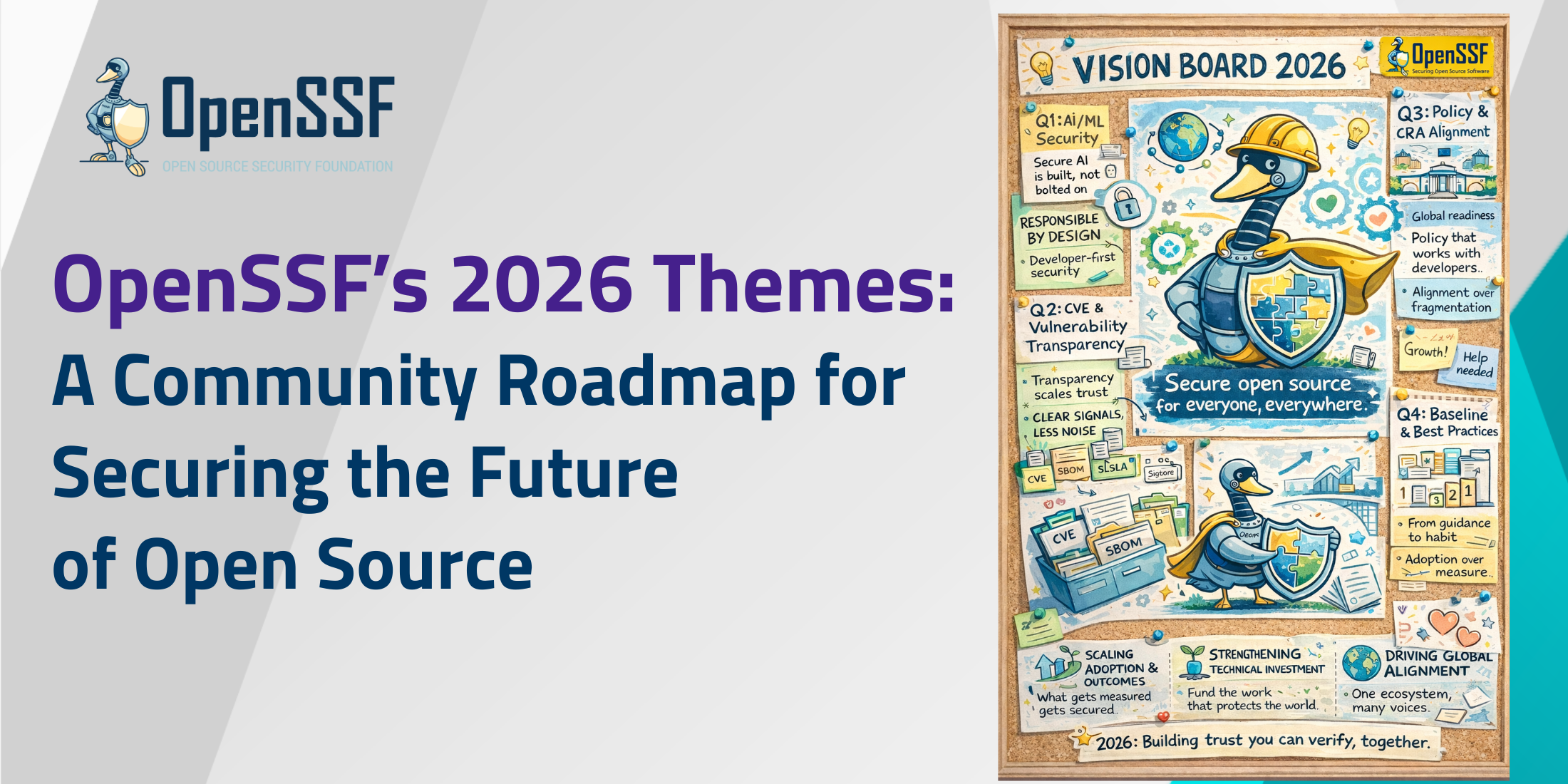
Each year, the Open Source Security Foundation (OpenSSF) focuses its content and engagement on the security topics that matter most to the open source community. In 2026, we are organizing content around quarterly themes that reflect community priorities, global policy developments, and real-world security needs.
This roadmap outlines OpenSSF’s 2026 themes, how they align with major industry events, and how the community can contribute throughout the year as priorities evolve.
Q1: AI and ML Security
Advancing secure AI practices, education, and responsible model development
January: AI and ML Security
Focus on AI and ML security, including secure development practices.
February: Developer Enablement and Secure Practices
Content on secure AI development workflows, Baseline integrations, and developer-focused resources.
March: Securing Emerging Technologies
Guidance on securing ML models, integrating AI into secure supply chains, and promoting developer learning.
You can connect with OpenSSF at:
- GVIP Summit #01, EU Open Source Policy Summit, and FOSDEM 2026 in Brussels
- LF Member Summit in Napa Valley
- FOSS Backstage
- Open Source SecurityCon and KubeCon EU in Amsterdam
Q2: CVE and Vulnerability Transparency
Strengthening vulnerability coordination and disclosure
April: Vulnerability Management and Collaboration
Content highlighting OSV, disclosure coordination, and community best practices.
May: Securing the Software Supply Chain
Guidance on CVE data integration with SLSA, SBOM tools, and Sigstore.
June: Community Collaboration and Transparency
Recaps, podcasts, and community initiatives focused on transparency and collaboration.
You can connect with OpenSSF at:
- FIRST VulnCon in Scottsdale
- Open Source Summit and OpenSSF Community Day North America in Minneapolis
- Open Source Security Forum EU in Brussels
Q3: Policy and Cyber Resilience Act (CRA) Alignment
Preparing open source projects and communities for global regulatory frameworks
July: Global Policy and CRA Readiness
Guidance on CRA readiness and global regulation.
August: Industry Collaboration
Policy discussions and partner engagement.
September: Government Engagement
Content focused on public sector collaboration.
You can connect with OpenSSF at:
- Black Hat USA in Las Vegas
- CRA focused community tech talk
Q4: Baseline and Security Best Practices
Driving consistent and measurable adoption of secure development practices
October: Baseline Adoption and Best Practices
Spotlights on Baseline pilot programs and Working Group case studies.
November: Training and Implementation
Resources and success stories from developers applying Baseline guidance.
December: Reflection and Looking Ahead
Annual reporting on Baseline adoption metrics and future roadmap priorities.
You can connect with OpenSSF at:
- Open Source Summit and OpenSSF Community Day Europe in Prague
- All Things Open in Raleigh
- OSSCon and KubeCon North America in Los Angeles
- Policy Summit North America in Washington, DC
How to Get Involved
OpenSSF is a community-first foundation and there are many ways to participate.
For Members
If your organization is an OpenSSF member, you can:
- Join the Marketing Advisory Council meetings
- Help shape content priorities and campaign themes
- Be part of blog submissions, podcasts, tech talks, case studies, and thought leadership
Submit ideas or content proposals to marketing@openssf.org
Learn more about OpenSSF membership at https://openssf.org/join/
For Non Members
OpenSSF is open by design and everyone is welcome.
You can:
Planning Your Content Contributions
OpenSSF welcomes community contributions throughout the year. To support thoughtful planning and timely publishing, we encourage contributors to use the guidance below when preparing submissions.
Recommended planning lead times:
OpenSSF 2026 Calendar Themes
- Guest blog: 2 to 3 weeks
- Case study: 1 to 2 weeks
- Podcast participation: 1 month
- Webinars, whitepapers, and tech talks: 6 weeks
- Newsletter additions: 3 weeks
- Social media content: 2 to 5 days
We encourage contributors to begin early outreach and planning if you hope to align submissions with specific months or major events.
Submission guidelines and details.